
“An astonishing void: official history ignores football. Contemporary history texts fail to mention it, even in passing, in countries where football has been and continues to be a primordial symbol of collective identity. I play therefore I am: a style of play is a way of being that reveals the unique profile of each community and affirms its right to be different. Tell me how you play and I’ll tell you who you are.”
So wrote Eduardo Galeano, the legendary Uruguayan author and journalist. For much of football history, he was right. National teams had a distinct identity in terms of their playing style.
That is less true these days: due to globalisation, approaches to football have become increasingly homogenised. Yet these national ways of viewing the game still exist to some extent.
In the first part of this article, we explore five soccer cultures from around the world. As well as outlining the style of play associated with each country, we assess how true the stereotype is.
Brazil: Samba Style
Ahead of the 1998 World Cup, Nike released an advert starring several members of the Brazil national team. It showed the likes of Ronaldo, Romario, Roberto Carlos, Denilson and Juninho doing tricks and flicks inside an airport.
The commercial helped to solidify Brazil’s reputation as a group of happy-go-lucky footballers for whom o joga bonito (‘the beautiful game’) was the most important thing of all. Brazil, or so the myth goes, has long played a style of football that mirrors samba, an energetic, rhythmic dance performed on the beaches of Rio de Janeiro and beyond.
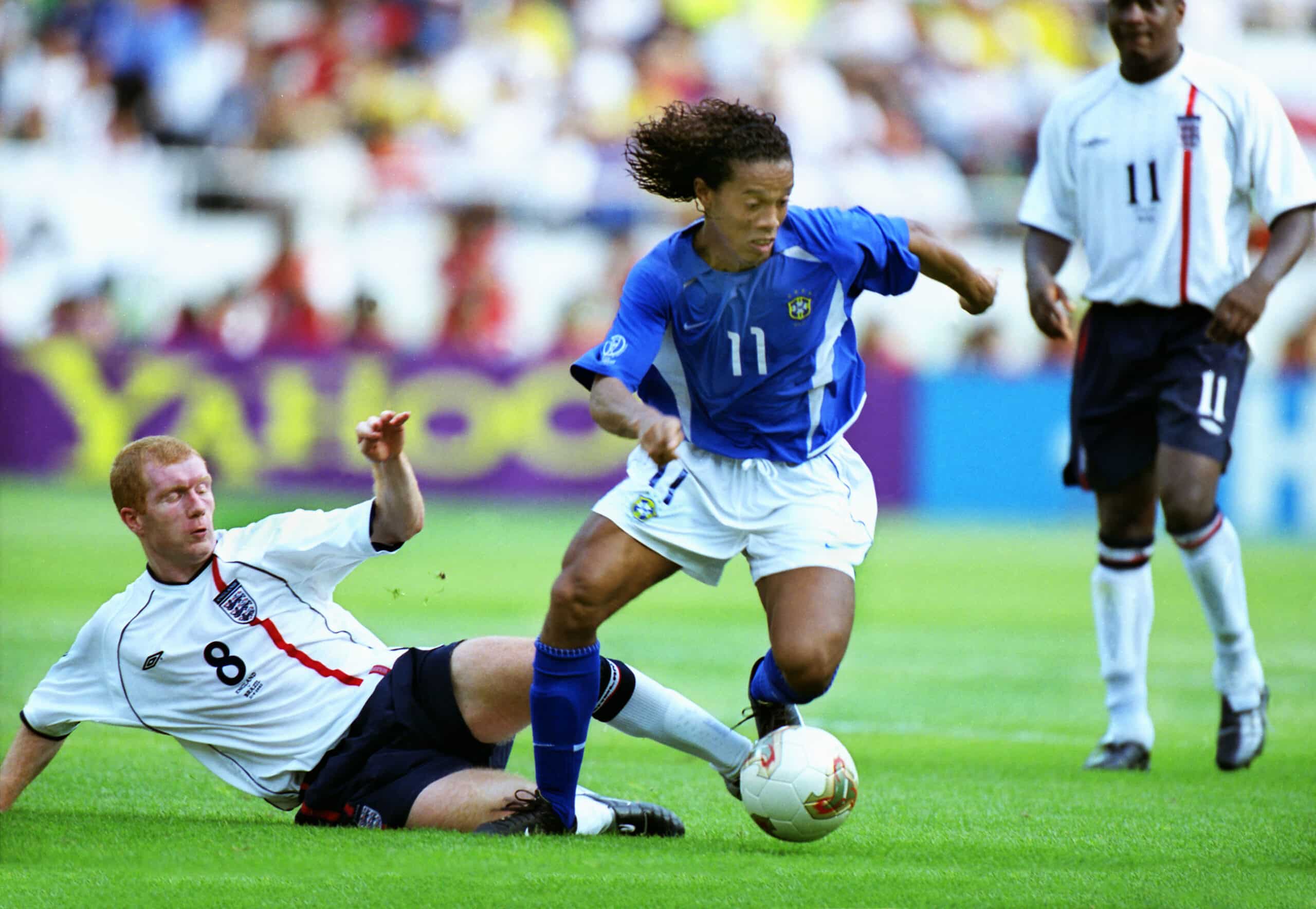
It is certainly true that Brazil has produced more than its fair share of wonderfully gifted and entertaining footballers: think Garrincha, Zico, Ronaldinho, Neymar. In 1970, a team led by Pele won the World Cup while playing a spellbinding version of the game. Twelve years later Brazil did not lift the trophy, but they won the hearts of football fans everywhere with their free-flowing play.
“Beauty comes first. Victory is secondary. What matters is joy,” said Socrates, a member of that 1982 team that was eliminated by Italy in the second group stage. His team-mate Zico described that fatal 3-2 defeat as “the day football died”.
Yet in Brazil’s case at least, the stereotype goes too far. It also does not give enough credit to the country for its achievements: you do not win a record five World Cups by turning up in your flip-flops and having a kick around. Indeed, Brazil’s pioneering work in the fields of tactics and preparation is often missed due to the depiction of the Selecao as a group of carefree entertainers.
The South American giants won their first World Cup in 1958. Having a sensational 17-year-old Pele in their ranks helped, while Didi, Garrincha, Djalma Santos, Nilton Santos and Mario Zagallo were excellent players too. But the use of a back four, a novelty in those days, was equally key. Brazil arrived in Sweden that summer with a masseur, a sports psychologist and even a dentist in tow. No other team had prepared so thoroughly.
Another thing worth pointing out is that the majority of Brazilian supporters would prefer to win ugly than lose beautifully. In that respect, Socrates was out of step with his compatriots. There was little criticism of the functional, pragmatic 1994 team because they won the World Cup that year. By contrast, an attack-minded side containing Kaka, Ronaldo, Adriano, Ronaldino, Robinho and Juninho Pernambucano was censured for suffering a quarter-final exit in 2006.
Italy: Defence First
In the fields of art, fashion, music, food and more, a stylistic flourish is central to the Italian way of doing things. La dolce vita (‘the sweet life’) depicts the ideal lifestyle on the peninsula, full of beauty and indulgence.
Yet this attitude does not extend to football. In this area at least, Italians are more than happy to sacrifice style for substance. “Winning is not the most important thing,” reads the motto of Juventus, the country’s most successful club domestically, “it is the only thing that counts.”
Many credit this attitude not to a player or a manager, but to a journalist. In 1949 Gianni Brera became the editor-in-chief of the daily newspaper La Gazzetta dello Sport, a position from which he had an outsize influence on the game.
It might be apocryphal, but Brera is said to have described a 0-0 draw as “the perfect game”. Regardless of whether or not it is an accurate quote, it gives an insight into his preference for the defence-first style of play with which Italy has long been associated.
The best example of this is catenaccio, which literally translates as ‘door-bolt’. It was invented by an Austrian coach, Karl Rappan, but was popularised by Helenio Herrera, whose Inter side won three Serie A titles and two European Cups while using it. Inter lined up with four man-marking defenders and a sweeper behind them for extra protection. They were content to sit deep and cede possession, before breaking forward at speed on the counter-attack.
Italy has produced numerous top-class attackers down the years, from Giuseppe Meazza and Gigi Riva to Roberto Baggio and Francesco Totti. Yet it could be argued that its two greatest ever players were defenders: Paolo Maldini and Franco Baresi.
Even as the country has moved away from an overly cautious and reactive style - a shift for which Arrigo Sacchi is responsible more than most - Italy is still renowned for its obsession with tactics and strategy. Serie A managers are routinely asked detailed questions about their models of play.
“In 20 minutes here”, Rafael Benitez, formerly of Liverpool and Chelsea, said at his introductory Napoli press conference in 2013, “I have been asked more tactical questions than in an entire year in England.”
Netherlands: Total Football
The entire planet seemed to be behind the Netherlands when they faced (and lost to) West Germany in the final of the 1974 World Cup. Over the previous few weeks, a dazzling Dutch team featuring Johan Cruyff, Johan Neeskens and Johnny Rep had produced several glorious displays of Total Football, a style which involved players interchanging positions all over the pitch.
The Netherlands did not invent this system from scratch. Austria in the 1930s and Hungary in the 1950s demonstrated elements of an approach that would later become synonymous with the Dutch. Jimmy Hogan, a British coach, is credited with being the father of Total Football. He influenced other managers, including Hugo Meisl, Jack Reynolds and Vic Buckingham.
Rinus Michels, who led the Netherlands at the World Cup in 1974, played under Reynolds and took his ideas to another level. The Ajax team he put together won three European Cups in the early 1970s, although two of those triumphs came after his departure.
Total Football was all about the mastery of space. Every position on the pitch had to be filled at all times, but it did not particularly matter who filled it. Hence you would sometimes see the Netherlands’ left-back pop up on the right wing, a concept that was unthinkable to most other national teams in the 1970s.
There were other factors central to the approach, including the use of a 4-3-3 system, a high defensive line, pressing in advanced areas, and wingers who stretched the play. Future Dutch teams did not necessarily promote the interchanging of positions to quite the same extent as Michels, but the other elements have been a core part of the Dutch identity for decades.
Unlike the example of Brazil that we discussed earlier, many Netherlands fans have expressed their opposition to moves away from this style, even when results have been broadly positive. In 2010 a cynical, physical Dutch team reached the World Cup final under Bert van Marwijk, but there was little love for the side back home. Cruyff, no less, described their style as “anti-football”.
The Netherlands were not quite as negative under Louis van Gaal four years later, but even a surprise third-place finish could not assuage some of the Dutch critics who disliked the 5-3-2 formation and counter-attacking approach.
England: Direct Play
English fans are now used to seeing their club sides play out from the back and involve the goalkeeper in the build-up, but these policies were not exactly welcomed with open arms initially. That is because they are antithetical to the approach historically taken by English teams, namely getting the ball forward quickly and favouring vertical passes over horizontal ones.
Even today, foreign players and managers often comment on the relative lenience of Premier League referees. English football has always been more physical than the game in other countries, which is why slide tackles evoke huge roars from the crowd and the award of a corner kick - signalling an imminent aerial battle inside the penalty area - tends to be greeted positively.
The famously damp British weather could be one reason for this. Football is a winter sport in Western Europe and, until the 2000s, pitches were often little more than mud heaps for much of the season, even at the highest level.
It was therefore difficult to play passing football through the centre. The turf was typically less boggy out wide, though, so teams often worked the ball to their wingers and flung crosses into the box. Some of England’s first superstars were wide men, such as Tom Finney and Stanley Matthews.
Charles Reep, one of the sport’s first data analysts, was also influential in promoting direct, long-ball football. He produced a somewhat dubious study which purported to show that most goals were scored from moves that contained at most three passes. His ideas were taken on by figures like Charles Hughes, the FA’s director of coaching. Managers like Graham Taylor, who failed as England boss in the 1990s, put the principles into practice.
For a long time England was wedded to the 4-4-2 formation, often with one large striker who would aim to flick headers into the path of a smaller, faster partner. In previous decades, the English game distrusted technical players like Glenn Hoddle, or those who played patiently like Ray Wilkins. Today, though, the likes of Phil Foden, Trent Alexander-Arnold and Jude Bellingham show that England is capable of producing some of the finest technicians around.
Uruguay: Garra Charrua
Uruguay are the biggest overachievers in international football. They won the World Cup in 1930 and 1950, while no one can better their tally of 15 Copa America titles. Even today, a nation of just 3.5 million people is regularly tipped as a potential World Cup dark horse.
How do they do it? Their early success can be attributed in large part to a golden generation of players that came through in the 1910s and 1920s, winning Olympic gold on two occasions and then lifting the Jules Rimet trophy at the inaugural edition of the World Cup. The willingness to field a multi-racial team, drawing on talent whatever its background, also helped.
Yet although it is near-impossible for Uruguay to conquer the world these days, the country continues to punch above its weight. For a relatively small nation, it has produced more than its fair share of talent: Jose Leandro Andrade in the 1920s, Juan Alberto Schiaffino in the 1950s, Enzo Francescoli in the 1980s, Diego Forlan in the 2000s, Luis Suarez in the 2010s and Fede Valverde today, to name just a few.
What binds it all together is la garra charrua. Garra translates as ‘claw’, while charrua is related to an indigenous people mostly found in Uruguay. In football terms, it refers to the idea of playing with grit, tenacity and a degree of cunning. Uruguay are not as big as other nations, but that does not mean they cannot work harder or play smarter.
“It is a way of living football. It is the way all Uruguayans grow up. It is the way we play football in our neighbourhoods,” explained former Arsenal and Uruguay midfielder Lucas Torreira. “The garra charrua is inside every Uruguayan.”