
There are many reasons why football is the most popular sport in the world.
One is its relative simplicity. The game is easy to understand and it does not require much in the way of equipment, thus lowering the barriers to entry.
Another reason why soccer thrills so many people is the fact that, due to its low-scoring nature, it tends to produce more upsets than other sports.
Here are 12 instances of a footballing underdog triumphing against all odds.
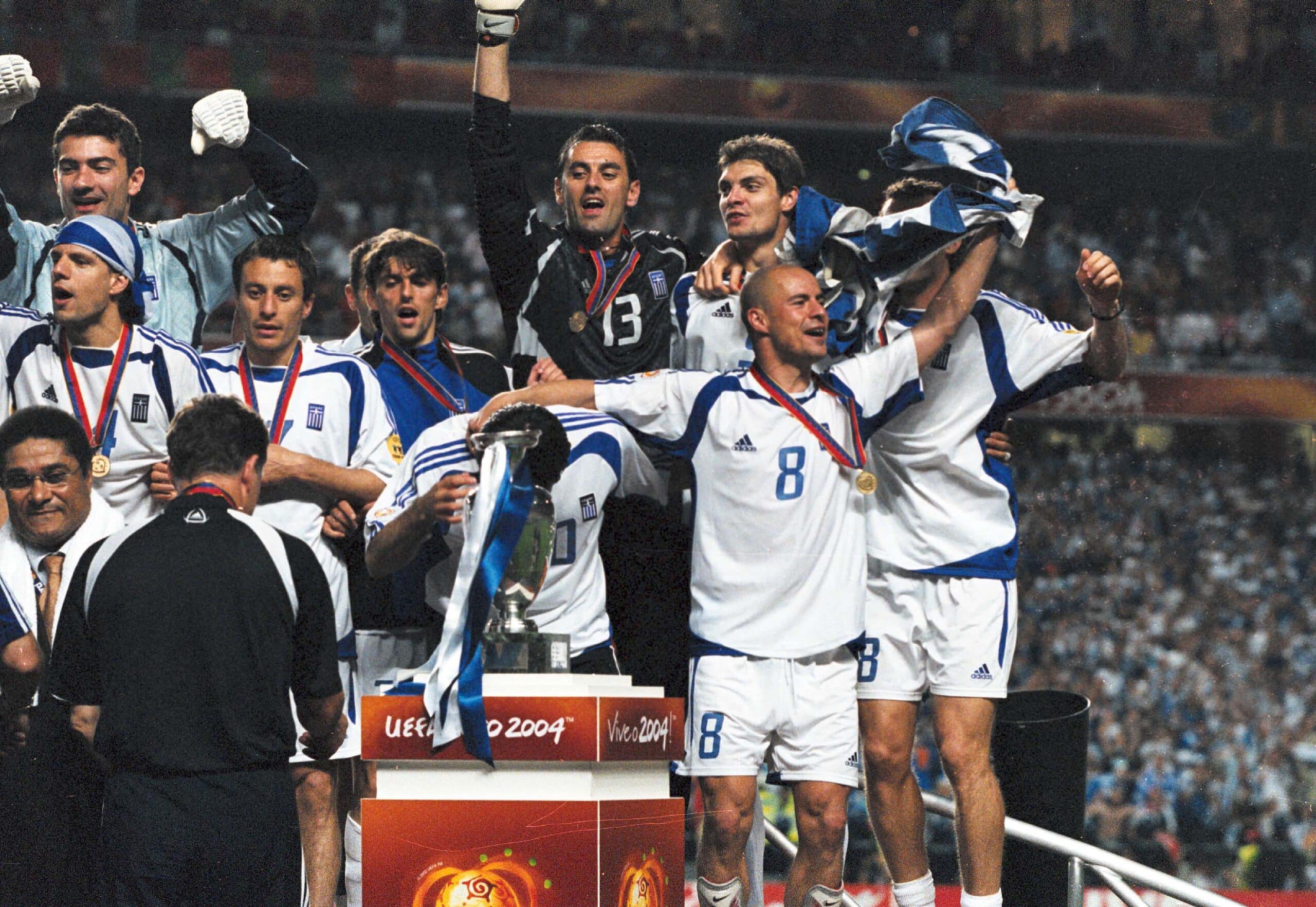
Greece win the European Championship (2004)
Greece finished above Spain in their qualifying group for Euro 2004 despite scoring only eight goals in eight games. It was a sign of things to come in the tournament proper, when the rank outsiders pulled off a major shock by going all the way.
Greece were expected to roll over for the hosts Portugal in the opening game, but they instead pulled off a 2-1 win. They were less impressive in the rest of the group stage yet still did enough to advance to the quarter-finals.
A defence-minded team that used a man-marking system that had gone out of fashion, Greece’s organisation without the ball was their main strength. Their performance in the knockout phase cannot be argued with: Otto Rehhagel’s side beat the holders (France), the dark horses (Czech Republic) and the hosts (Portugal) without conceding a goal.
Leicester City win the Premier League (2016)
Leicester City only just survived relegation from the Premier League in 2014/15. Despite leading the team to survival, Nigel Pearson left the King Power Stadium that summer, paving the way for Claudio Ranieri’s appointment - which was initially unpopular.
Relegation favourites before the big kick-off, Leicester made a surprisingly good start to the season. They were second at the midway point of the campaign, by which point people were beginning to take Leicester seriously as top-four challengers.
They did much more than that. In the end Leicester won the title by 10 clear points, as Ranieri’s counter-attacking style got the best out of the players at his disposal, including the key trio of Jamie Vardy, Riyad Mahrez and N’Golo Kante.
Aberdeen win the Cup Winners’ Cup (1983)
Alex Ferguson led Manchester United to 13 Premier League titles and two Champions Leagues, but the standout single achievement of his managerial career came during his time at Aberdeen.
Breaking up Scottish football’s Celtic-Rangers duopoly was hard enough, yet Ferguson led the Dons to league titles in 1980, 1984 and 1985. The crowning glory, however, came in the Cup Winners’ Cup of 1982/83.
Ferguson oversaw victories over Sion, Dinamo Tirana and Lech Poznan to set up a quarter-final tie with Bayern Munich. A valiant 0-0 draw in Germany was followed by a stunning 3-2 triumph back in Scotland. After easing past Belgian outfit Waterschei in the last four, Aberdeen beat Real Madrid 2-1 in the final to claim their first ever piece of continental silverware.
Bolivia win the Copa America (1963)
Venezuela and Ecuador are the only South American nations that have never won the Copa America. That might surprise today’s readers given that Bolivia have often been the whipping boys on that continent in recent years.
Yet in the 1963 edition, it was they who emerged victorious. Granted, hosting the tournament gave them a huge advantage, with Bolivia playing all of their games at high altitude. Even so, finishing top of a single seven-team group was no mean feat.
Bolivia kicked things off with a remarkable 4-4 draw with Ecuador, before consecutive wins against Colombia (2-1), Peru (3-2) and Paraguay (2-0) put them in a promising position. The hosts then edged out Argentina 3-2, before winning their final match against Brazil 5-4 to claim the trophy.
Kaiserslautern win the Bundesliga (1998)
When Bayern Munich hosted Kaiserslautern on the opening weekend of the 1997/98 season, those present at the Olympiastadion thought they were watching the future champions in action. It turned out they were, but not in the way they expected.
Kaiserslautern upset the odds to beat Bayern 1-0 that day. From there they never looked back. Yet even after losing only one of their first 15 games, no one truly believed that the promoted club could actually finish atop the table.
They were wrong. Kaiserslautern were not quite as dominant in the second half of the season as they were in the first, but a 2-0 defeat of Bayern Munich on home turf meant they thoroughly deserved to finish two points clear of the Bavarians. Their manager? Otto Rehhagel of Greece 2004 fame.
Steaua Bucharest win the European Cup (1986)
It may surprise younger readers to learn that Barcelona only won their first European Cup in 1992. Six years earlier they suffered one of the most gut-wrenching defeats in their entire history, as Terry Venables’ side lost the final of the same competition on penalties in Spain.
The surprise victors were Steaua Bucharest, who were not even spoken of as potential contenders at the start of the tournament. They went under the radar until the semi-finals, when the Romanian club beat Anderlecht 3-1 over two legs.
Few anticipated them causing Barcelona many problems in the final, however, but Steaua held on for a 0-0 draw after extra time, then won 2-0 on penalties. In doing so they became the first club from the Eastern Bloc to triumph in the European Cup.
Zambia win the Africa Cup of Nations (2012)
There were virtually no neutrals in the world who did not want Zambia to beat Ivory Coast in the final of the 2012 Africa Cup of Nations. That had nothing to do with a talented Ivorian crop of players, but rather everything to do with the spirited Zambians.
The tournament that year took place in Equatorial Guinea and Gabon. It was in the latter country where the most talented Zambian squad of all time was wiped out in a tragic air disaster in 1993.
Nineteen years later, Herve Renard’s team exceeded all expectations to win the country’s first Cup of Nations. A nerve-jangling final against Ivory Coast was eventually settled with a 8-7 victory on penalties. During the shoot-out, the Zambian players sang in unison while huddled together in the centre circle.
Deportivo La Coruna win La Liga (2000)
In the 1998/99 La Liga season, Deportivo La Coruna scraped into the UEFA Cup after finishing sixth. That was seen as a fine achievement for a club that had finished in the bottom half of Spain’s top flight the previous campaign.
Yet unbeknownst to the biggest clubs in the land, something was brewing at Estadio Riazor. Under the astute management of Javier Irureta, a team containing Roy Makaay, Djalminha and Victor swept all before them in La Liga.
Deportivo ultimately finished five points clear of the chasing pack at the summit of the standings. They lost 11 games but won a league-high 21, allowing them to beat Barcelona, Valencia, Real Zaragoza and Real Madrid to the prize.
Once Caldes win the Copa Libertadores (2004)
The Copa Libertadores is South America’s equivalent of the Champions League in Europe. Unsurprisingly, it is usually won by the biggest clubs in Brazil and Argentina. There have been some shock triumphs down the years, though, such as Once Caldes’ success in 2004.
They may have been reigning champions at national level, but the Colombian outfit did not have high expectations going into the Libertadores. That did not change even after they finished top of their group in the first stage of the tournament.
They then ground out victories over Barcelona of Ecuador and Santos of Brazil in the last 16 and quarter-finals respectively, before the underdogs beat Sao Paulo 2-1 on aggregate in the semis. Boca Juniors were the favourites in the final, yet Once Caldas held their nerve to win on penalties.
Denmark win the European Championship (1992)
Denmark did not even qualify for the European Championship of 1992. But when Yugoslavia were forced to withdraw on the eve of the tournament due to the breakup of the country, the Danes were drafted in at the eleventh hour.
Not everyone answered the call, though. Michael Laudrup, the greatest Danish footballer of all time, rejected the opportunity to represent the national team in nearby Sweden, although that was mainly to do with his difficult relationship with manager Richard Moller Nielsen.
Denmark scraped into the knockout phase, which was an accomplishment in itself given they were drawn in the same group as the hosts, England and France. They then edged out the Netherlands on penalties in the last four, after which Denmark stunned Germany 2-0 in the final.
Hellas Verona win Serie A (1985)
It would be wrong to say Hellas Verona were underestimated in 1984/85, because that would imply they were estimated at all. This was the only season in which referees were assigned to games by way of a random draw, and many Italian fans would say it was no coincidence that none of the big three - Inter, AC Milan or Juventus - finished in the top two.
Still, no one thought it would be Verona who would take advantage. Crucially in Serie A in those days, Osvaldo Bagnoli’s men were tough to score against. Verona had the best defensive record in the division that year, while only Juve put the ball in the net more often.
Verona only lost twice on their way to an improbable title triumph, and neither of those defeats came against one of Italy’s traditional powerhouses.
Montpellier win Ligue 1 (2012)
Paris Saint-Germain fans might have been excited when Qatar Sports Investments bought their club in 2011, but it was widely seen as bad news for the rest of French football. With so much money behind them, PSG were expected to dominate Ligue 1 immediately.
Montpellier had something to say about that. They finished a lowly 14th the previous season, but everything clicked in 2011/12 as Rene Girard’s side amassed three more points than PSG to win the title.
A young Olivier Giroud finished as Ligue 1’s joint-top scorer with 21 goals, before joining Arsenal the following year.
Iraq win the Asian Cup (2007)
Iraqi football fans had other things on their mind when the Asian Cup kicked off in the summer of 2007. A United States-led coalition had invaded the country four years earlier, leading to the deaths of around 85,000 civilians up until this point.
The 23 players called up to the national team were determined to do their people proud, but simply getting out of the group stage would have been seen as a decent performance. Iraq did just that, topping their section ahead of Australia, Thailand and Oman.
Iraq then got past Vietnam in the last eight, before eliminating South Korea on penalties in the semis. Underdogs for the final against Saudi Arabia, a second-half goal from Younis Mahmoud brought Iraq their first (and, to date, only) Asian Cup.