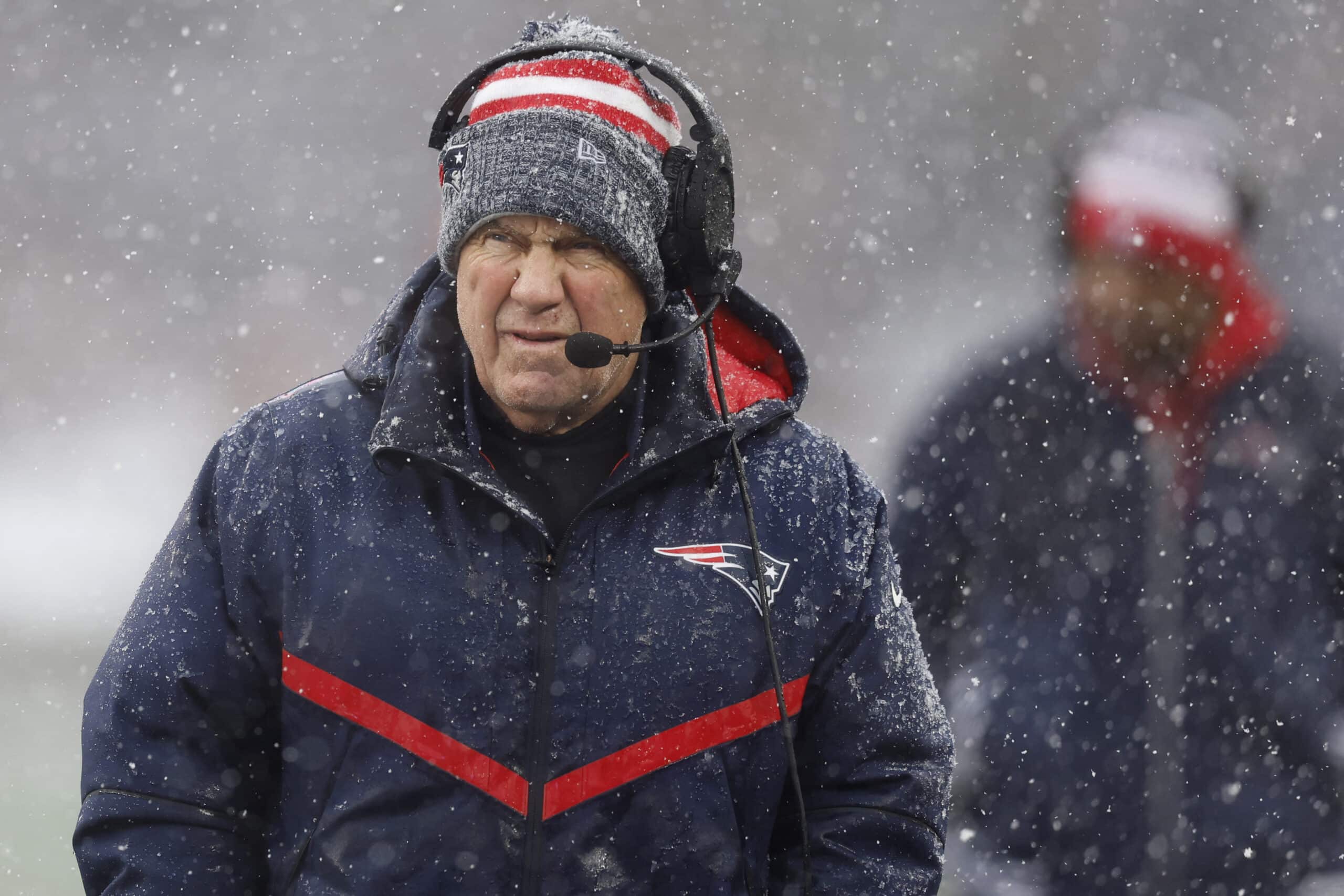

Why is it that when a sports team is performing well, it always seems to be the players who get praised. And yet, when things are going badly, it’s the head coach that gets it in the neck?
That concept is complicated yet further in the NFL, where the head coach will often delegate departmental leadership to his defensive and offensive coordinators.
So although they don’t always get the recognition they deserve – while attracting sometimes unwarranted criticism in the toughest times – there are still some coaches that have ascended to a position of legendary status.
Here’s our rundown of the greatest NFL coaches that have helped to change the face of American football and usher in a totally fresh way of thinking.
Bill Belichick
Of course, it’s human nature to judge a head coach on the number of Super Bowls they have won, or their career win percentage.
And Bill Belichick takes his place above and beyond all other NFL coaches in that regard. His six Super Bowl triumphs is at least two more than any other coach in the modern era… and is a record that may never be matched or broken.
But there’s more to Belichick than just silverware. This is a head coach that revolutionised American football… especially in his stint at the New England Patriots between 2000 and 2023.
His mastery of the defensive side of the game ensured that the Patriots always had a solid foundation upon which to build, influencing many of his rivals to adopt Belichick’s tactical strategies and shore up their teams defensively.
Football historians judge Belichick on the tangibles, but it was ability to get the best from his players – particularly veterans in the autumn of their careers – that should also get more column inches.
He helped to extend the career of Tom Brady, ensuring that one of the finest quarterbacks in NFL history was able to prolong his playing days into his forties. Others, including Corey Dillon and Rodney Harrison, also benefitted from their head coach’s ability to help his players retain their elite level for a longer stretch.
Although he’s yet to be voted into the Hall of Fame, largely due to his part in Spygate, Belichick is nonetheless assured of his position among the pantheon of NFL legends.
Vince Lombardi
When your legacy is so strong that the Super Bowl trophy is named after you, it goes without saying that your place in the annals of American football history is pretty much secured.
Vince Lombardi only got to win two Super Bowls – the championship-deciding event was established at the end of his coaching career, but you wonder how many he would have landed had he had the chance.
He did of course guide the Green Bay Packers to five NFL championships, which was in essence the Super Bowl of the 1960s, which established Lombardi as one of the greatest coaches of the era – and of all-time, it should be said.
His tenure with the Packers was a masterclass in building a dynasty. He moulded great athletes into elite footballers, arming them with the technical skills and the game intelligence to thrive.
Of all coaches post-1960, only John Madden ended their career with a better win percentage than Lombardi; the latter’s extraordinary record shows that he lost just six of the 136 NFL games that he coached in.
American football changed in the 1970s in many ways, but the early part of the decade was certainly dominated by the physical battle of the run game – an homage to Lombardi, who conditioned his players to be relentless in all phases of play.
Paul Brown
Some of those who have delivered iconic NFL coaching success didn’t always get to enjoy the spotlight themselves.
Paul Brown, for example, was a head coach in the era of disengagement in American football in the 1940s, when the NFL and the All-America Football Conference (AAFC) were waging their turf war.
Brown never got to win a Super Bowl, and he technically only won three NFL championships – with four AAFC titles also on his resumé.
But football historians now look very kindly on Brown’s coaching career due to the innovations that he masterminded – many of which changed the face of the sport forever.
Brown was the first to use video clips to scout the opposition, the first to test his players on the playbook, and also the first to employ a full-time backroom of coaches and support staff.
Arguably his biggest play was to be the first coach to utilise African-American players on his roster; that is, ultimately, Brown’s greatest legacy.
Rightly regarded as a legend of both the Cleveland Browns and Cincinnati Bengals, Paul Brown has to be considered as one of the best NFL coaches for his achievements on the field and off it.
Bill Walsh
Some coaches are famed for their trophy collection. Some coaches are beloved for their cultural impact on the sport. And others are renowned for the tactical innovations that have shaped football in the contemporary era.
As influential football tactics go, few have revolutionised the way the sport is played quite like the West Coast Offense. And that’s why its originator, Bill Walsh, is rightly regarded as one of the greatest coaches to have ever graced the NFL.
Today, we recognise the West Coast Offense – which are plays built around short range, low risk passes – as one of the go-to options in football. But before Walsh came along and tore up the playbook with the San Francisco 49ers, franchises were still basing their offense around physically punishing run games and high-risk long passing networks.
Walsh realised that there was a smarter way to play, relying on ball possession and the slippery running of his receivers – rather than risking turnovers and non-completions by tossing the pigskin dozens of yards and just hoping for the best.
The proof of the pudding is in the eating, as they say, and between 1981 and 1988 the 49ers absolutely dined out in the NFC West, winning six divisional titles in those eight seasons.
In among that run was a trio of Super Bowl victories, which vindicated Walsh’s offensive revolution. Within a couple of seasons, many other head coaches had adopted his strategy – imitation is the sincerest form of flattery, and all that.
Don Shula
During the 1970s, the NFL had a plethora of legendary coaches prowling the sidelines.
From John Madden and Chuck Noll to Don Landry and Bud Grant, this was an era in which head coaches were revered just as much as the players out on the field.
Another member of that vintage arguably burst clear on his own. Don Shula’s remarkable longevity saw him employed in American football’s top coaching job for more than 30 years, encompassing spells with the Baltimore Colts and then the Miami Dolphins.
He won the NFL Championship in 1968 with the Colts, before landing two Super Bowl titles with the Dolphins. In fact, their 1972 triumph remains the only perfect, unbeaten season in NFL history.
No single coach has won more career games than Shula, whose ability to reinvent himself like some sort of footballing chameleon kept him at the very top of the sport for 32 years before his retirement in 1995.
Records tumbled in Shula’s wake. He was the first head coach to appear in six Super Bowl games, the first to take two different franchises to the championship game, and he was also the first to appear in three consecutive Super Bowl Sundays.
Often, the facts and the stats speak for themselves…
Chuck Noll
Another much vaunted head coach of football’s halcyon days was Chuck Noll.
He was the rarest of birds: a one-franchise man, having taken the helm of the Pittsburgh Steelers in 1969 and remaining in situ until 1991.
It’s a spell that yielded four Super Bowl successes – only Belichick has more to his credit to this day, and spawned the infamous ‘Steel Curtain’ defensive line, upon which Pittsburgh’s glory days of the 1970s were built.
Noll was renowned for his meticulous attention to detail when planning for games, becoming one of the first head coaches to utilise advanced data in his preparations and to help inform plays.
The Steelers were incredibly strong in the draft, bringing in talented youngsters that Noll then turned from raw potential into elite performance – from that dominant 1970s period, ten of the Pittsburgh roster would go on to be inducted into pro football’s Hall of Fame.
But perhaps what is most impressive about Noll’s work is that he took over the Steelers when they were in the pits of despair. They were, undoubtedly, among the weakest franchises in the NFL.
Noll, though, was able to turn the ship around, transforming Pittsburgh into the pre-eminent force in football in the 1970s, while maintaining a winning record in the playoffs against some of the most respected coaches in the game’s history – Madden (3-2), Landry (2-0) and a Super Bowl IX victory over Bud Grant’s Minnesota Vikings. Impressive stuff.