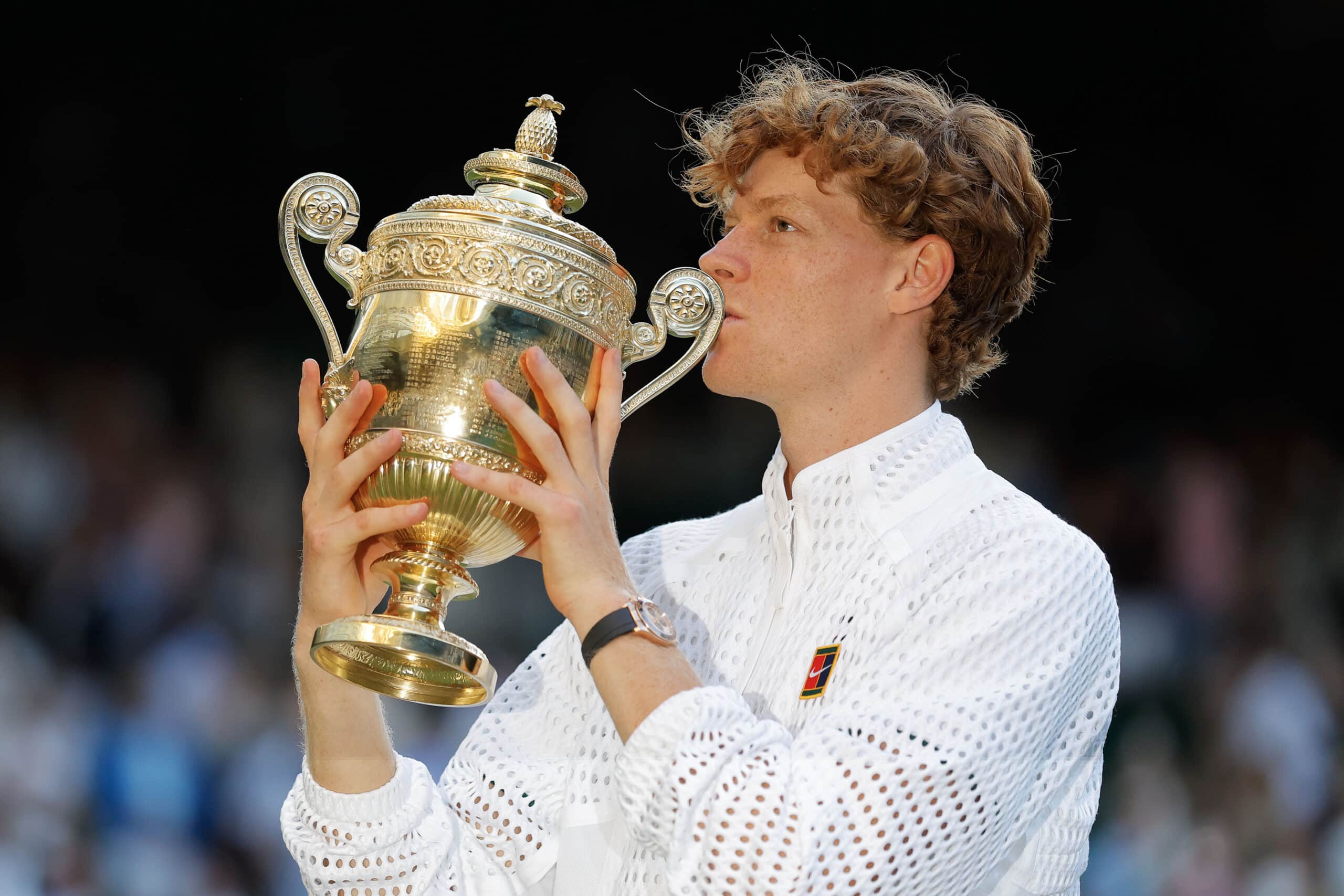

What makes for a Wimbledon champion?
Tennis has, of course, changed beyond recognition over the past 50 years or so. Guile and strategy have, somewhat, been replaced by brute force and power – while huge serves and booming groundstrokes aren’t a guarantor of success, they certainly help on grass courts.
But to win Wimbledon, any prospective champion has to be able to move well both laterally – to facilitate their part in lengthy baseline rallies – and vertically, with serve-and-volley and also hunting down dropshots both vital weapons in the armoury.
And that’s just the physical attributes. What about the psychological? That ability to think like a champion, strategize, understand peaks and troughs in form and, naturally, an ability to handle highly-pressurised moments on court.
It takes outstanding all-round talent to win the men’s and women’s singles at Wimbledon. In this article, we’re going to flesh out how this iconic tournament’s champions are made.
Why Wimbledon Produces a Certain Type of Champion
Name an all-time tennis great and there is a chance they will have won the Wimbledon title at some point in their career.
This is a tournament that has a habit of franking greatness. Whether it’s the famous grass courts or the heritage and traditions of the All England Club, there’s just something about Wimbledon that seems to bring out the best from the best.
Despite the occasional flirtation with a big server like Goran Ivanisevic or Richard Krajicek, the men’s singles Wimbledon champions have long been what we might describe as a ‘shot maker’.
Some of the most decorated champions at SW19 – Roger Federer, Pete Sampras, Bjorn Bjorg – can certainly be filed in that category, as can Rafa Nadal, Boris Becker and even Novak Djokovic, who doesn’t have the most explosive of serves and yet can still be considered one of the greatest players in history.
The women’s singles had a similar theme for many years: think Martina Navratilova, Steffi Graf, Billie Jean King… all classic Wimbledon winners. And then along came the Williams sisters, Venus and Serena, who in a reign of terror won 12 titles at SW19 between them.
That laid the foundation for a new way in women’s grass court tennis, with powerhouses like Angelique Kerber, Simona Halep and Ashleigh Barty following them into the winner’s enclosure.
After a passage of somewhat surprise Wimbledon champions – Elena Rybakina and Barbora Krejicova had never gone beyond the fourth round before, while Marketa Vondrousova was unseeded – the super-classy Iga Swiatek was anointed queen of SW19 in 2025… a return to the shot-making pedigree of yesteryear.
Mastering Grass: Movement, Serve and Variety
Playing on grass is a whole different animal to the hard and clay courts of the other Grand Slam events.
When the ball hits the turf – manicured to 8mm on all 18 courts at the All England Club – it tends to skid through, rather than bouncing upwards invitingly. This is especially the case in the early days of the tournament, when the grass is at its lushest.
It’s a dynamic that has led itself to some big servers rampaging through the draw over the years: the likes of John Isner, Sam Querrey, Milos Raonic and Kevin Anderson all saved much of their best work for Wimbledon.
Look up the stats for all-time aces on the grass and the usual suspects are present: Isner, Querrey, Taylor Fritz and Ivo Karlovic among them.
But placement is still as effective as power on the grass, with Roger Federer, one of the finest servers in history when it comes to hitting lines, once serving 50 aces in a match at Wimbledon (the 2009 final against Andy Roddick).
Rallies are, by their very nature, faster and lower, which shortens reaction times. Hitting with aggressive top spin can also decrease the amount of time that the receiver has to get to the ball – everything is speedier at SW19.
As the tournament progresses and the courts lose their greenness, the action slows somewhat. In the rare event that England has a hot early summer, the show courts in particular can begin to look very bare at the baseline, with shots losing some of their velocity accordingly.
One of the other skillsets that links Wimbledon winners is their movement. Carlos Alcaraz, Jannik Sinner, Roger Federer… these are/were players blessed with an almost balletic agility and a lightness of foot that enabled them to move quickly and change direction with the minimum of fuss.
Other Wimbledon champions have thrived thanks to their speed across the baseline. Novak Djokovic, Andy Murray and Lleyton Hewitt are/were famed for their determination to make their opponent hit one more shot to win the point. Their defensive rearguard action – and ability to grind opponents down – coming as a result of their balance and low centre of gravity.
While it’s accepted that power is an advantage at Wimbledon, that can only help take you so far. Look up the list of the most recent winners of the tournament over the past 20 years or so and one thing will strike you: these are, largely, the best players of the modern era.
They are able to hit with power on both wings, change pace, angle and trajectory, drive, drop, slice… basically, hit every shot in the book.
The days of acing your way to grass court success are, by and large, a thing of the past. The power game can take you so far, but the difference between Wimbledon champions and the rest is that they have everything in their locker – a quality serve (power + placement) allied to great movement, savvy shot selection and dizzying variety in their groundstrokes.
Mental Strength and Composure Under Pressure
Those are the tangible attributes. What about the tennis champions traits that cannot be judged so subjectively?
This is a sport populated by nearly men/women; those with tremendous talent but who were unable to get over the line in the biggest matches at Grand Slam events.
And then we have the repeat winners. In the men’s singles at Wimbledon in the Open Era, 13 players have won two or more titles – three of those in Federer, Sampras and Djokovic have combined to win a whopping 22 championships at the All England Club.
In a sport of the finest margins, what separates the elite from the very good?
The answer lies within the psychological aspect of the game. Whether we want to label it as mental strength, composure, an ability to handle pressure (not ‘choking’ on break point or match point) or the will to win, without that mental toughness it can be very difficult for sportsmen and women to take the final step in their career.
“The difference, I guess, between the guys who are able to be the biggest champions, and the ones that are struggling to get to the highest level, is the ability to not stay in those emotions for too long.”
That’s the opinion of no less a judge than Djokovic, by the way. (source - https://www.cbsnews.com/news/novak-djokovic-tennis-villain-retirement-opponents-60-minutes/#text22The20difference2C20I20guess2Ctoo20long2C2220Djokovic20said)
We can even equate being able to handle fatigue, or play through the pain barrier, as a psychological advantage – the accumulative tiredness of a two-week long major, played on a surface that lends itself to light muscle and joint injuries, will act as a heavy burden on even the hardiest of performers.
There’s something about the unique atmosphere of Wimbledon that can have an impact on a player’s mentality, too.
One of the oldest tennis tournaments on the planet and certainly one of the best known, it’s interesting to see how many debutants freeze in the spotlight… and which positively thrive in this rarefied air of expectant crowds and nobility watching on from the Royal Box.
Controlling emotions. Handling pressure. Dealing with adversity. These are all chapters in the playbook of a prospective Wimbledon champion.
Adaptability Across Eras of Tennis
Federer played in his first Wimbledon final in 2003. He played his last in 2019. That’s 16 years of watching rivals come and go… so how did the Swiss ace remain such an elite performer for so long?
It’s a question that can be asked of Djokovic, who won his first Wimbledon title in 2011 and was still reaching the semi-finals as of 2025, as well as Martina Navratilova, whose first and last Wimbledon final appearances were separated by 16 years.
At SW19, Federer became the master of shortening points; very helpful once you enter your thirties and are playing against significantly younger opponents.
Often, that meant serving-and-volleying, with the Swiss legend a master at curving his serve wide or down the ‘T’ to unbalance his opponent before getting a gift of a volley to put away.
Federer also worked extremely hard on his backhand, realising that his one-handed grip – a rarity in the contemporary era – left him at the mercy of more powerful hitters.
So he found a way to hit the ball flatter and with more spin on the backhand side, aided by a willingness to embrace the latest in tennis racket innovations like larger heads and more aerodynamic frames.
Djokovic’s longevity owes much to his total commitment to maximising his physical capabilities.
He adopted a gluten-free diet at the mid-point of his career, which he credits to enhancing his stamina and injury resistance, and has since transitioned into dairy-free, low sugar and plant-based living.
In many ways, Navratilova was a forerunner to Djokovic. After enjoying early success in her career, a series of new rivals – notably Chris Evert – forced Navratilova to up her game.
She started looking for marginal gains in her conditioning, taking up long-distance running and weightlifting in a bid to return to the top of the sport.
After winning Wimbledon in 1978 and 1979, the new and improved Navratilova won six titles in a row between 1982-87. She made more finals thereafter, including a run to the 1994 trophy match at the age of 37.
Preparation and Experience on Grass Courts
In 2003, Federer won his first Wimbledon title; his previous best effort was a quarter-final appearance.
Nadal lost twice in finals before beating Federer in 2008, while Djokovic – the 2011 champion – had reached the semi-finals twice before.
Even those modern greats, like Alcaraz and Sinner, had won multiple matches at Wimbledon prior to getting their hands on the iconic trophy.
You can probably guess what we’re driving at here: experience really does count at SW19.
There are anomalies – Boris Becker and Martina Hingis both winning as teenagers spring to mind – but for the most part experience of the conditions at the All England Club, both in terms of the grass courts and the unique atmosphere around the venue, is vital.
As is building a grass court campaign. The season lands for just a few weeks, but getting in a prep tournament – be it Queen’s, Eastbourne, Halle or another event – has typically been crucial in transitioning from the far slower clay courts that come before in tennis’ annual schedule.
Legends, Patterns and Modern Champions
If you win one edition of Wimbledon, you can win more.
In the men’s singles in particular, repeat champions are not rare. There are legendary legacies that have been built on the grass; you wonder how many Wimbledon titles Alcaraz and Sinner will rack up between them over the years.
The women’s singles is slightly different; the best-of-three set format lends itself to shock results and more variance. Between 2017 and 2025, eight different players were crowned champions at SW19, while four more have lost in the final.
Incredibly, at the time of writing, world number one and four-time Grand Slam winner Aryna Sabalenka is yet to get her hands on the trophy… but that situation will change in the future, surely?
Past performance can be an excellent predictor of future success in the gentlemen’s singles. As for the ladies’ event, all bets are off in this contemporary era.
What Wimbledon Success Tells Us About Greatness
Wimbledon can be considered a useful metaphor for any sport… or life in general.
Having talent alone is not enough; mental fortitude, composure and an unrelenting will to succeed are also non-negotiables.
All of the true tennis greats have won Wimbledon – that is no coincidence.