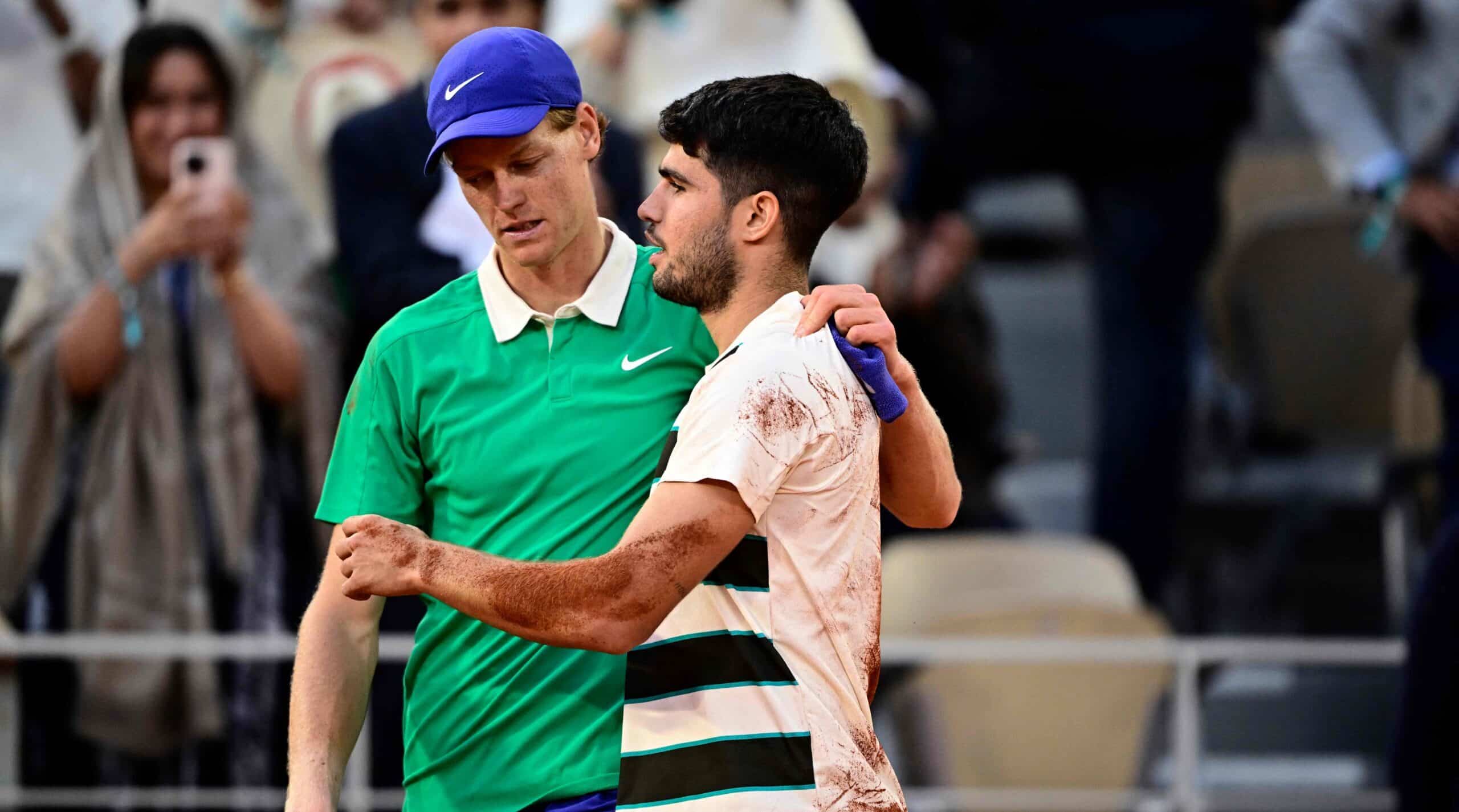

The sheer nature of clay court tennis means that the French Open is, by definition, the toughest of tennis’ Grand Slam events to win.
Clay courts, typically, lend themselves to the ball bouncing slower and higher, which makes it more difficult to win points through sheer power and brute force alone.
And, as a consequence of the above, there are fewer aces served on clay courts than the other surfaces – that means there are fewer ‘free’ points to be won on serve.
Add into the mix the occasionally volatile atmosphere at Roland Garros, and the only conclusion we can draw is that the French Open demands the most elite levels of physical strength and mental fortitude.
That perhaps explains why this iconic event has produced so many epic finals since it was established more than a century ago. We’ve seen super-long matches that have swung with momentum one way and then the other, as well as dramatic comebacks and feats of extraordinary resilience.
The French Open is a tournament of tactics, strategy, physical conditioning and psychological strength; being able to play to an elite level for four hours or more, at least in the men’s singles final, is a pre-requisite.
Here’s our comprehensive look back at some of the French Open finals that have gone before… including that classic five-hour battle between Carlos Alcaraz and Jannik Sinner in 2025.
Why French Open Finals Are Unlike Any Other
Each of tennis’ Grand Slams have their own point of difference.
The Australian Open, for instance, is the first major of the calendar year – hence why there’s a real appetite amongst the players to do well. And then there’s the small matter of the 1.36 million fans cramming into Melbourne Park to watch each year… confirming the Aussie Open as the best attended of the Grand Slam events.
Wimbledon, meanwhile, is all about the history and the heritage of a tournament first held way back in 1877. The all-white clothing rule, the iconic grass courts, the attendance of the Royal Family… Wimbledon is all class.
The US Open is a tough old event to win too, with the players having to battle searing summer heat in New York. But it’s worth it: conquer this hard court major and you’ll not only lift the trophy, you’ll also walk away $5 million (€4.27 million) richer.
But the French Open is different. It demands more of its players, and in an age of booming serves and forehand winners that paint the line, some tennis fans would agree that’s no bad thing.
Some players build an entire career around their clay court successes; the French Open representing their only genuine chance of tennis immortality each year.
This is a throwback tournament, in many ways. No matter how much of a physical specimen you are, no matter how innovative your racket and training shoes, the slow and dusty red courts of Roland-Garros will always be something of a leveller.
This is thinking man’s and woman’s tennis… and that’s why French Open finals are often unlike any other Grand Slam match.
Clay Courts, Endurance and Mental Toughness
When a tennis ball bounces on fresh, tightly mown grass, it tends to gain speed and velocity. On modern hard courts, the ball will at least maintain its pace – if not add a little – after kissing the surface.
But on clay, especially the red dirt found at Roland Garros, the ball appreciably slows down after bouncing. Not only that, balls can bounce much higher than on other surfaces – in the French Open, hitting from around shoulder height is not uncommon.
That lends itself to a very specific skillset, which is why clay court specialists – who perform markedly better on his surface than any other – are rarely in short supply from continental Europe and South America.
Between 2005 and 2025, every single winner of the French Open was from mainland Europe. Before that, three of the four editions were won by a Brazilian or an Argentine. You have to go back to 1999 for the last champion outside of that geography.
And then there’s the matter of the physical endurance required to go all the way at Roland Garros. This is the average rally length of each of the Grand Slams in 2024:
- Australian Open – 4.23
- French Open – 4.78
- Wimbledon – 3.74
- US Open – 3.83
(Data: https://courtspeed.com/rally-length)
The difference may not look that vast on paper, but consider that every single point is approximately one shot longer on clay than it is as the other majors – then extrapolate the extra workload required to win a set, a match and an entire tournament.
Not only that, it should also be noted that when ranking the average length of match at each of the Grand Slams, the French Open is tied with the US Open as the longest – with the players having to play more shots at Roland Garros than Flushing Meadows, remember (source: https://www.nytimes.com/athletic/4651272/2023/07/01/mens-grand-slam-matches-five-sets-three-sets/).
We can hypothesise, therefore, that the French Open is the hardest of the majors to win – both physically and mentally.
The Longest Finals in French Open History
There are two ways that we can measure the longest French Open matches: the time elapsed and the number of games played.
In 2025, the men’s singles final between Alcaraz and Sinner broke the record both – records, it should be noted, that had stood for more than 40 years.
The 1982 final between Mats Wilander and Guillermo Vilas was truly bizarre. It lasted for four hours and 42 minutes, which was then the record, and yet only four sets were played and two of those were won 6-0 and 6-1.
In the end, Wilander won 3-1 in a contest of remarkable length.
The previous milestone for the most games played in a French Open final belonged to the 1984 edition, where John McEnroe collided with Ivan Lendl in a feisty battle. And it was the Czech born ace that landed the title in a fine comeback victory 3-6, 2-6, 6-4, 7-5, 7-5.
That 51-game epic was bested by the amazing match between Alcaraz and Sinner in 2025. The two young guns were on court for five hours and 29 minutes, as the Spaniard came from two sets behind to win 4-6, 6-7, 6-4, 7-6, 7-6.
In the women’s singles, the longest final lasted for 40 games: Steffi Graf defeating Arantxa Sanchez Vicario 6-3, 6-7, 10-8. They were on court for three hours and three minutes.
Comebacks That Defined Careers
Of all thegreat French Open comebacks, it’s hard to say with confidence that Alcaraz’s back-from-the-brink victory will define his career – he may go on to win 20 Grand Slam titles at this point.
But Lendl’s famous triumph over McEnroe in 1984 certainly was career defining. He had already lost in four Grand Slam finals, so when he went two sets down to the American Lendl must have been fearing the worst yet again.
However, great champions find a way… and Lendl would go on to become a great champion: that French Open final was the first of eight major wins for a player that would go on to become world number one for some 270 weeks.
An honorary mention should also go to Andre Agassi, who hadn’t won a Grand Slam since the 1995 Australian Open when he fought his way through to the French Open final four years later.
After going two sets down – and winning just three games – against Andriy Medvedev, it looked like it might be an unhappy return, until Agassi somehow found a way to battle back and win 1-6, 2-6, 6-4, 6-3, 6-4.
It was a win that opened up the second chapter of the American’s career, in which he would win five of his eight Grand Slam titles.
Match Points, Momentum Swings and Turning Points
Alcaraz’s amazing comeback in 2025 was made all the more remarkable by the depths he plummeted.
The Spaniard faced THREE match points against Sinner, yet somehow conjured up a way to save his skin every time… before completing that incredible back-from-the-brink victory.
If anyone can pull a rabbit out of the hat it’s Alcaraz, but at 1-2 down in sets and 3-5 in games in the fourth, he was walking a tightrope – even more so when Sinner went 0-40 up in the ninth game.
By hook or by crook, Alcaraz battled his way into the game, took it to deuce and then, somehow, saved his service game… before going on to win the set via a tiebreak.
That was the first time in history that a player of either gender had saved three match points on the way to a comeback victory. Surprisingly, it took more than a century of men’s French Open finals before a player fought off match points to win.
That man was Gaston Gaudio, who clinched the sole Grand Slam title of his career at Roland Garros in 2004. It was an all-Argentine affair, with Gaudio tackling his compatriot Guillermo Coria in a gruelling battle for the trophy.
Coria took first blood alright: bagelling Gaudio 0-6 in the first set, before clinching the second as well 3-6.
Gaudio bounced back to win the next two sets to send the final into a decider, where Coria would twice serve to win the match.
In amongst all that, he had two match points as well… but Gaudio showed tremendous resolve to battle back from the brink and claim the fifth set – and trophy – by a margin of 8-6 in the fifth.
Twice in the post-war era have two women’s singles champions at Roland Garros faced match points on their way to ultimately hoisting the trophy.
And it was the two Margarets: Smith, in 1962, who overcame a match point against Lesley Turner to prevail, after Margaret Osbourne had survived two match points to defeat Pauline Betz in 1946.
Players Who Thrived in Roland-Garros Finals
No player has a better record in clay court tennis history than Rafael Nadal… and perhaps nobody ever will.
This is a guy that once won 81 consecutive matches on clay – the longest winning streak on a single surface in the Open Era.
Nadal played in 19 editions of the French Open, winning the title on a staggering 14 occasions. His overall match record at Roland Garros read 112-4 at the end of his glorious career, which will surely never be beaten.
For context, Max Decugis amassed eight French Open titles in the pre-war era, but in the Open Era the other best record belongs to Bjorn Bjorg with six wins – less than half of Nadal’s incredible tally.
No female player can match the Spaniard’s monopoly on the dirt, although Chris Evert’s haul of seven French Open titles still stands up to scrutiny.
The great Steffi Graf won six championships at Roland Garros and lost in three more finals, while Martina Navratilova lost in the final to both Evert and Graf some 12 years apart.
Who knows… maybe Iga Swiatek will one day join that vaunted company? She has already amassed four French Open singles titles at the age of 24, including three in a row between 2022-2024.
Why These Finals Still Matter Today
While we as mere mortals tend to focus on the prize money attached to winning these major finals, for the players it’s all about one thing: legacy.
Winning a Grand Slam is what all young players dream about. And for those from continental Europe and South America in particular, the French Open has extra resonance given the history of the tournament and the rollcall of former winners.
This is a major that has a little bit more about it. Players with huge serves and booming drives can thrive on the other surfaces, but on clay it takes exceptional shot-making prowess, guile and court intelligence – not to mention the physical conditioning to manage longer rallies and, often, lengthy matches. To win the French Open is, in many senses, the ultimate triumph in tennis.