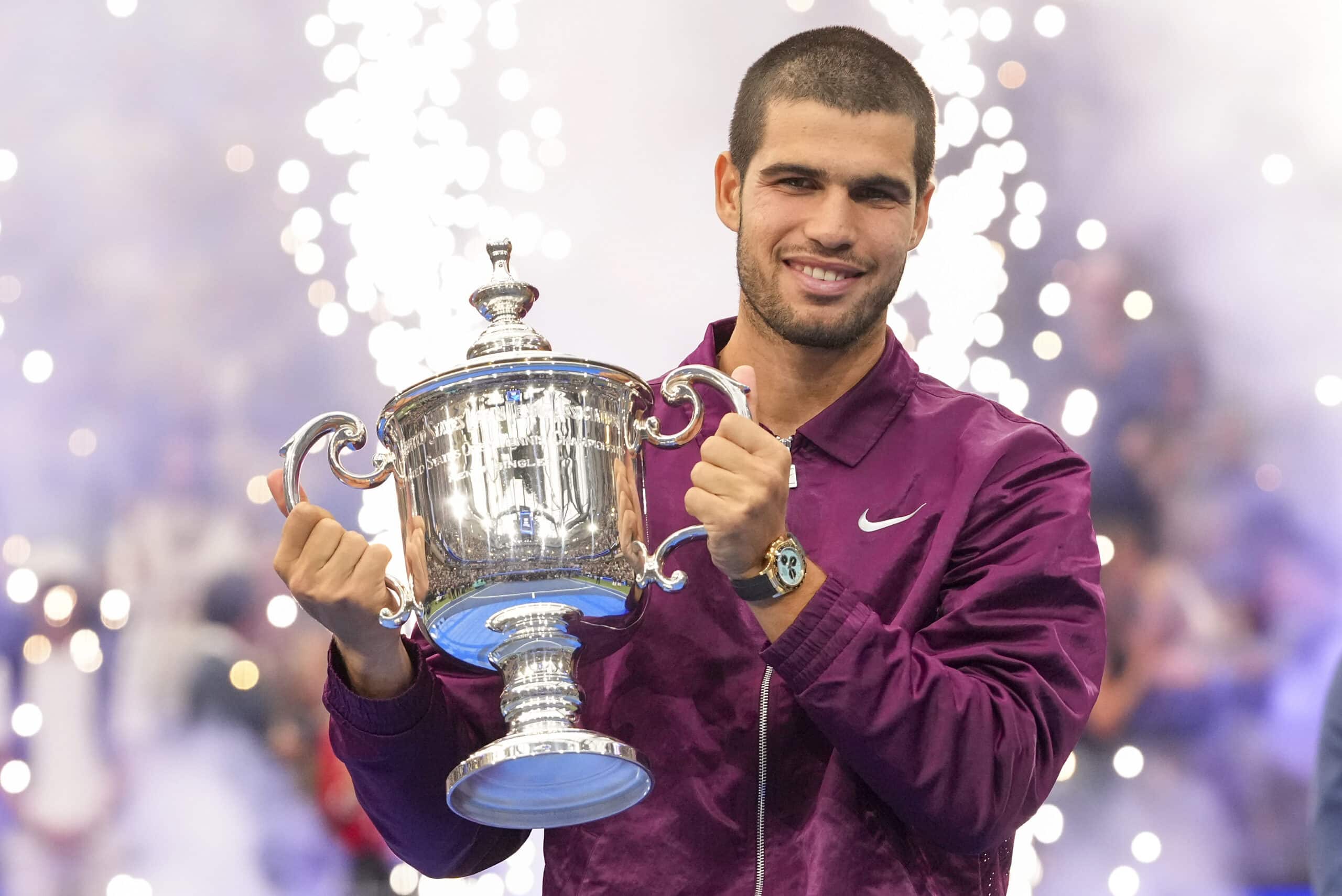

The US Open presents the final chance of the calendar year for the players to add a Grand Slam title to their collection.
But in some respects, the US Open is the toughest of the majors to win. Played in August and September in Queens, New York, temperatures can often exceed 30 degrees Celcius – that’s 86 Fahrenheit – at the Billie Jean King National Tennis Center.
The challenge is one of physical endurance and mental strength. Two weeks of difficult matches and hard-hitting action is a punishing schedule for even the fittest of players.
Between 2019-2025, six different individuals won the men’s singles, while a half-dozen women also won the ladies’ singles in that timeframe.
So why is this title so difficult to retain? And what makes a US Open champion prevail in the New York summer heat?
Experience Matters
They say that in sport, in business and even in life that ‘past performance does not predict future results’.
But that’s not necessarily the case in Queens, where the US Open champions have typically offered a sneak preview of their future success before.
Each of the last six men’s singles winners – Rafa Nadal, Dominic Thiem, Daniil Medvedev, Novak Djokovic, Carlos Alcaraz and Jannik Sinner – had reached at least the quarter-final stage of the tournament in the years prior to their maiden US Open victory.
Of that sextet, Nadal, Djokovic and Sinner had all won a Grand Slam final before, while Thiem and Medvedev had previously reached a major final . Only Alcaraz, in 2022, was something of an outlier. His prior Slam best at that time was a quarter-final appearance in the US and French Opens.
The women’s singles is an entirely different animal, mind you. Of the last six winners of that title, Bianca Andreescu and Emma Raducanu have never gone beyond the fourth round of a Grand Slam before or since their triumph.
Naomi Osaka had never gone beyond the fourth round of a major prior to her first US Open win in 2018, while Coco Gauff’s 2023 victory was her first major title lift.
Only Iga Swiatek and Aryna Sabalenka had signposted their triumphs beforehand, with Swiatek a two-time French Open champion prior to prevailing at Queens and Sabalenka twice having won at the Australian Open – and reaching the semi-final stage (at least) of the US Open three times prior to finally getting over the line in 2024.
The takeaway point is that US Open predictions, certainly in the men’s singles, can be based on past performances.
But in the women’s draw, which lends itself to variance anyway due to the shorter format of the game, all bets are off. This is a tournament that class-acts and shock winners alike have enjoyed in recent times.
In the Open Era, there have been 11 multiple time winners of the US Open men’s singles and 13 in the women’s draw. Those numbers fall to ten and ten at the French Open, while only eight women have won multiple Wimbledon titles in the Open Era.
You can slice and dice those numbers however you want, but one viewpoint would be that once you find a level of comfort and suitability for the hard courts in Queens, there can be ample opportunities for repeat success in the years to come.
Sewing the Seeds of Success
The seedings can also be useful when predicting US Open winners, but again seems to be the men’s draw that is most predictive in that sense.
At the 2025 edition, six of the eight quarter-finalists were seeded 1-10, with the number one and two seeds – Alcaraz and Sinner – meeting in the final.
All eight of the quarter-finalists in 2024 were seeded, with Sinner (1) beating Taylor Fritz (12) in the final, while in 2023 the swashbuckling home favourite Ben Shelton was the anomaly. He was unseeded, but the other seven players to reach the quarters were all seeded 12 or higher. Numbers two and three, Djokovic and Medvedev, met in the trophy match.
Although perhaps riper for unpredictability, three of the last four editions of the women’s singles have been won by the number one or two seed, with the anomaly being Gauff’s 2023 triumph. She was still a highly-respected player, though, with a seeding of six.
Opportunity does knock for others to go deep into the tournament, though. In three of the last four editions, at least one unseeded player has reached the quarter-final stage – Karolina Muchova, the 2026 Wimbledon finalist, was unseeded when she made it to the semi-finals in 2024, where she went down to Jessica Pegula despite winning the first set.
Although not the most unexpected or advanced tennis analysis by any means, it is nevertheless interesting that if you want to try and predict the winner of the US Open, sticking with the seeds in favour of chancing a longshot or two remains the most fruitful strategy.
Of course, the seeds are generally the better players in the draw. And enjoying a lofty world ranking is useful as it allows the player to manage their schedule more effectively – they don’t need to grind and travel the world to play here, there and everywhere. Instead, they can focus on the key tour events, timing their run to the majors perfectly.
Lower ranked players, on the other hand, have to play as often as they can to secure their passage into the Grand Slams. The season starts in January, of course, so by the time that the US Open rolls around in late summer, they are likely to have played dozens of matches already – accumulative fatigue, niggling injuries and swings in confidence are all likely to dictate how well a player can fare in the final major of the year.
Plus, lower ranked players are likely to run into one of the top seeds early in the draw, and need to beat a number of seeded players to navigate a route deep into the tournament.
The top seeds lead a charmed, ‘protected’ life… but tennis, like all sports, is a meritocracy; exactly as it should be.
The Anatomy of a Champion
So what sets a US Open champion apart from the rest… other than being very good at tennis, of course?
The key, perhaps, remains the surfaces at the various venues at the Billie Jean King National Tennis Center. According to Court Speed1, the US Open is the second fastest of the Grand Slams based on the number of shots per rally (as an average of the last three editions):
- Wimbledon – 3.60 shots per tally
- US Open – 3.86
- Australian Open – 4.09
- French Open – 4.69
Although the tournament is played on hard courts, it actually has more in common with a grass event.
So what does that mean for the US Open? The traits of successful tennis players in this event are clear: you need to be able to win points quickly and efficiently, hitting lines and keeping unforced errors to a minimum.
Clearly, a strong serve is fundamental to that. This isn’t just pace for the sake of it, as a combination of speed and direction is key – as well as variety in being able to go wide, up the central ‘T’ and even into the body.
Powerful groundstrokes on both wings are also essential, as they will get maximum reward out of the slick surface in Queens.
And then, of course, there’s the attributes that lend themselves to Grand Slam success. You will not win this event unless your conditioning is supreme; this is two weeks of matches against elite opposition in searing heat and humidity.
Tying into that is winning points quickly and cheaply as discussed already, so aces and unreturnable serves are essential as is an ability to construct winning points in three shots or fewer – power, evidently, is non-negotiable.
But the courts are unique too, which perhaps explains why the recent champions – certainly in the men’s draw – have showcased their aptitude for the US Open test prior to lifting the trophy.
Balls grip and kick high off the surface, so players that can hit with exaggerated topspin are able to get the best out of the conditions, while the most agile and flexible are able to slide around the baseline and get to drop shots.
Mental fortitude is helpful too, as the crowds at the Billie Jean King National Tennis Center can be raucous to say the least. These matches at majors often have swings in momentum, so being able to deal with peaks and troughs is vital.
Commenting on the crowds2 at the event back in 2025, Shelton said: “I guess I find peace in the chaos, because I feel more uncomfortable at the quiet tournaments.”
Petra Kvitova, the former world number two and double Wimbledon winner, never went beyond the quarters in New York. She described the crowd’s anarchic behaviour as ‘really confusing’.
Clearly, the US Open is not for everyone. But if you can handle the crowds and the heat – as well bringing the attributes discussed in this article to the party – you might just have a chance of landing the final major of the tennis calendar year.
Sources
1 - https://courtspeed.com/rally-length/
2 - https://www.independent.co.uk/sport/tennis/us-open-chaos-major-tournament-crowds-b2813692.html