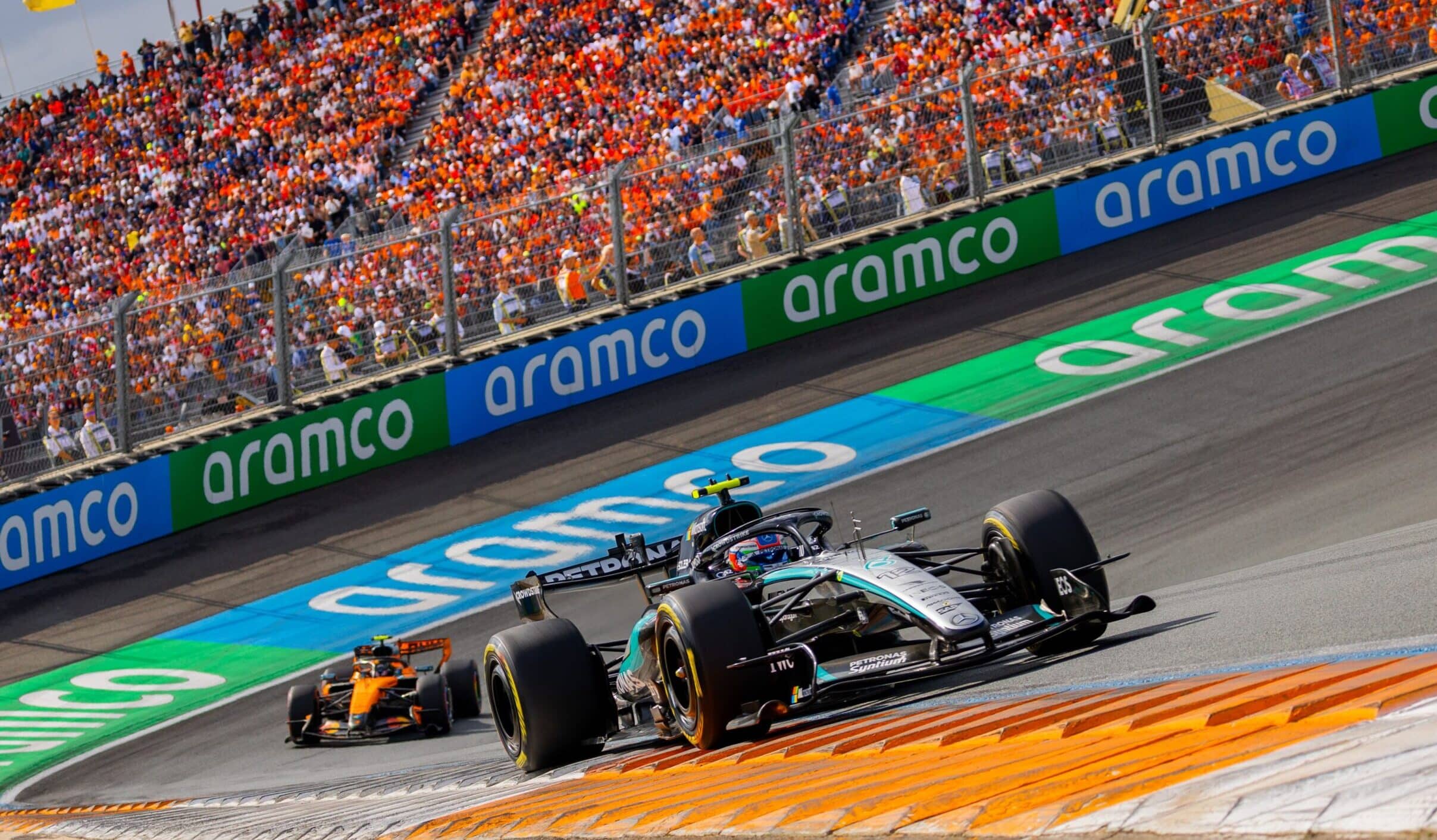

One of the most common accusations levelled at Formula One, particularly by those who don’t follow the sport closely, is that it is predictable.
Of course, that’s an argument that doesn’t always make sense – the 2025 title race was one of the closest in history.
If predictability is anathema to good sport, then the 2026 campaign should be one to savour. New regulation changes have upended F1 and taken even the most successful of drivers and constructors out of their comfort zones.
That is great news for race fans… and it may prove to be excellent news for punters that can get an early handle on the latest rule changes.
In that spirit, here’s a deep dive into the new F1 regulations…
What are the Rule Changes for the New Season?
The ambition of the new rules is to make the grid more competitive, while promoting energy efficiency and the use of greener technologies.
Car shapes will be redesigned and power units overhauled in order to comply, which has seen every team effectively starting from scratch – those that are able to adapt the fastest, and innovate where possible, will likely see the most positive early season results.
- Power Unit Changes
The new regulations that are likely to have the biggest impact on the outcome of the 2026 season are related to power units.
The build will still be geared around a 1.6-litre V6 turbo hybrid engine, but the power base will be a 50/50 split between petrol and electricity, which will enhance sustainability and energy efficiency.
The MGU-H heat recovery system has been removed, which added weight and was never truly adapted for contemporary cars.
The new power units will also be fuelled by greener sources too, including municipal waste and even non-food biomass.
- Boost and Overtake Mode
Being a driver is a physically demanding, highly pressured job. But in 2026, they will have access to two simple dashboard buttons that can help to enhance the performance of their cars with a single touch.
The new power unit will facilitate ‘boost’ mode, which will allow for maximum power to be achieved from both the engine and the battery. This provides drivers with increased performance for a short period of time… which can be used tactically to attack or defend as necessary.
The ‘overtake’ mode can be activated when a driver is within one second of the car in front – the extra surge of power can help them to move ahead of a rival at a critical time in the race.
- New Wings
Red Bull will be hoping that the new rules on wingspans and sizes can sustain Max Verstappen’s late improvement in 2025.
This season, front wings will be narrower and more streamlined, while the rear beam wings have been removed entirely.
Both front and rear wings can be adjusted with new angles – a concept known as ‘Aero Angle’. Their flaps can be opened and closed as a driver desires, creating additional grip on corners (when closed) but greater speed on straights (when open).
Meanwhile, rules officials will allow some headway when it comes to front wing design, which is likely to become a key battleground behind the scenes as constructors look to gain an edge on the grid.
- More Aerodynamism
New rules on car design will ensure that cars are lighter and streamlined as of 2026.
The objective is to make cars shorter, narrower and lighter, with a smaller wheelbase and thinner 18-inch Pirelli tyres.
They will have a flatter floor and an extended diffuser, which will reduce downforce and therefore minimise drag on straights – although, of course, some downforce is required to keep drivers safe when cornering at breakneck speeds.
The upshot? The standard Formula One vehicle will now be smaller, faster and more ‘agile’ around corners than ever before – resulting in higher speeds and rapid lap times.
- Driver Safety
The new car design will implement a range of safety features to enhance driver protection.
The main innovation will be a reinforced roll hoop, which has been strengthened to the point that it can now bear loads of nearly 25% higher.
The front structure of the car will now also break down into two parts, which will help to protect drivers in the event of a collision.
So, those are the main rule changes for F1 in 2026. The outcome is faster and cars that are more sustainably powered… what’s not to like about that!?
Will Teams with Strong Engine Programmes or ‘Customer’ Teams Thrive?
The new season will kick off with five power unit manufacturers on the grid:
- Mercedes
- Ferrari
- Red Bull Ford
- Audi
- Honda
Typically, we might expect ‘works’ teams to benefit the most in these changing times, with Ferrari, Mercedes and Red Bull – backed by a new alliance with Ford – three that can roll out innovations the fastest.
But McLaren have a successful working relationship with Mercedes which brought them driver’s and constructors championship glory in 2025, so despite being a ‘customer’ don’t expect them to be short-changed by the German manufacturer this season.
That said, some competitive advantages ARE expected for those with integrated factories like Red Bull, Ferrari and Mercedes – certainly early in the season.
Insiders believe that ‘syncing’ the new power unit build with the changing regulations on aerodynamism will provide a first-mover advantage to works teams… but only time will tell if that comes to pass.
Mercedes will also power Alpine’s car for the first time, while Ferrari will be on duty with debutant team Cadillac – it will be fascinating to see how they fare.
And how will Ford’s long history in motor racing aid Red Bull’s quest to return to the top of the tree in Formula One?
Honda return as a power unit provider – they will assist Aston Martin, while Audi will be making their first appearance on the grid with their own power unit… will they be able to hit the ground running?
Adaption Over Reaction: Who Has Historically Fared the Best After Regulation Resets?
The 2026 regulation changes are some of the most significant in years.
So, to that end, it’s difficult to predict how each individual team will fare this season. But, when analysing performances immediately after rule changes ahead of previous campaigns, two names stand out: Mercedes and Red Bull.
Can you remember the incredibly short-lived success of Brawn GP? In their sole season back in 2009, Brawn won both the Driver’s Championship – courtesy of Jenson Button – and the Constructors’ Championship, in a year defined by rule changes regarding aerodynamism and the introduction of the kinetic energy recovery system (KERS).
So innovative and ahead of their time were Brawn, Mercedes instigated a complete buy-out of the team ahead of their own return to the grid in 2010. It took a while for the new entity to hit their straps, but by 2014 they were dominating the sport – winning the Constructors’ Championship be nearly 300 points.
That 2014 campaign was marked by further rule changes – the 2.4-litre V8 engine configuration being completely replaced by the V6 model, but yet again it was the Germans that were able to react best: they won the Constructors’ Championship every year between 2014 and 2021, with one of their drivers landing the title in all but one of those.
Ironically, Mercedes’ winning streak came to an end in 2022: when new regulation changes were enforced.
The team that adapted best to the new landscape: Red Bull, who landed their first construction title in nearly a decade thanks to their RB18 car, which was able to best harness the new guidelines on ground effect aerodynamics.
That 2022 campaign would herald a period of domination for the Austrian outfit, who won 17/22 races in ’22 and an incredible 21/22 in 2023.
Will the Early Season Races Be More Unpredictable?
Immediately after a series of regulation changes, it becomes very difficult to predict which drivers and teams will react most successfully.
That could particularly be true in 2026, given that the new rule changes are the most significant adaptions in many a year. And, as we learned in the previous section, some constructors have a fine record of adapting quickly to new legislation… others, well, not so much.
Brawn won six of the opening seven races in 2009; to demonstrate how unlikely that was, Button was available at odds of 81.00 to win the driver’s title before the season started.
Mercedes won six in a row at the start of 2014 to showcase just how advanced their car was of the rest – remember, in 2013, they only won three GPs and none after Hungary in Round 10.
And talk about an unpredictable start to the next season with regulation changes in 2022. Ferrari, having not won a single race in 2021, came out of the blocks and triumphed in Bahrain and Australia, while Red Bull – using their own in-house Powertrains technology after the switch from Honda – won seven of the opening nine renewals.
The curtain-raising Bahrain GP in 2022 was particularly unpredictable, with Max Verstappen and Sergio Perez – who ultimately finished first and third in the Constructors’ Championship – retiring due to mechanical problems.
And the unpredictability of those opening races after rule changes was perhaps best exemplified by the efforts in Bahrain of Lewis Hamilton, whose tenth-place finish was one of his worst of the 2022 campaign, and Kevin Magnussen, whose fifth was his best performance of the season.
The new innovations for 2026, particularly the refined aerodynamism, hybrid power and ‘drive modes’, are so unique that the early races of the season could provide the most unpredictable shock results that the sport has seen for some time.
How Will the Regulation Changes Affect the Betting Markets?
When quizzed on how the new rules will affect teams and drivers in the early going of the 2026 season, Oscar Piastri replied, ‘I have no idea’!
When one of the best drivers in F1 is in the dark as to what to expect, the job of odds-makers to provide accurate pricing in their betting markets becomes all the more challenging.
What is fascinating is that bettors are using the history books as a guide. George Russell, who only won twice during the 2025 season, has been installed as the betting favourite for the 2026 opener in Australia.
Why? Maybe that has something to do with the fact that he drives for Mercedes, who as we have learned in this article have been very adaptive – and successful – in previous eras of rule changes.
Lando Norris, the reigning champion no less, is considered only the third favourite for the Aussie GP behind Verstappen, while his McLaren teammate Oscar Piastri is ranked a relatively lowly fifth in the betting market.
Let’s not forget: McLaren are a ‘customer’ of the Mercedes power unit. In times of new regulations, generally it’s the in-house works team that gets the most benefit from factory innovation, which helps to explain why Mercedes – and Russell – are the early favourites for Formula One’s season-long titles.
That’s a bold call, although the old adage ‘you can’t win a title in the early weeks, but you can lose it’ is perhaps well remembered in this context.
The general sense is that the likes of McLaren and Red Bull will eventually catch up to Mercedes if the German firm does enjoy technical advantages in the early weeks of the season.
As such, it will be fascinating to see the Driver’s Championship and Constructors’ Championship odds fluctuate throughout the campaign – it’s probable, although not certain, that value opportunities for bettors will present themselves at different times of the season.
As for now, it’s time to sit down, relax and buckle your seatbelt as we look forward to what could be one of the fastest, most entertaining F1 seasons in a long time… well, since the incredible conclusion to 2025, anyway.