
World Cup 2026 will feature at least four debutants from three regions. Cape Verde (Africa), Curacao (North America, Central America and the Caribbean), Uzbekistan (Asia) and Jordan (Asia) have already booked their places at the tournament in the USA, Canada and Mexico.
Depending on how the play-offs in March turn out, that quartet could be joined by New Caledonia (Oceania), North Macedonia (Europe), Kosovo (Europe) and Suriname (North America, Central America and the Caribbean).
All the debutants will be desperate to make a positive impression in their first ever appearances. Since major tournament experience is a vital asset for national teams, that will not be easy to do.
However, the likes of Cape Verde, Curacao, Uzbekistan and Jordan can take inspiration from the following 11 sides, all of whom did much more than merely make up the numbers in their first ever outing on the global stage.
As there were so many debutants in the first three editions, we have ignored the 1930, 1934 and 1938 tournaments for the purposes of this article. The entries are in no particular order.
Croatia (1998)
Croatia declared its independence in 1991 as part of the breakup of Yugoslavia. Admitted to FIFA in 1994, the World Cup of that year came too early for the Vatreni to compete, but they qualified for Euro 1996 by topping a group ahead of Italy. At that tournament in England, Croatia had a creditable run to the quarter-finals, where they suffered a slender 2-1 loss to Germany.
Led by manager Miroslav Blazevic, Croatia qualified for France 1998 with a 3-1 aggregate defeat of Ukraine in the play-offs, a triumph which sparked celebrations in Zagreb and beyond.
They were one of three debutants in their group that summer, as fellow newcomers Japan and Jamaica joined them alongside two-time champions Argentina. Croatia narrowly lost to the South Americans, but victories in their two other games earned them a place in the knockout phase.
Croatia edged out Romania 1-0 in the round of 16, before a stunning 3-0 defeat of Germany in the quarters. Their run came to an end in the last four as Croatia were beaten 2-1 by hosts France, but they bounced back to win the third-place play-off, triumphing 2-1 over the Netherlands.
With six goals to his name, Davor Suker won the Golden Boot that year. Croatia were not a one-man team, though: Robert Prosinecki, Zvonimir Boban and Robert Jarni also caught the eye as the Vatreni exceeded all expectations in their first ever appearance on the global stage.
Portugal (1966)
After finishing second in their qualification group in five attempts out of six, Portugal finally got over the line in 1966. Grouped with Czechoslovakia, Romania and Turkey, Portugal won four games out of six to finish top and book their place at the tournament in England.
Back in 1966 the tournament contained only 16 teams, giving it a concentration of quality that has been diluted with subsequent expansions. That is not to say it was wrong to offer more places to nations from Africa, Asia and other underrepresented continents, but in the 1960s qualification alone meant you were one of the best teams on the planet.
Portugal went into the event as potential dark horses. Their team contained the likes of Eusebio and Mario Coluna, two players who had helped Benfica win the European Cup earlier in the decades, so Manuel Afonso’s side were not exactly rank outsiders. At the same time, a run to the semi-finals was a fantastic achievement for the debutants.
Portugal beat Hungary 3-1 and Bulgaria 3-0 in their first two games that summer, before an impressive 3-1 victory over defending champions Brazil. Portugal then survived a scare in the quarter-finals, coming from 3-0 down to beat surprise package North Korea 5-3 at Goodison Park, Everton’s home ground.
Portugal’s adventure came to an end in the last four, as they lost 2-1 to hosts England. They claimed the bronze medal a few days later, though, beating the Soviet Union 2-1 in the third-place play-off.
Senegal (2002)
Cameroon were the first ever African World Cup quarter-finals, but their history-making endeavour in 1990 came in the country’s second taste of the tournament, following an appearance in 1982. You could argue, then, that Senegal’s run to the last eight in 2002 was the more impressive feat as it came in their debut campaign.
Senegal were a coming force on the African scene. Quarter-finalists at the 2000 Africa Cup of Nations, they reached the final of the 2002 tournament, held in Mali in January and February. Senegal suffered penalty heartache that day, losing to Cameroon on spot-kicks after a 0-0 draw, but it was their maiden appearance in the competition’s showpiece match.
A talented group of players, which included future Premier League players El Hadji Diouf, Papa Bouba Diop, Amdy Faye among others, had already edged out Morocco and Egypt in a tough World Cup qualification group.
Senegal were huge underdogs against holders France in the opening game of the tournament in Japan and South Korea. It was a game with heavy political overtones, pitting Senegal against their former colonial masters. France were expected to win easily, but Bouba Diop scored the only goal of the game to complete an incredible upset.
Senegal then drew with Denmark (1-1) and Uruguay (3-3) to secure second place in their group, before a golden goal brought them a 2-1 extra-time victory over Sweden in the round of 16. The boot was on the other foot in the quarters as Turkey scored via a golden goal, but the Lions of Teranga returned to Senegal as heroes.
Northern Ireland (1958)
Before they participated at Sweden 1958, Northern Ireland had only ever won one World Cup qualifier. They appeared to be up against it in the qualification campaign for 1958 too, drawn alongside Italy and Portugal in a three-team group. However, Northern Ireland beat both those teams at home to top their section, booking their spot at the tournament courtesy of a 2-1 victory over the Italians in front of 50,000 fans at Windsor Park.
Peter Doherty’s team pulled off another surprise at the competition itself. Every group was strong that summer, but Northern Ireland’s was particularly so: West Germany, Argentina and Czechoslovakia were their opponents in the first round. A goal from Wilbur Cush brought them a 1-0 victory over the Czechs and Slovaks on matchday one, before Northern Ireland lost 3-1 to Argentina a few days later.
It thus all came down to their third group game against West Germany. Northern Ireland twice took the lead in Malmo, and although they ultimately drew 2-2, that point was enough to keep them in contention for a place in the knockout phase.
Goal difference was not used as a tiebreaker back then, so Northern Ireland and Czechoslovakia contested a play-off after finishing level on points. A tight game went to extra time, with Peter McParland notching his second of the match in the 97th minute to give Northern Ireland a 2-1 win.
Doherty’s men were well beaten by France in the quarter-finals, going down 4-0 against a Just Fontaine-inspired team, but Northern Ireland departed with their heads held high.
Ukraine (2006)
From 1930 to 1990, Ukraine competed as part of the Soviet Union. In footballing terms, they were a major supplier of talent to the national team. Players like Oleg Blokhin, Anatoliy Demyanenko and Leonid Buryak hailed from Ukraine, as did the iconic manager Valeriy Lobanovskyi, who led the Soviet Union in three different spells.
Ukraine became an independent member of FIFA in 1992, and the national team made its first attempt to qualify for the World Cup ahead of the 1998 edition. Ukraine came up short and also missed out on Japan-South Korea 2002, but they did enough to book a place at the 2006 tournament in Germany.
The draw was arguably kind to Ukraine, but they still deserved credit for topping a group containing 2002 semi-finalists Turkey and reigning European champions Greece, plus Denmark, Albania, Georgia and Kazakhstan. With one of the world’s best strikers up front in Andriy Shevchenko, Ukraine arrived in Germany determined to make an impression.
That is exactly what they did, although not straight away. A 4-0 loss to Spain on matchday one represented a harsh wake-up call, but Ukraine did not let their heads drop and proceeded to beat Saudi Arabia by the same scoreline. A 1-0 victory over Tunisia was enough to send Ukraine through to the round of 16 as Group H runners-up.
A notoriously dull clash with Switzerland followed, with neither team able to score in 120 minutes of football. That led to a penalty shoot-out in which the Swiss still failed to find the back of the net, giving Ukraine a 3-0 win. Italy then beat them 3-0 in the quarter-finals, but Ukrainian fans were delighted with their team’s efforts.
Nigeria (1994)
Despite winning five out of six qualifiers on the road to Mexico 1986, yet they still missed out on the tournament after losing a two-legged play-off to Tunisia. The Super Eagles also failed to reach Italy 1990, but they finally secured a spot at a World Cup by pipping Ivory Coast to top spot in their qualification group ahead of USA 1994.
Not for the last time, Nigeria were drawn in the same group as Argentina, who were champions in 1986, runners-up in 1990 and favourites in 1994. A talented Bulgaria team were also in Group D, but Nigeria put them to the sword with a confident and stylish 3-0 win in Dallas.
The Super Eagles then took a shock lead against Argentina before going on to lose 2-1, but they signed off for the group stage with a 2-0 defeat of Greece. That left Nigeria, Argentina and Bulgaria level on six points, but the African nation’s superior goal difference meant they advanced to the knockout phase in top spot.
Led by the Dutch coach Clemens Westerhof, Nigeria’s squad featured youngsters Sunday Oliseh and Jay-Jay Okocha, as well as Finidi George, Rashidi Yekini and future national team manager Stephen Keshi. Nigeria were not short of talent and their progression to the round of 16 was no fluke.
The Super Eagles could not make it any further than that, losing 2-1 to Italy after extra time, but statistically speaking it remains their best ever showing on the world stage.
North Korea (1966)
For much of its history, the World Cup did not really live up to its name. For the 1966 edition in England, 14 of the 16 participants were from Europe and South America, with Mexico of CONCACAF taking one of the remaining berths. That left just one place for the whole of Africa and Asia combined.
North Korea claimed that spot. It is fair to say they had a helping hand along the way. After FIFA denied Africa a direct qualification berth, the 15 nations who had entered the process from that continent immediately announced a boycott.
FIFA then decided on a four-team tournament involving South Korea, South Africa, North Korea and Australia. But South Africa’s apartheid laws led to their disqualification, and South Korea withdrew after the event was switched from Japan to Cambodia. That left a two-legged play-off in Phnom Penh between North Korea and Australia, with the former winning 9-2 on aggregate.
Even less was known about North Korea - both the country and the football team - in 1966 than it is today. Just over 23,000 fans watched them lose 3-0 to the Soviet Union in Middlesbrough on matchday one, but North Korea held their own in a 1-1 draw with Chile a few days later.
Then came the extraordinary moment: a 1-0 defeat of Italy in their third group game saw North Korea qualify for the knockout phase. They then stormed into a 3-0 lead against Portugal in the quarters, only to concede five times in an eight-goal thriller. By that point, though, North Korea’s players had won many friends and admirers.
Republic of Ireland (1990)
After finishing fourth out of five in their qualification group for Mexico 1986, the Republic of Ireland dismissed manager Eoin Hand and brought in Jack Charlton as his replacement. It was a controversial move in some quarters: Charlton was born across the water in England and had won the World Cup with the Three Lions in 1966.
It did not take long for the former defender to win over any doubters, though. He took Ireland to Euro 1988, then guided them through qualification for Italy 1990. Ireland finished in the top two in Group 6, behind Spain but ahead of Hungary, Northern Ireland and Malta, to reach the tournament for the first time in their history.
Charlton’s direct style of play was not one for the purists, but it was undoubtedly effective. The manager also made use of the sizable Irish diaspora, recruiting several players who, like him, had been born and raised in England.
Ireland did not win any of their group games in Italy, but they did not lose any either. Charlton’s men drew 1-1 with both England and the Netherlands, in between which they were involved in a scoreless stalemate against Egypt. After finishing with an identical record to the Dutch, Ireland finished second after the drawing of lots, with the Netherlands also progressing as one of the best third-place finishers.
Another 0-0 draw awaited in the round of 16, before Ireland beat Romania in the resultant penalty shoot-out. A slender 1-0 defeat by Italy marked the end of their campaign, but Ireland had done the country proud by reaching the quarter-finals.
Saudi Arabia (1994)
Saudi Arabian football has made waves in recent years, with the Saudi Pro League attracting some top stars from Europe, South America and Africa. The Green Falcons also pulled off one of the biggest ever World Cup shocks at Qatar 2022, as Herve Renard’s side beat future champions Argentina 2-1 in the group stage.
That result goes down as their greatest ever, but Saudi Arabia were unable to build on it by reaching the knockouts. As such, 1994 remains the pinnacle for the three-time Asian champions, who were crowned kings of their continent at the Asian Cup in 1984, 1988 and 1996.
Saudi Arabia lost to Japan in the final of that competition in 1992, but a year later they secured one of Asia’s two World Cup qualification berths, alongside South Korea. Still, no one expected much of the Saudis in the USA, with most football fans dismissing them as guaranteed also-rans.
Yet Saudi Arabia relished their role as underdogs. They gave a good account of themselves against the Netherlands, taking the lead before losing 2-1 after conceding the decisive goal late on. But the Saudis recovered to beat Morocco 2-1, after which they upset the odds in a 1-0 triumph over Belgium to secure second place in Group F.
The Saudi dream came to an end in a 3-1 loss to Sweden in the round of 16, but 1994 is a summer the Gulf country will never forget - not least because they have not been back to the knockouts since.
Wales (1958)
Northern Ireland made their bow at Sweden 1958 and so did Wales, one of the other Home Nations alongside England and Scotland. The Dragons would have to wait another 64 years for their next appearance at the competition, so 1958 holds a special place in the history books of Welsh football.
Wales finished second in their qualification group, above East Germany but behind Czechoslovakia. They were one of nine runners-up in the UEFA process, together with the Republic of Ireland, Belgium, Bulgaria, the Netherlands, Poland, Romania, Italy and Spain.
Rather than ranking those teams on points or goal difference, a random draw was held to determine who would represent Europe in the inter-confederation play-offs. Lady Luck shone on Wales, whose name was pulled out of the hat. They beat Israel pretty comfortably, triumphing 4-0 on aggregate to progress to the main event in Sweden.
Wales did more than just make up the numbers that summer. Their first match saw them hold Hungary, the runners-up four years earlier to a 1-1 draw, before Wales repeated that scoreline against Mexico. A goalless draw with Sweden in their third game set up a play-off against Hungary, which Wales won 2-1 thanks to goals from Ivor Allchurch and Terry Medwin.
One-way traffic was expected in a quarter-final tie against Brazil, but Wales gave a good account of themselves in Gothenburg and only lost 1-0, with Pele making the net ripple in the 66th minute. All in all, it was a fine showing by the first-time participants, who lost only one of their five matches in Sweden.
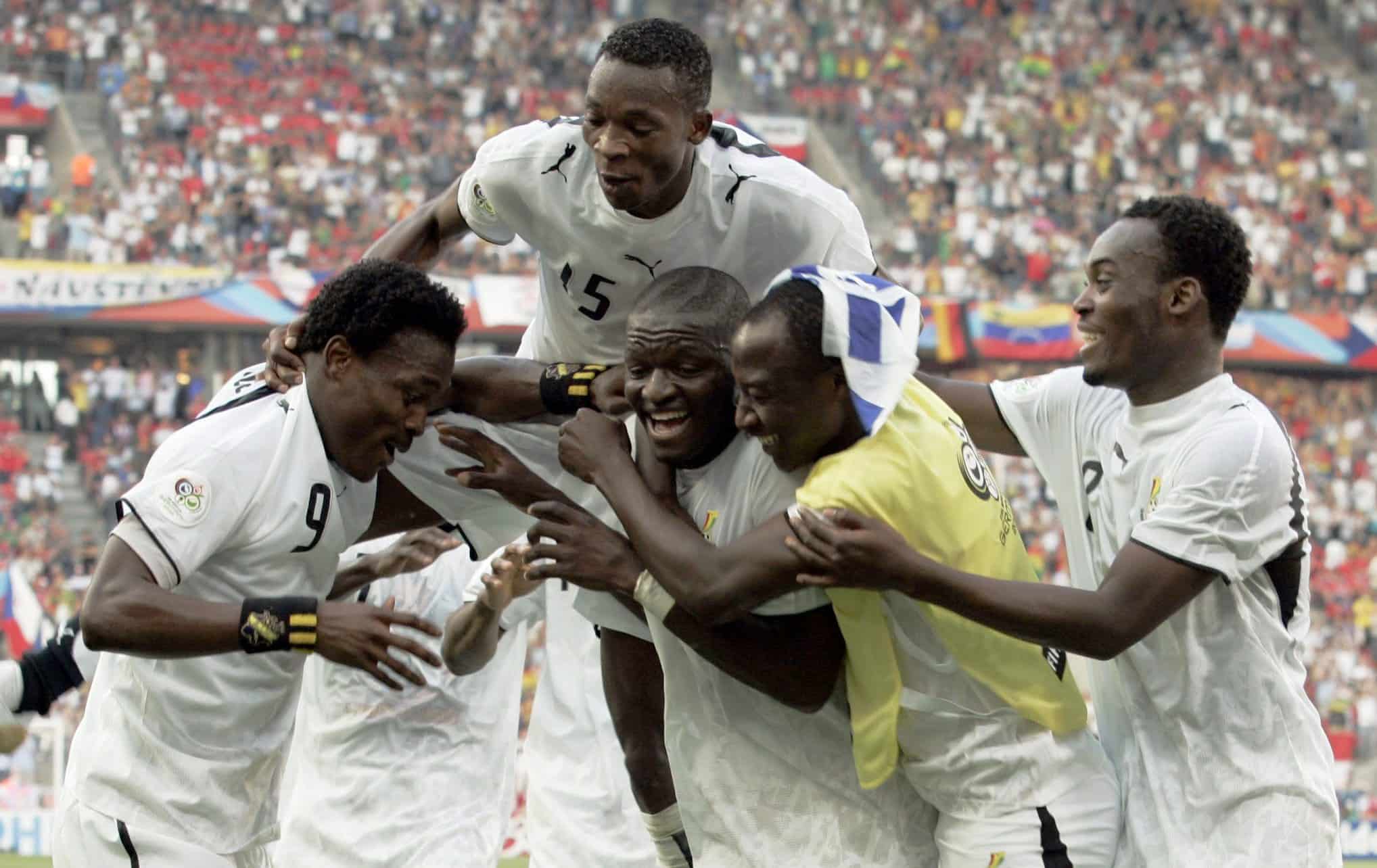
Ghana (2006)
Ghana became only the third African team to get through to the last eight of the World Cup in 2010, and they also outperformed expectations four years earlier. The Black Stars took their first steps on the world stage at Germany 2006, and they did themselves proud that summer.
Not many people saw it coming. Ghana failed to qualify for the 2004 Africa Cup of Nations, while at the 2006 edition (held just a few months before the World Cup), they crashed out in the group stage after finishing behind Nigeria and Senegal.
The manager Ratomir Dujkovic survived that disappointment, in large part because he had already qualified Ghana for Germany. The debutants were drawn into Group E, where games against eventual champions Italy, 2002 quarter-finalists the USA, and dark horses Czech Republic awaited.
A 2-0 defeat by the Italians on matchday one was seen as par for the course, but Ghana did not lose faith. An early goal from Asamoah Gyan saw them take control of their subsequent meeting with Czech Republic, with Sulley Muntari adding a second in the 82nd minute to give Ghana their first ever win in the world’s biggest sporting event. A 2-1 victory over the USA then saw Dujkovic’s charges reach the last 16.
Ghana could not go any further than that, losing 3-0 to a star-studded Brazil side in Dortmund in the first knockout round. But there is no doubt that their experience in 2006 served them well four years later, when Ghana came within a controversial Luis Suarez handball of reaching the semi-finals.