
The Champions League is the biggest and best club competition in world football. The tournament adopted its current name in 1992 and it has gone from strength to strength since then, with fans all around the globe intrigued and enthralled by every single edition.
Needless to say, the final (usually held in May or June) attracts the most attention from all four corners of the planet. In this article we have delved into the history books and, in no particular order, picked out 10 Champions League finals you will never forget.
Manchester United 2-1 Bayern Munich (1999)
Manchester United did not have an easy run to the final in 1999. They started their journey in the second qualifying round, then faced Bayern Munich and Barcelona in the group of death. The knockout stage brought meetings with Inter and Juventus, the second of which saw United launch a memorable comeback in the second leg.
A more dramatic turnaround was to follow. United were not at full strength for the final against Bayern, with captain Roy Keane and his midfield colleague Paul Scholes both suspended. It was the Bundesliga outfit who took the lead early on via a Mario Basler free kick.
United left it late to respond. The equaliser arrived in the first minute of second-half stoppage time as Teddy Sheringham turned the ball home from close range. Extra time beckoned - or did it? Before Bayern had time to draw breath, Ole Gunnar Solskjaer diverted a Sheringham header into the roof of the net to complete a stunning comeback and give United the trophy.
Real Madrid 4-1 Atletico Madrid (2014)
Atletico Madrid pipped Barcelona to the La Liga title in 2013/14, pushing Real Madrid down to third place. Diego Simeone’s side did not have time to dwell on that success, however, having reached this European final for only the second time in Atletico’s history. Their opponents were their rivals from across the Spanish capital, as Madrid sought a 10th continental crown.
Madrid had more individual stars in their ranks, but for a long time it looked like the power of Atletico’s collective would win the day. Diego Godin’s looping header put Simeone’s men ahead in the 36th minute and Atletico did a good job of holding Madrid at arm’s length thereafter.
In the end, though, Atletico were not quite able to complete the job. Sergio Ramos finally restored parity in the third minute of the second-half injury time, forcing an additional 30 minutes. By then Atletico had collapsed and Madrid ran riot, scoring three times through Gareth Bale, Marcelo and Cristiano Ronaldo to defeat their adversaries.
Barcelona 3-1 Manchester United (2011)
The greatest team display in the final of this competition came in 2011, as Pep Guardiola’s Barcelona ran out 3-1 winners against Alex Ferguson’s Manchester United. The Blaugrana had beaten the same opponents in the final two years earlier, but this showing at Wembley Stadium was undoubtedly their crowning glory.
“In my time as a manager, I would say they're the best team we've faced,” admitted Ferguson, who had been in charge of United for 25 years. “Everyone acknowledges that, and I accept that. It's not easy when you've been well beaten like that to think another way. No one has given us a hiding like that. It's a great moment for them.”
Lionel Messi was the star of the show, but Xavi Hernandez, Sergio Busquets, Andres Iniesta, Pedro Rodriguez, Victor Valdes and Gerard Pique all played their part in Barcelona’s epic victory. The most remarkable thing is that all seven of those players, plus manager Guardiola, came through the club’s academy. We might never see that happen again.
Bayern Munich 1-1 Chelsea (2012)
Bayern Munich felt like it was their destiny to win this competition in 2012. The final was to be held at their own stadium, the Allianz Arena, and the German giants were understandably seduced by the idea of lifting the famous trophy in Munich. Bayern breezed past Basel and Marseille in their first two knockout ties, before edging out Real Madrid on penalties in the semis.
Their opponents in the Munich showpiece were Chelsea, who had only narrowly avoided elimination in the round of 16 after sacking their manager Andre Villas-Boas and appointing an interim replacement in Roberto Di Matteo. Chelsea really rode their luck against Barcelona in the last four, and they were huge underdogs in the final.
Bayern dominated possession and outshot Chelsea, who were defensively sound despite missing captain John Terry. Bayern eventually broke the deadlock through Thomas Muller in the 83rd minute, but a towering header from Didier Drogba forced extra time. There were no more goals and, with Bayern feeling the pressure, Chelsea won on penalties.
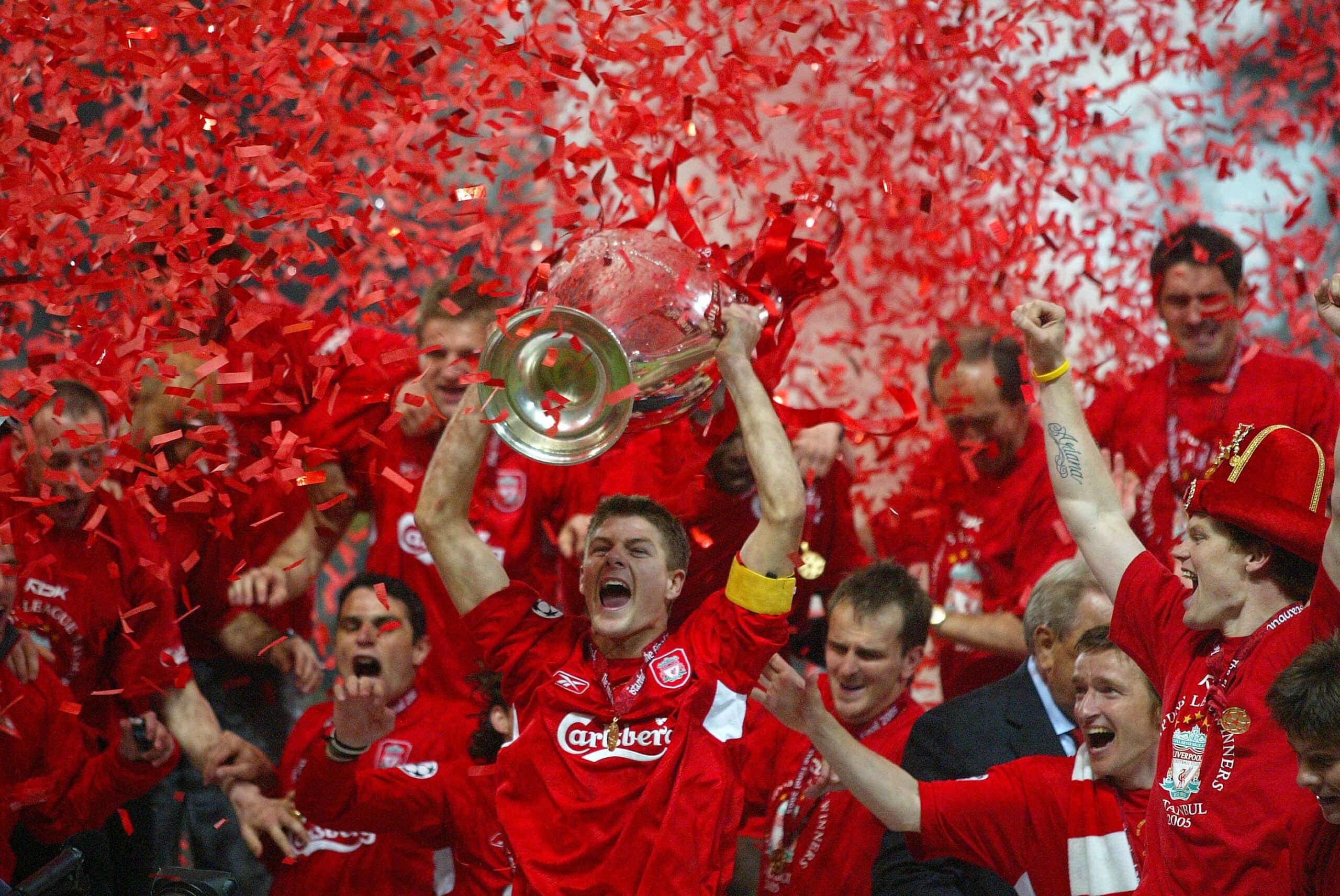
Liverpool 3-3 AC Milan (2005)
The most thrilling final in the history of this competition took place in 2005. It remains the only time both finalists scored at least two goals, but the prospect of Liverpool finding the net even once looked slim at half-time. Thanks to a dazzling display in the opening 45 minutes, AC Milan held a 3-0 lead at the interval. This looked set to be the most one-sided final ever.
Save for the inspirational Steven Gerrard and a young Xabi Alonso, Liverpool’s team was pretty average (after all, they finished fifth in the Premier League that year). But the spirit within the squad was formidable and, with nothing to lose, Liverpool gave it a go in the second half. To the surprise of everyone, they scored three goals in the space of seven minutes.
Neither team could find a winner in normal time or extra time, so the 2005 showpiece was decided on penalties. With Liverpool leading 3-2, Andriy Shevchenko had to score with Milan’s fifth spot-kick. He did not and, against all odds, Rafael Benitez’s Liverpool were European champions.
Real Madrid 2-1 Bayer Leverkusen (2002)
The 2002 final featured one of the best goals this competition has ever seen. Zinedine Zidane was its scorer, the Frenchman unleashing a stunning left-footed volley to put Real Madrid 2-1 up in the 45th minute. Before that, Raul had given the Spaniards the lead, only to see Lucio equalise for Bayer Leverkusen soon after.
Leverkusen are not a member of Europe’s elite, but they had a very useful team in 2002. Lucio starred at centre-back throughout that campaign, while Michael Ballack was brilliant in the heart of the midfield and Oliver Neuville scored plenty of goals up top. Dimitar Berbatov, Ze Roberto and Bernd Schneider were also part of that squad.
Madrid were not short of talent themselves, with the gifts of Raul and Zidane supplemented by the likes of Luis Figo, Claude Makelele, Fernando Hierro and Roberto Carlos. Even with so much quality around him, Zidane stole the show with that sublime strike on the stroke of half-time. It was a goal that deserved to win any game.
Manchester United 1-1 Chelsea (2008)
The Premier League was Europe’s dominant domestic competition in the mid-2000s and it was fitting that England supplied both finalists in 2008. Manchester United were the national champions having won the league title in both 2007 and 2008, but Chelsea had triumphed in 2005 and 2006. These were comfortably the two best teams in the country - and, in 2008 at least, on the continent.
Manchester United drew first blood in the 26th minute, as Cristiano Ronaldo planted a header past Petr Cech. But Alex Ferguson’s men could not hold on to their lead until the break, with Frank Lampard making it 1-1 shortly before the referee brought the first half to a close.
Both teams had opportunities to score a winner in the second half and then in extra time, but none were taken. That meant penalties. Ronaldo failed to convert from 12 yards, giving John Terry the chance to win the final for Chelsea. But Terry slipped and saw his effort cannon off the post, and United went on to triumph in sudden death.
AC Milan 4-0 Barcelona (1994)
Barcelona were only crowned kings of the continent for the first time in 1992. Two years later they were back in the final and, according to most observers, they were in pole position to claim the trophy - not least because AC Milan were missing four key men in Marco van Basten, Gianluigi Lentini, Franco Baresi and Alessandro Costacurta.
Instead, Milan delivered a masterclass to win 4-0, still the biggest margin of victory in a final. The Italian outfit started the brighter and deservedly took the lead through Daniele Massaro, who doubled his own tally and Milan’s lead in first-half stoppage time. The Rossoneri were in dreamland and Barcelona were shell-shocked.
Milan manager Fabio Capello preached focus in his team talk and his players duly hit the ground running in the second period. Dejan Savicevic made it 3-0 less than two minutes after the restart, before Marcel Desailly put the cherry on the cake shortly before the hour mark. Needless to say, Johan Cruyff regretted saying his Barcelona team were favourites before the game.
Real Madrid 3-1 Liverpool (2018)
European champions in 2014, 2016 and 2017, Real Madrid were seeking a fourth trophy in five years when they faced Liverpool in 2018. The Blancos had experience on their side, but Liverpool’s all-action style under Jurgen Klopp looked well suited to catching Madrid out. It was hard to call which way this one would go.
The first episode of note was a contentious one. Mohamed Salah, Liverpool’s top scorer, was forced off with a dislocated shoulder in the first half, and the club’s supporters accused Sergio Ramos of deliberately injuring their star man. Even without Salah, though, Liverpool went in at the break with the score 0-0.
Karim Benzema edged Madrid in front in the 51st minute after a catastrophic error from Liverpool goalkeeper Loris Karius, but Sadio Mane ensured the Reds were not behind for long. The decisive third goal was a wonderstrike from Gareth Bale, who later notched one more thanks to another Karius error.
Barcelona 2-1 Arsenal (2006)
Arsene Wenger won three Premier League titles as Arsenal manager, the latest of which came after a magnificent unbeaten season in 2003/2004. That team was gradually broken up over the next few years, but it had one last shot at a Champions League in 2006, when knockout stage victories over Real Madrid, Juventus and Villarreal put Arsenal in the final.
Their opponents at the Stade de France were Barcelona, who had edged out AC Milan 1-0 on aggregate in a tight semi-final. The sending-off of Gunners goalkeeper Jens Lehmann in the 18th minute made it advantage Barca, but it was Arsenal who took the lead via a Sol Campbell header.
Ultimately, though, it was too big an ask for Wenger’s team to preserve their advantage. Quick-fire goals from Samuel Eto’o and Juliano Belletti put Barcelona 2-1 ahead, sending the trophy back to Catalonia.