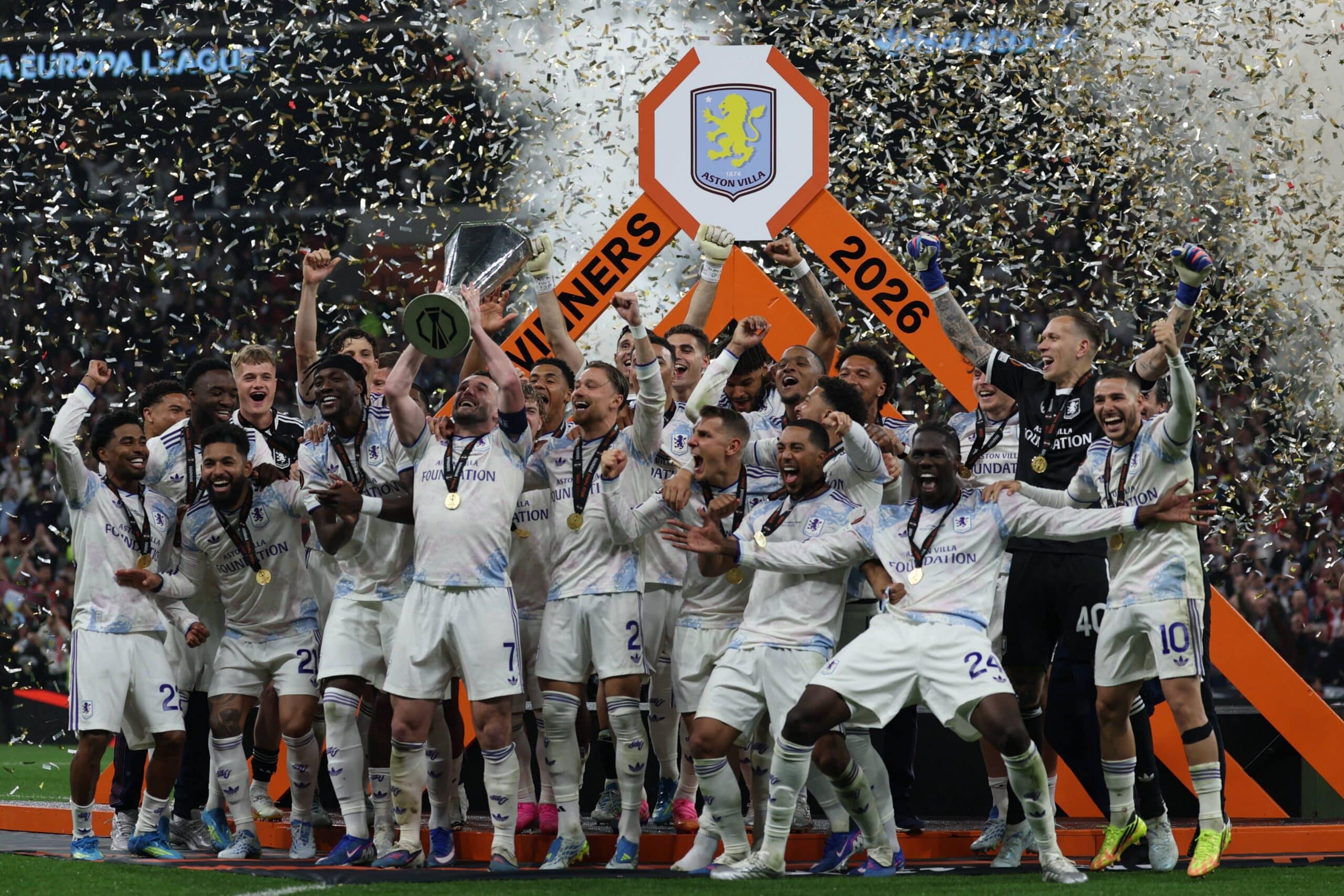

Since its inception in 1971, the UEFA Cup/Europa League has been lifted by 31 different teams from 11 different countries. Even in the last 10 years alone, there have been nine different winners. That makes it sound like an impossible competition to predict. But recent rule changes and restructuring may uncover the start of a new pattern that can be used to predict future Europa League winners…
Europa League winners from 2012 onwards
There is little to be gained from looking back at what Tottenham Hotspur lifting the 1972 UEFA Cup tells us about who might win the Europa League next season. But there are definitely European football trends to be seen from the last 15 years of competition.
2011-12: Atlético Madrid 3-0 Athletic Bilbao
2012-13: Chelsea 2-1 Benfica
2013-14: Sevilla 0-0 Benfica (4-2 on pens)
2014-15: Sevilla 3-2 Dnipro Dnipropetrovsk
2015-16: Sevilla 3-1 Liverpool
2016-17: Manchester United 2-0 Ajax
2017-18: Atletico Madrid 3-0 Marseille
2018-19: Chelsea 4-1 Arsenal
2019-20: Sevilla 3-2 Inter Milan
2020-21: Villarreal 1-1 Manchester United (11-10 on pens)
2021-22: Eintracht Frankfurt 1-1 Rangers (5-4 on pens)
2022-23: Sevilla 1-1 AS Roma (4-1 on pens)
2023-24: Atalanta 3-0 Bayer Leverkusen
2024-25: Tottenham 1-0 Manchester United
2025-26: Aston Villa 3-0 SC Freiburg
There is a common, albeit predictable theme that runs through every single one of these winners. Something they all have in common…
Europa League Champion Patterns
We are, of course, talking about the fact that every single one of the last 15 Europa League champions has hailed from one of the top five European Leagues. Spain have claimed eight titles, England five, and one each to Germany and Italy. But what other patterns are there to look out for with Europa League winners?
Spain are the dominant force in the Europa League
That means, in recent history, Spain has by far been the best bet when it comes to the next Europa League winners. No country has more than their 14 all-time trophies, and no club can even come close to Sevilla’s seven Europa League titles. However, it should be noted that Spain’s next most successful team is Real Madrid, who rarely play in the Europa League these days, and Valencia/Villarreal, who have only claimed one title each.
So, maybe we should be talking less about Spain as a whole, and more about Sevilla as a freak of Europa League nature. If Real Madrid are the kings of the Champions League, then Los Nervionenses wear the crown in the second tier. Like Los Blancos, Sevilla claimed a historic Europa League treble in 2014, 2015, and 2016, and have won five of the last 13 titles. Unfortunately, their La Liga form has dropped off in recent years, so they haven’t actually qualified for the Europa League since 2022/23.
France are nowhere to be seen in Europa League finals
Talking about the success of the so-called Top Five in the Europa League is actually a little flattering to Ligue 1. Well, more than a little. Believe it or not, France have never had a Europa League winner. In fact, they have never had a UEFA Cup winner either. Since 1972, there have only ever been five finals featuring a French team, and they have lost every time. After all, the Europa League is not about pitting league winners against league winners; it’s about measuring the strength of the fifth, sixth, or seventh best teams in each of the top domestic tables. Less of your Real Madrids vs Liverpools, more of your Sevillas vs Romas. The unfortunate truth for France is that Ligue 1 has never been that strong beyond PSG and a handful of other teams.
New structure could change European football trends
As a result of the expansion and restructuring of European competition in 2024/25, it appears that English teams have been handed an advantage in the Europa League.
The Group Stage has been replaced by the League Phase, and Champions League teams no longer drop down into the Europa League beyond the qualifying stage. That means the biggest names in the competition from day one are likely going to be the biggest names come the end, too. The League Phase places more emphasis on consistency, and removes some of the jeopardy of shock results, which arguably plays into the hands of the teams with the most money and deepest squads.
And who has the most money and deepest squads? Premier League clubs… by a long way. It comes as no surprise that since the restructuring, both the 2024/25 and 2025/26 Europa Leagues have been won by English clubs (Tottenham and Aston Villa). Further still, both Conference League titles have also been scooped by English winners (Chelsea and Crystal Palace). Premier League teams may not win the Champions League every season, but the strength of the league from top to bottom absolutely obliterates that of any other Top Five division.
Europa League Analysis: Traits of Successful Teams
Singling out the traits of a successful team is often the best way to highlight the next potential winners. Narrowing the pool from 32 wannabe champions to just a select few dramatically increases the odds of choosing correctly.
Impressive squad depth: European competition requires impressive squad depth. It is no easy task to travel on a Thursday night for a big European fixture, then head home for a domestic game on Sunday, and repeat. No matter how fit the players are, it becomes impossible to play the same XI in every match. So, don’t just look at the strongest potential line-up, but also how strong a team’s second XI is.
No distractions elsewhere: When it comes to the tail end of the Europa League knockouts, you ideally want to focus all your energy on lifting the trophy itself. In 2025, Tottenham gave up on the league and rested key players specifically for the Europa. In 2026, Aston Villa was so far clear in the top four that they could afford to take their foot off the gas. Mixing a title challenge, a top-four race, or a relegation battle with a Europa League campaign is a recipe for a shock exit.
A pedigree of winning in Europe: It always helps to have been there and done it before. Out of the last 15 winners, 13 of them had lifted a European trophy before at some point in their history. The only exceptions were Atalanta and Villarreal.
How to Predict Europa League Winners
If you take all of our tips and combine them, it begins to paint a picture of what the most likely Europa League winner could look like. Let’s go through our Europa League predictions step by step for 2026/27:
- A team from the top five leagues: Crystal Palace, Bournemouth, Sunderland, AC Milan, Juventus, Real Sociedad, Celta Vigo, Hoffenheim, Bayer Leverkusen, Marseille, Rennes
- Discount the French teams: Crystal Palace, Bournemouth, Sunderland, AC Milan, Juventus, Real Sociedad, Celta Vigo, Hoffenheim, Bayer Leverkusen
- Top teams with best squad depth: Crystal Palace, Bournemouth, AC Milan, Juventus, Real Sociedad, Bayer Leverkusen
- Teams with European trophies: Crystal Palace, AC Milan, Juventus, Bayer Leverkusen
Of course, this is not a foolproof plan. The English teams in the Europa League this season are not as strong, and both Italy and Germany have some big names in the 2026/27 competition. Even Marseille have been to three Europa League finals. We would keep an eye on AC Milan, Juventus, and Bayer Leverkusen as the three favourites this season as our top Europa League prediction.