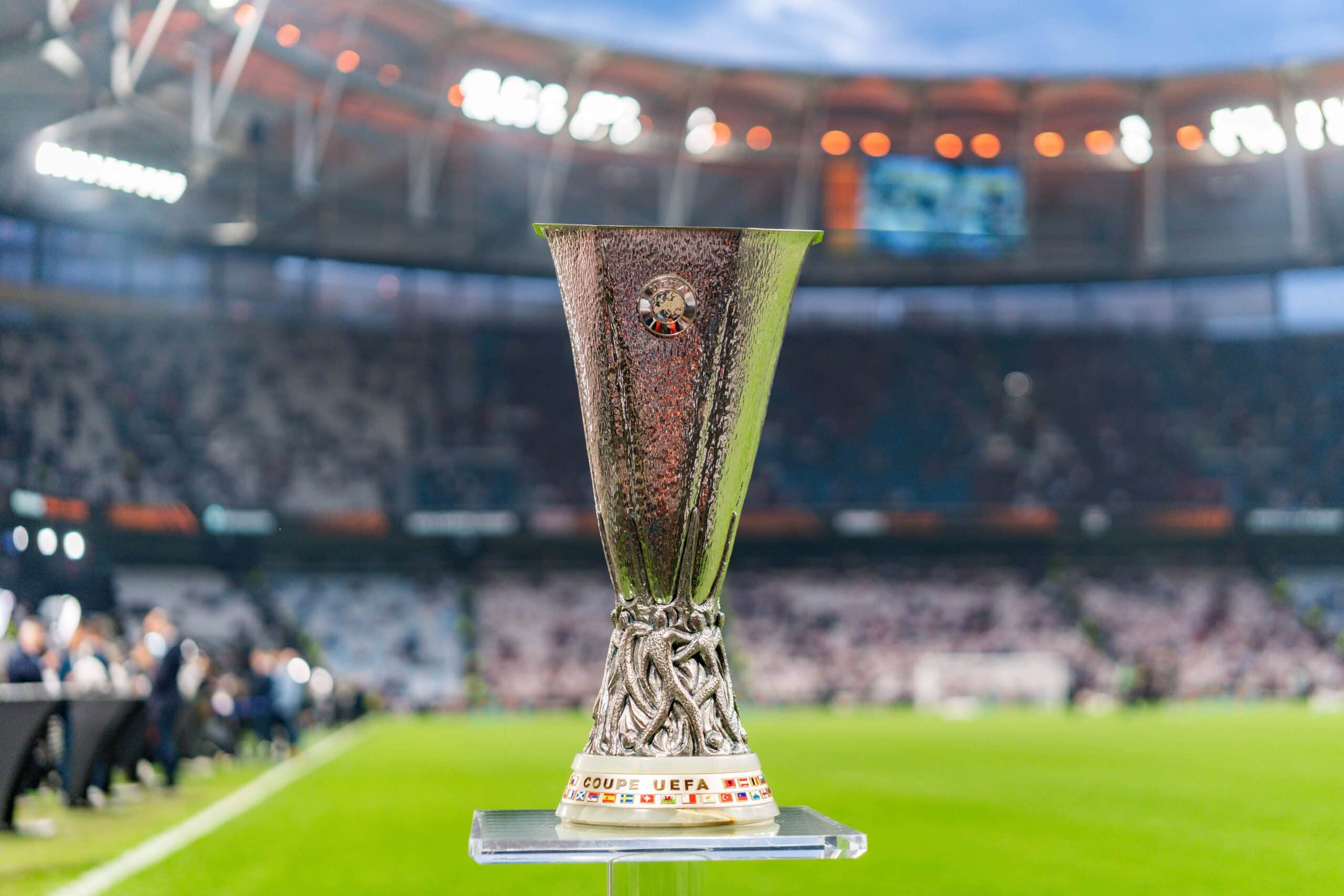

Tottenham beating Man United in Bilbao. Atalanta thrashing an unbeaten Bayer Leverkusen in Dublin. Chelsea thumping Arsenal in Azerbaijan. Iconic Europa League finals are often remembered for their locations, forever intertwined with their host stadiums. But how important actually is a stadium when it comes to a final? And how does a venue get selected to host the Europa League showcase? Let’s take a look at everything you need to know about the locations, atmospheres, and designs that help to forge Europa League champions.
How are stadiums chosen for the Europa League final?
UEFA selects the Europa League final host a few years in advance by holding a bidding process for the honour. The general secretary sends out a letter to all 55 member associations, inviting them to submit bids for prospective stadiums to host the event. Certain criteria have to be met for a stadium to be valid, including pitch size, dressing room size, floodlighting, CCTV coverage, parking spaces, etc. UEFA ideally likes to choose a stadium with a capacity between 40,000 and 60,000, too. Once all bids have been submitted, they are evaluated based on the facilities, experience hosting major events, transport links, security, hotel capacity, and more.
Which stadiums have been used for the Europa League final?
Since the switch to one-match finals at neutral venues in 1998, a total of 26 different stadiums have been used to host the Europa League final.
- 1999 – Luzhniki Stadium (Russia) – Parma (3–0) Marseille
- 2000 – Parken Stadium (Denmark) – Galatasaray (0–0, 4–1 pens) Arsenal
- 2001 – Westfalenstadion (Germany) – Liverpool (5–4 AET) Alavés
- 2002 – De Kuip (Netherlands) – Feyenoord (3–2) Borussia Dortmund
- 2003 – Estádio José Alvalade (Portugal) – Porto (3–2 AET) Celtic
- 2004 – Ullevi Stadium (Sweden) – Valencia (2–0) Marseille
- 2005 – Estádio José Alvalade (Portugal) – CSKA Moscow (3–1) Sporting CP
- 2006 – Philips Stadion (Netherlands) – Sevilla (4–0) Middlesbrough
- 2007 – Hampden Park (Scotland) – Sevilla (2–2, 3–1 pens) Espanyol
- 2008 – City of Manchester Stadium (England) – Zenit St Petersburg (2–0) Rangers
- 2009 – Şükrü Saracoğlu Stadium (Turkey) – Shakhtar Donetsk (2–1 AET) Werder Bremen
- 2010 – Volksparkstadion (Germany) – Atlético Madrid (2–1 AET) Fulham
- 2011 – Aviva Stadium (Ireland) – Porto (1–0) Braga
- 2012 – Arena Națională (Romania) – Atlético Madrid (3–0) Athletic Bilbao
- 2013 – Amsterdam Arena (Netherlands) – Chelsea (2–1) Benfica
- 2014 – Juventus Stadium (Italy) – Sevilla (0–0, 4–2 pens) Benfica
- 2015 – Stadion Narodowy (Poland) – Sevilla (3–2) Dnipro
- 2016 – St. Jakob-Park (Switzerland) – Sevilla (3–1) Liverpool
- 2017 – Friends Arena (Sweden) – Manchester United (2–0) Ajax
- 2018 – Parc Olympique Lyonnais (France) – Atlético Madrid (3–0) Marseille
- 2019 – Baku Olympic Stadium (Azerbaijan) – Chelsea (4–1) Arsenal
- 2020 – RheinEnergieStadion (Germany) – Sevilla (3–2) Inter Milan
- 2021 – Stadion Gdańsk (Poland) – Villarreal (1–1, 11–10 pens) Manchester United
- 2022 – Ramón Sánchez Pizjuán (Spain) – Eintracht Frankfurt (1–1, 5–4 pens) Rangers
- 2023 – Puskás Aréna (Hungary) – Sevilla (1–1, 4–1 pens) Roma
- 2024 – Aviva Stadium (Ireland) – Atalanta (3–0) Bayer Leverkusen
- 2025 – San Mamés (Spain) – Tottenham Hotspur (1–0) Manchester United
Five reasons stadiums matter on European final nights
While the pros and cons of certain stadiums over others are minute, they can create subtle advantages that can impact the outcome on the pitch.
The pitch size and quality: Pitch size variation is not as much of an issue as it once was in major finals. These days, Europa League final hosts must fall within the UEFA Category 4 qualifications, meaning a pitch size that ranges from 100-100m x 64-75m. The vast majority of major stadiums now use exact 105m x 68m measurements, which are preferred by UEFA. However, this can still have an impact on the result in a final. If one team is used to playing their home games on a 105m x 65m pitch, and the other team is used to a far narrower surface, it can present a subtle ‘home’ advantage. Surface quality and how much the grass is watered can also benefit certain teams over others, depending on how much they like to pass the ball during build-up phases.
Home stadium/home country: Having your home stadium for the Europa League final is almost impossible. It’s only ever happened twice since 1998. Think about the moving parts in the equation. A member association would have to submit a certain stadium, UEFA would have to select it as the winning bid to host the final, the team that plays at that ground would have to qualify for the competition three years later, and then they would have to make it all the way to the final. However, playing in your home country or at a stadium you have competed at a lot in the past can present a similar advantage. For example, Real Madrid are more familiar with playing at the Camp Nou than Juventus.
Climate can make all the difference: While every final is held within Europe, there can be stark differences between certain countries. For example, English teams spend most of their time playing through colder temperatures and rain, while clubs from Portugal, southern Spain, and Turkey are often used to playing in warmer temps. Therefore, the temperature and weather in the Europa League final stadium can play a part.
Football stadium atmosphere brings fans into play: Atmosphere varies from stadium to stadium. Some modern stadiums are specifically designed to magnify and hold sound to produce loud, intense matchday experiences. Other stadiums, often older designs, allow noise to escape. If you get a team with famously rowdy fans in a stadium that retains noise, it can make for a hostile Europa League final atmosphere. And we all know how the 12th man can influence results.
Prime examples of when European final stadiums became main characters
The deciding factors in European finals are almost always managers, players, and referees, but occasionally the stadium becomes a main character of its very own.
- Feyenoord at De Kuip in 2002: What better example of a stadium becoming a main character than when Feyenoord found themselves playing the 2002 Europa League final at their own ground. The advantage of sheer familiarity appeared to play a big part as they pulled off a shock 3-2 underdog win against Borussia Dortmund.
- The Puskas Arena penalties in 2023: The Puskas Arena bowl is known for creating an intense football stadium atmosphere. So, when the 2023 final between Sevilla and Roma went to penalties, the coin flip to decide which end to kick from felt significant. Sevilla won the toss and elected to shoot toward their own supporters. While we will never know just how pivotal that 50:50 flip was, the intimidating wall of noise could well have played a part as Roma missed two crucial spot kicks.
- Home advantage before 1998: Before the introduction of a one-match final, teams played the Europa League showcase across two legs, home and away. It is a well-held belief that playing the second leg at home is an advantage, because it leaves you knowing exactly what result you need to get the job done.
Has anyone ever won the Europa League at their home stadium?
Technically, plenty of teams have lifted the Europa League/UEFA Cup title at their home stadiums, but that comes with a bit of a catch. Before 1998, the finals were played across two legs, meaning any eventual champion playing the second leg at home would technically win the UEFA Cup in their home stadium. For example, Tottenham played the second leg of the very first UEFA Cup final at White Hart Lane when they beat Wolves in 1972.
However, if we are talking about single-match finals since the change in 1998, then only one team has tasted Europa League glory on home turf. That came in 2002 when Feyenoord pulled off an underdog victory over German giants Borussia Dortmund, winning 3-2 in front of 45,000 fans in De Kuip. The only other time a team has had home stadium advantage in the Europa League final came in 2005, but Sporting CP still managed to lose 3-1 to CSKA Moscow at the Estadio Jose Alvalade.
What are the biggest venues to host the Europa League final?
Back in the old two-legged UEFA Cup final format, the host stadiums were just based on whoever had qualified for the final. That means the likes of Anfield, White Hart Lane, the Bernabeu, the San Siro, and San Mames were all technically used as host venues. However, since the switch to a one-match final, host stadiums have been selected by UEFA through a bidding process. Since 1998, the biggest stadiums we have seen host the Europa League final include the Parc des Princes, De Kuip, Hampden Park, Allianz Stadium, Puskas Arena, and the Dublin Area. Only one stadium has even hosted multiple Europa League finals since 1998, with the Aviva Stadium (Dublin Arena) holding the 2024 and 2011 events. If we are talking about the biggest in terms of capacity, then that award goes to the Santiago Bernabeu in 1985, when it held 90,000 people. Since the change in 1998, the biggest venue has been the Puskas Arena in Hungary at 61,476 people.