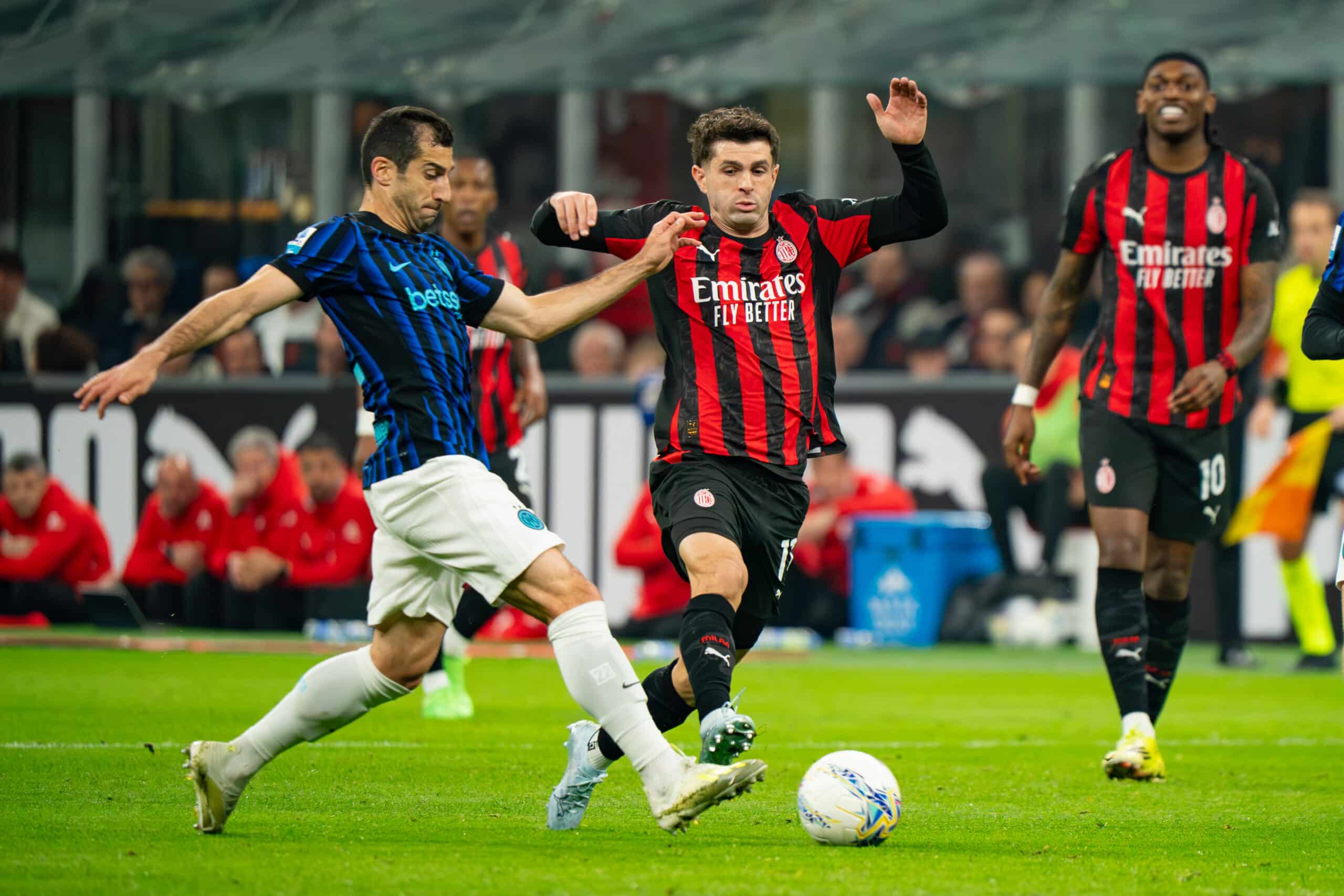

There are few better places to be in world football than San Siro when AC Milan are facing Inter. The two Milanese giants share the iconic stadium, making it a sight to behold on derby day. As two of the biggest clubs in Italy and Europe, this rivalry also stretches far beyond the borders of the city.
So, what is it that makes the Derby della Madonnina tick? In this article we have explored this famous rivalry from the very start up until the present day, looking at the events, narratives and individuals that made it what it is today.
Roots of the Rivalry
AC Milan were founded in 1899 by an English expat living in the city. His name was Herbert Kilpin, who played as an amateur in his hometown of Nottingham before he moved to Turin to work in the textile industry. Kilpin represented a team called Internazionale Torino in his first few years in Italy, before setting up Milan Foot-Ball and Cricket Club after he moved across to Milan.
It did not take long for AC Milan to make their mark. In 1900/01, only the second season of their existence, the club won the Italian Football Championship (which admittedly only contained five teams) and the Medaglia del Re, a cup competition. They were champions again in 1905/06 and 1906/07, but it would not be long until they faced competition from within their own city.
In 1908, a debate was raging within the club. AC Milan were founded as an expatriate club, but as football became more popular in the first decade of the 20th century, it increasingly became Italianised. Some club officials were happy with that direction of travel, while others wanted AC Milan to be open to all regardless of nationality.
The first group ultimately won the battle, but that was not the end of the affair. The disgruntled members who had pushed for a more inclusive approach left AC Milan and founded their own club, which they named Internazionale as a clear signal of their international outlook. In the 1908 Chiasso Cup, AC Milan and Inter met for the first time, with AC Milan winning 2-1.
However, over the next few years and decades it was the Nerazzurri who enjoyed more success. AC Milan did not win another league title until 1950/51, whereas Inter were crowned champions in 1909/10, 1919/20, 1929/30, 1937/38 and 1939/40. They also won the Coppa Italia in 1938/39, establishing themselves as the strongest team in Italy’s second city at that time.
Narratives and Characters
The 1960s was a defining period for the Derby della Madonninna, which is named after the Madonnina statue on top of the Milan Duomo. AC Milan won two Serie A titles during that decade, while Inter won three. Meanwhile, both teams won the European Cup twice in the 1960s, when Milan was arguably the leading centre of football on the continent.
This period featured four major characters who helped to build the rivalry between the pair. Two were managers: Nereo Rocco for AC Milan and Helenio Herrera for Inter. Two were players: Gianni Rivera for AC Milan and Sandro Mazzola for Inter.
Both Rocco and Herrera were associated with catenaccio, a defensive style of play. Rocco was one of its first proponents, but the style reached its peak under Herrera at Inter. On the field, Rivera and Mazzola were both wonderful players who dazzled crowds at San Siro and beyond.
Other individuals have played huge roles in the Derby della Madonnina. In the 1980s, Giuseppe Bergomi was the heartbeat of Inter and Franco Baresi was AC Milan’s leader. Both were legendary defenders and one-club men who racked up almost 1,500 collective appearances for the two teams. Later, Javier Zanetti (Inter) and Paolo Maldini (AC Milan) played similar roles.
In the 1980s and 1990s, football became increasingly globalised. As Serie A was the world’s strongest league at that time, it attracted many overseas stars. AC Milan had a strong Dutch contingent represented by Marco van Basten, Ruud Gullit and Frank Rijkaard. Inter employed several prominent Germans, such as Lothar Matthaus, Jurgen Klinsmann and Andreas Brehme.
The rivalry between the Netherlands and West Germany national teams was particularly strong at that point, so the Dutch-German dynamic lent the AC Milan vs Inter derby a more international flavour.
Fan Culture
In the early days of the rivalry, Inter were seen as the team of the Milanese middle-class, with AC Milan representing some working-class communities within the city. Inter became associated with the motoretta, because their fans were considered rich enough to get to San Siro on motorbikes. AC Milan supporters, who tended to get to the stadium by tram, were known as the tranvee.
There is no such economic dimension to the rivalry today. The derby is not particularly based on geography either, which stands in contrast to rivalries such as Boca Juniors vs River Plate in Argentina, where fans of either side tend to be drawn from distinct neighbourhoods in Buenos Aires.
The only spatial distinction between the two sets of supporters is within San Siro itself. Inter’s ultras congregate on the Curva Nord, the north side of the stadium, while AC Milan’s most hardcore fans gather on the Curva Sud to the south. On derby day, San Siro is awash with flares, flags and banners, making it one of the most colourful and vibrant derbies in Europe.
Ever since their creation, AC Milan have worn red and black shirts. It was a decision taken by Kilpin himself, who famously said: “We will be a team of devils. Our colours will be red like fire and black like the fear we will invoke in our opponents.”
Giorgio Muggiani, the principal founder of Inter, had his own reasons for choosing the club’s famous blue and black jerseys: “This wonderful night will give us the colours of our crest: black and blue against a backdrop of stars. It shall be called Internazionale, because we are brothers of the world.”
Defining Derby Moments
There have been eight seasons where AC Milan and Inter have finished first or second in Serie A, or vice versa. In 1950/51, AC Milan finished a point clear of Inter in the title race, so their 1-0 victory over their rivals in March was decisive. The boot was on the other foot in 1964/65, when Inter beat AC Milan 5-2 on their way to the scudetto.
In 2010/11, AC Milan did the double over Inter and won the league by six points. Had Inter won those two derbies instead, they would have been champions. In 2021/22, AC Milan finished two points above their chief adversaries, so a 2-1 victory over Inter in February was arguably the moment the title was decided.
There has only been one meeting between the pair in the Coppa Italia final. That came in 1977, when AC Milan won 2-0 to get their hands on the prize. That was the last trophy Nereo Rocco won in his fourth and final spell in charge of the Rossoneri.
Perhaps the three most famous editions of the derby came in Europe. AC Milan beat Inter in the semi-finals of the Champions League in 2002/03, then repeated the feat in the quarter finals of 2004/05. However, Inter eventually got their revenge when they defeated AC Milan in the last four in 2022/23.
The Rivalry Today
AC Milan and Inter are two of the most successful clubs in Italian football. As of 2026, Juventus have won a record 36 titles, with Inter on 20 and AC Milan on 19. Both teams have finished as runners-up on 17 occasions, second only to Juventus with 21 second-place finishes.
Juventus have also tasted success the most times in the Coppa Italia, but Inter are joint-second on nine, with AC Milan a little further down the list on five. On the European scene, the Milanese giants have outperformed even Juve. AC Milan are seven-time continental champions, second only to Real Madrid. Inter have lifted the famous trophy on three occasions.
The rivalry between AC Milan and Inter is as strong today as it has ever been. It helps that matches between the pair are often entertaining, which stands in contrast to several other derbies where the tension and anxiety seems to influence the quality of football on display.
At the time of writing, Inter have the edge on the overall head-to-head record. They have won 85 editions of the Derby della Madonnina compared to 76 victories for AC Milan. Inter have scored 311 goals and AC Milan have scored 297.