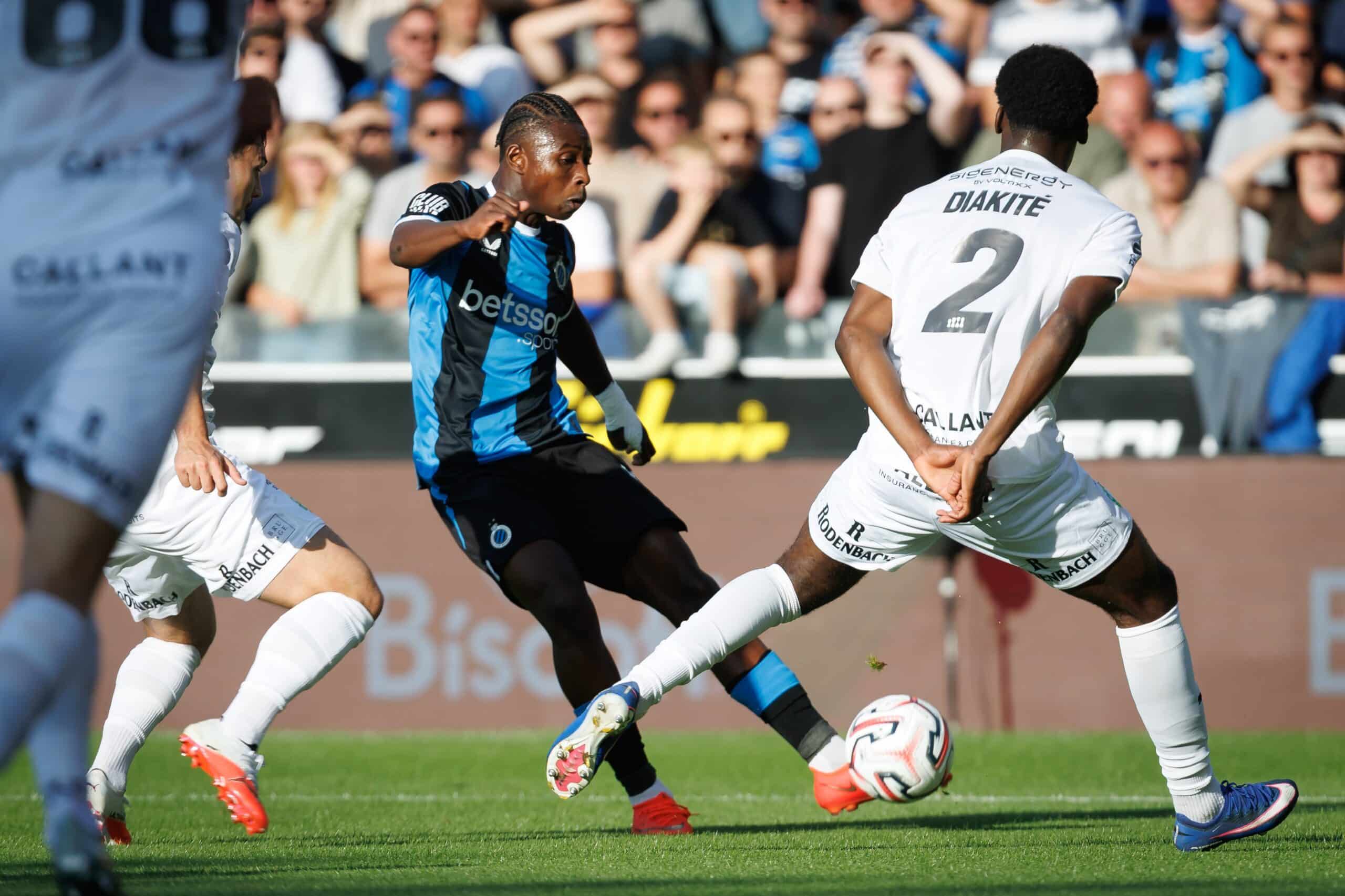

Belgium is not a footballing powerhouse in the way England, Spain and Italy are, but its relatively small size and population should not be mistaken for a lack of passion. Anyone who has ever attended a game between Cercle Brugge and Club Brugge knows that football is not merely a form of entertainment in this part of the Low Countries.
In this article we will take a deep dive into the Cercle Brugge-Club Brugge rivalry, tracing the derby from its origin story right through to the present day. These two clubs may share a city, but from the very start the differences between them were obvious…
Roots of the Rivalry
Having been formally established in England in 1863, football came to Belgium in the years that followed.
As was the case in much of Europe, British expatriates played a big role in the game taking off. Living away from home, these Brits formed sports clubs to keep them occupied on the weekends. Football was not the only sport played, but it was the one which drew the most interest from the local population.
In 1880, Royal Antwerp became the country’s first football club. Club Brugge followed a year later, with RFC Liege, Union Saint-Gilloise and Standard Liege all formed soon after. In 1899, just before the turn of the century, Club Brugge were joined by another club from the city, Cercle Brugge.
There was a key distinction between the pair from the off. Many early Belgian clubs were formed through the education system, with former pupils from the same school joining together to establish formal football teams after graduation.
Club Brugge was set up by individuals from several different state schools who came together because they shared a liberal, secular ideology. On the other hand, Cercle Brugge’s founders had ties to Catholic institutions, giving them a religious affiliation which was absent in the case of Club Brugge.
The first edition of the derby was in the 1899/00 season, shortly after Cercle Brugge came into being. Unfortunately, we do not know anything about the game today - the names of the players, where it took place or even the result. Belgian footballing archivists were conspicuous by their absence early on.
We do know that, in 1900/01, the two teams played out a 0-0 draw in November, which was followed by a 2-2 draw in the return fixture. Cercle Brugge went on to win five derbies in a row thereafter, but Club Brugge’s maiden success was worth the wait as they ran out 5-0 winners in 1904. Just five years after Cercle Brugge’s arrival on the scene, there was genuine spice in this derby.
Narratives and Characters
In 1919/20, the first season back after the First World War, Club Brugge became champions for the first time. Fast forward a decade and Cercle Brugge were on top. They won the title in 1927 and 1930; together with their earlier triumph of 1911, that put them two clear of Club Brugge.
The latter only claimed their second league title in 1973, before they finally pulled level with Cercle Brugge in 1976. Since then this has been a one-sided rivalry, with Club Brugge regularly winning silverware and Cercle Brugge barely doing so at all.
Cercle Brugge more than held their own early on, though, and matches between the two sides were hard-fought from the beginning. In 1907, Raoul Daufresne de La Chevalerie - a Cercle Brugge player and future Commander-in-Chief of the Free Belgian Forces - caused a stir when he crossed the divide to join Club Brugge. The strong reaction from everyone associated with Cercle Brugge showed how seriously the rivalry was taken.
In the 1950s, Robert Somers was a Club Brugge stalwart. He also had brothers who had belonged to the club at one point or another. Imagine the shock, then, when one of his siblings moved to Cercle Brugge.
Cercle Brugge actively took steps to avoid losing players to their local rivals. In the middle of the 20th century, Cercle Brugge retained links with Xaverian Brothers, a Catholic teaching institution.
These schools had sports departments which fed players into the Cercle Brugge system. At one point Cercle Brugge were so worried about Club Brugge capturing their young talents that they made an agreement with Xaverian Brothers, compelling young players from their schools to remain part of the Cercle Brugge network.
Fan Culture
Brugge is one of the most picturesque cities in Europe. The canals, cobblestones and churches have enchanted tourists for decades, with others drawn in by the offerings of world-class beer, waffles and chocolate.
Most foreign visitors do not leave the well-preserved, historic centre of the city. The UNESCO heritage parts are highly walkable, giving the impression that Brugge is a small place, but the real, live-in city extends far beyond its medieval core. Around 20,000 people live in the centre of Brugge, compared to 100,000 elsewhere in the city.
Appearances can be deceiving, and after wandering through the pretty streets of the centre, some may be surprised to learn that Brugge has a strong working-class core. Initially, these working-class groups tended to support Club Brugge, who drew support from the Flemish community as well as low-income members of society, earning themselves the nickname the ‘Farmers’.
Cercle Brugge, conversely, were associated with the middle classes and the Catholic bourgeois. In contrast to the farmers across the city, Cercle Brugge were known as the ‘Snobs’. These identities are no longer so relevant, but both Club Brugge and Cercle Brugge are proud of their respective origin stories.
Since 1975 Club Brugge and Cercle Brugge have shared the Jan Breydel Stadium, which is named after a local revolutionary who led a violent uprising against Philip the Fair, the King of France.
While Club Brugge today draws fans from every region across Belgium, Cercle Brugge supporters like to claim that they are the true club of the city.
Defining Derby Moments
It is easy to imagine footballers in the 1920s as well-behaved gentlemen, but that was not necessarily the case. In 1925, a game between Club Brugge and Cercle Brugge descended into anarchy when the two sets of players started fighting each other on a muddy, snowy pitch.
There was another bout of violence in a much more recent Brugge derby. In 2025, Club Brugge beat Cercle Brugge 3-1. After the game, Club Brugge's Ardon Jashari attempted to plant a club flag in the centre circle, sparking a brawl involving players from both sides.
It is often said that football is the most important of the least important things in life, and in times of genuine difficulty Club Brugge and Cercle Brugge have come together. In 1923, a mixed Cercle/Club team played a fundraising charity match against a garrison based in Brugge to raise money for the victims of a Japanese earthquake that year.
Three years later, when Brugge itself was hit with major floods, Club Brugge and Cercle Brugge again joined forces to raise money for the victims.
The Rivalry Today
The Cercle Brugge vs Club Brugge derby has changed considerably in the modern era. Cercle Brugge had the upper hand at times in the early days, but for a long time now this has not been a meeting of equals.
Club Brugge are a Belgian powerhouse. Regulars in the Champions League in recent years, they have won 19 league titles, 12 cups and 18 Super Cups. They have reached the final of both the European Cup and the UEFA Cup, and are one of the most well-known Belgian clubs across the continent and the wider world.
Cercle Brugge have not enjoyed as much success as their rivals from across the city. They have been in and out of the top division in recent times, and even when they have been part of the top flight, Cercle Brugge have struggled to climb much higher than mid-table. Whereas Club Brugge have scooped silverware on a regular basis, you have to go back to 1985 to find Cercle Brugge’s last major trophy, the Belgian Cup. They won their last top-flight title in 1930.
The fixture Club Brugge fans look forward to most these days is the one against Anderlecht, with whom they have frequently competed for trophies and glory. Anderlecht may not be based in the same region as Club Brugge, but they are more capable than Cercle Brugge of giving them a tough game. Indeed, as of March 2026, Cercle had won just one of the last 21 derbies in the Belgian Pro League.
As two clubs from the same city, there will always be some form of rivalry between Club Brugge and Cercle Brugge. Right now, though, this derby has a big brother vs little brother dynamic, and it is difficult to see that changing any time soon.