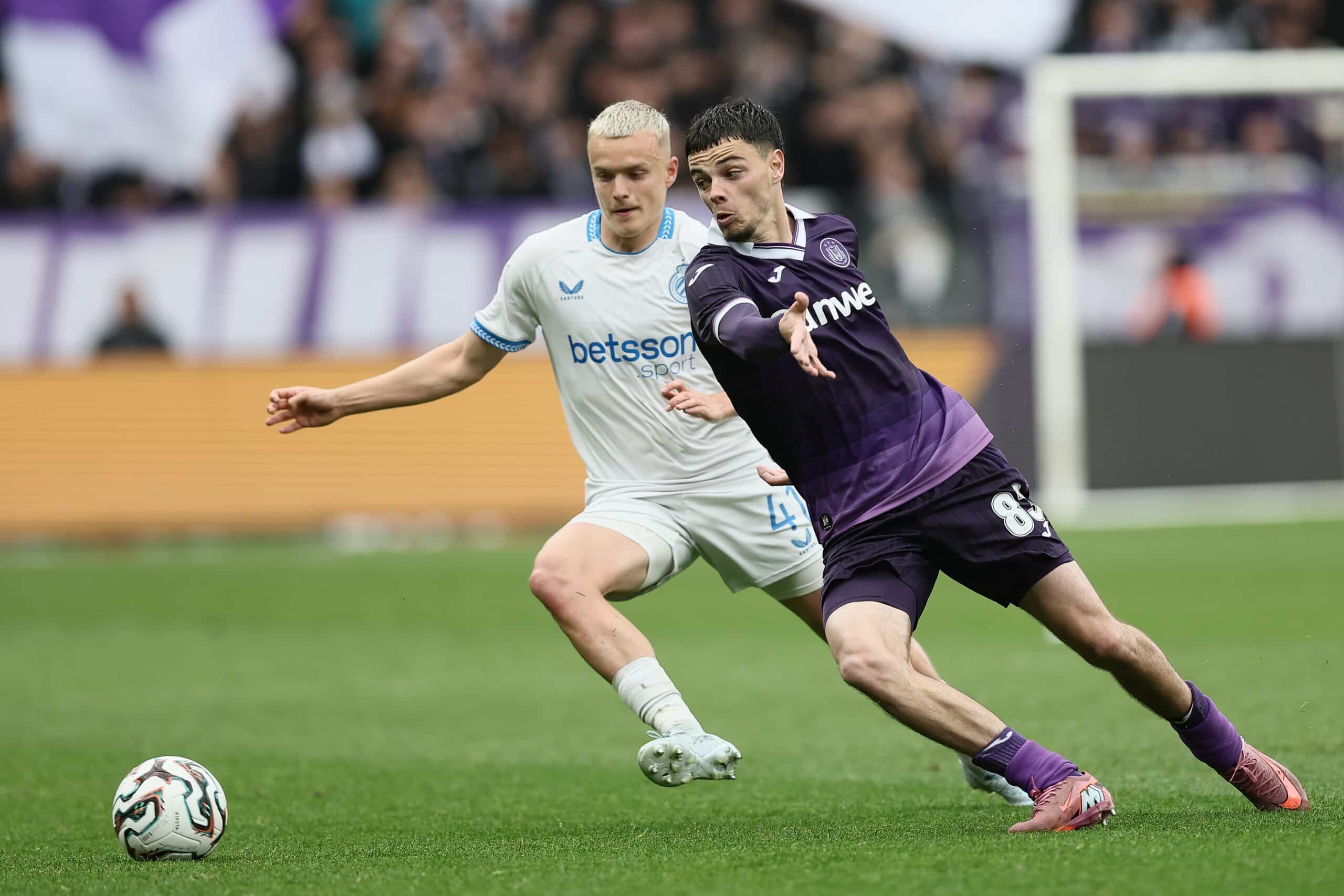

The two most successful clubs in the history of Belgian football are Club Brugge and Anderlecht, so it is always a special occasion whenever these two teams go head-to-head. Their status as Belgium’s two main powers naturally breeds competition between the pair, but there is more to the rivalry than a shared desire for silverware.
In this article we have explored the history of Club Brugge vs Anderlecht, focusing on the origin stories of both teams, as well as picking out significant individuals and analysing key battles from years gone by.
Roots of the Rivalry
Club Brugge were founded in 1891 by a group of students from various state schools in the area, as was common among the first football clubs in Belgium. In contrast to local rivals Cercle Brugge, who had a strong Catholic identity in their early years, Club Brugge had a liberal and secular outlook.
Anderlecht were formed in 1908 as a club to represent the municipality of the same name within the Brussels-Capital Region. It took Anderlecht until the 1921/22 season to reach the top flight of Belgian football, where Club Brugge (then known as FC Brugge) had been competing for several years. Club Brugge won the title in 1919/20, before dropping down to fourth the following year.
The first league meeting between the two clubs took place on the opening weekend of that 1921/22 campaign, with Club Brugge and Anderlecht drawing 1-1. On that September afternoon, no one could have guessed what the rivalry would become decades later.
Indeed, it would take many years before Club Brugge vs Anderlecht was considered a grudge match by the two teams involved. For one, each side had more local rivalries to concern themselves with. For Club Brugge, that was Cercle Brugge from the same city, and Gent from the same region. For Anderlecht, it was Union Saint-Gilloise, Daring Club and RRC Brussels from Brussels.
Another reason why this was a slow-burning conflict is that neither Club Brugge nor Anderlecht won much until after the Second World War. Anderlecht became a major force from 1946 onwards, winning 14 league titles between that year and 1968, but it took another couple of decades or so before Club Brugge were regularly competing for trophies.
For a long time, Club Brugge and Anderlecht did not really share the same objectives, so there was nothing particularly special about their meetings.
Narratives and Characters
The enmity between these two clubs began to be ramped up in the 1970s. Club Brugge won the Belgian Cup in 1968 and 1970, announcing themselves as new contenders for the biggest prizes. That was a direct challenge to Anderlecht, who had won no fewer than six league titles in the previous decade.
Pierre Sinibaldi was the manager who made Anderlecht the most feared team in Belgium in the 1960s, but his second spell at the club ended in 1971, after which several different coaches won trophies at the Constant Vanden Stock Stadium. The most significant of those was Raymond Goethals, who won the Cup Winners’ Cup and two UEFA Super Cups as Anderlecht boss.
The face of the team throughout the era was Paul Van Himst, a prolific forward who scored 309 goals in 566 appearances for Anderlecht. Needless to say, his success for the Mauves made him public enemy number one at Club Brugge.
The equivalent figure for Club Brugge was Raoul Lambert, a one-club man who scored 224 goals in 399 outings for his hometown team. As well as competing for collective prizes, Van Himst and Lambert spent much of the 1960s and 1970s battling with each other to be the Belgian league’s top scorer.
Ernst Happel is Club Brugge’s greatest ever manager. The Austrian won three league titles with the Blue and Blacks, while also leading them to the final of both the European Cup and the UEFA Cup, giving Club Brugge continental pedigree for the first time.
A rare figure who enjoyed success on both sides of the divide is Hugo Broos. He played for both clubs, albeit for longer and with more success at Anderlecht, and managed them both too (this time winning more at Club Brugge).
Fan Culture
Brugge is located in Flanders and is therefore a Flemish-speaking city. Club Brugge, as you would expect, are a Flemish-oriented club. That does not mean they do not have any French-speaking supporters, but Club Brugge’s links to the Dutch language are firmly established.
Anderlecht’s identity is more complex. Despite being surrounded by Flanders, Brussels is a primarily French-speaking city. Yet according to a poll from RTL, more than two-thirds of Anderlecht’s season-ticket holders speak Dutch. As a result of this mix among their supporters, Anderlecht are a bilingual club. Attend a match at the Constant Vanden Stock Stadium and you will hear fans chanting in Dutch, French and English.
Whereas Anderlecht are seen as a more national club, Club Brugge are tied to West Flanders (they too have fans right across the country, but are not as well represented in every region as Anderlecht). Anderlecht supporters often mock Club Brugge fans as “farmers” or “peasants” due to the association of West Flanders with agriculture. In response, Club Brugge supporters promote their own working-class identity and dismiss Anderlecht followers as aloof and arrogant. It is a classic province vs capital, local vs cosmopolitan split.
Defining Derby Moments
One of the moments that gave this rivalry lift-off took place in 1973, when Club Brugge became champions at Anderlecht’s stadium. A 1-1 draw was sufficient for Leo Canjels’ team to get over the line, giving Club Brugge their first championship for 53 years. From there, they went from strength to strength.
Four years later, Club Brugge beat Anderlecht in the Belgian Cup final. Anderlecht stormed into a 2-0 lead and appeared to have one hand on the trophy, but Club Brugge mounted a spirited comeback and triumphed 4-3. It remains one of the greatest Belgian domestic matches of all time. Club Brugge also beat Anderlecht in the cup finals of 2015 and 2025, with Anderlecht defeating their rivals in the final of 1994.
One of the most momentous meetings between Club Brugge and Anderlecht occurred in 1986. The two teams finished level on points at the top of the table, so a play-off was held to decide who the champions would be. The first leg was a 1-1 draw at Anderlecht’s stadium, before Club Brugge hosted a 2-2 draw a few days later. That made Anderlecht victorious on away goals.
End-of-season play-offs were introduced as standard in 2009/10. Anderlecht, who had topped the table in the regular campaign, sealed the title with a 2-1 victory over Club Brugge. In 2011/12, Anderlecht were also crowned champions after a game against Club Brugge.
The boot was on the other foot in 2015/16 and 2020/21. A convincing 4-0 triumph over Anderlecht in the former season won Club Brugge the title. Five years later, Club Brugge again secured the crown against Anderlecht, this time courtesy of a 1-1 draw.
The evidence of the last few years suggests it will not be long before Anderlecht and Club Brugge contest another season-defining game in either the league or the cup.
The Rivalry Today
Club Brugge vs Anderlecht remains one of the biggest fixtures in Belgian football. Cercle Brugge have not consistently competed at the same level as Club Brugge for a long time now, so that rivalry has a big brother vs little brother dynamic which reduces some of the ferocity.
There is still plenty of hostility in the air whenever Anderlecht face Standard Liege, but the latter have not won the title since 2009, and have finished top of the league just twice since 1983. As such, games between the pair rarely influence the destination of major trophies.
Conversely, Club Brugge and Anderlecht are the two most successful sides in the history of the Belgian game, and both have won multiple titles in the 21st century. Club Brugge have been more successful in recent times, but Anderlecht are more than capable of giving them a tough game on a regular basis.
In the last 14 Belgian Pro League campaigns, Anderlecht and Club Brugge have won a combined 10 championships. Even if that changes and other sides emerge as major forces within the Belgian game, there is more than enough historic animosity for this rivalry to endure.