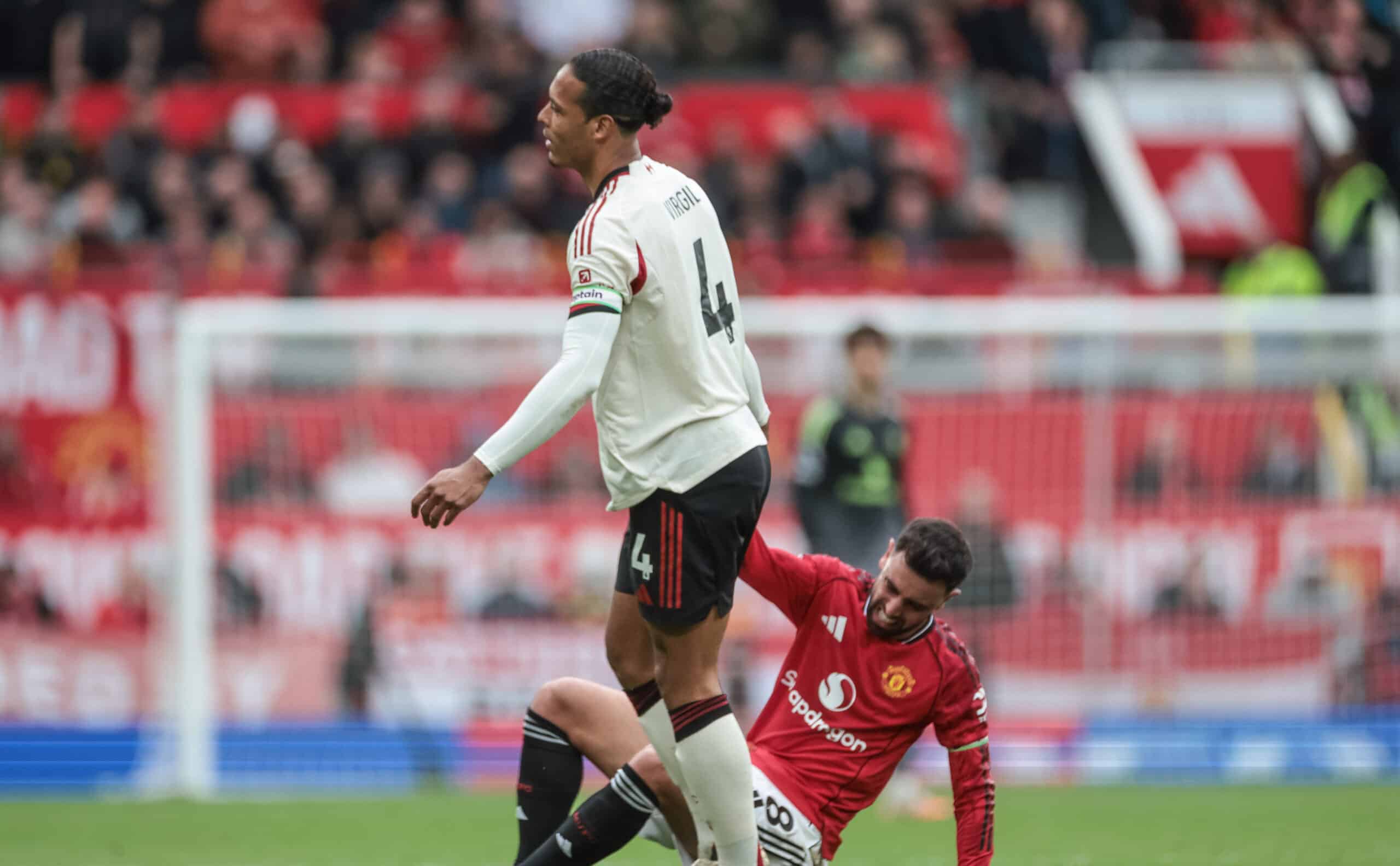

In recent years, we have heard plenty of talk about a ‘big six’ in English football comprising Manchester United, Chelsea, Arsenal, Liverpool, Tottenham Hotspur and Manchester City. This is not a historic term, however. Consider a period in the late 1980s, when a so-called ‘big five’ - Arsenal, Everton, Liverpool, Manchester United and Tottenham - pushed for a breakaway competition that would become the Premier League.
As you will have noticed, Arsenal, Manchester United and Liverpool belonged to both groups. Of that trio, the latter two are the biggest clubs in the English game, a fact with which even Arsenal supporters would not argue. In this article we have taken a deeper look at the rivalry between Manchester United and Liverpool, the two giants of English football.
Roots of the Rivalry
Manchester United were founded in 1878 under the name Newton Heath LYR Football Club. They were essentially a railway team in their first few years, with LYR standing for Lancashire and Yorkshire Railway. In 1902, the club was saved from possible bankruptcy by local businessmen who proceeded to change the name to Manchester United.
Liverpool were 10 years old by then. The club was founded in 1892 after a dispute between Everton and John Houlding, the man who owned the Anfield stadium. The famous ground was Everton’s home originally, but when the Toffees moved to Goodison Park, Houlding created Liverpool FC to play at Anfield.
It is worth pointing out that there has long been a rivalry between Manchester and Liverpool, the two biggest cities in the northwest of England. There are just 56 kilometres between the two cities, so a degree of competition throughout history was inevitable. Both were economically important: Manchester was the home of the Industrial Revolution, while Liverpool emerged as a major trading seaport in the late 1800s.
The most significant source of tension between the two places was the construction of the Manchester Ship Canal, which opened in 1894. The canal was opposed by officials in Liverpool because it would allow ships carrying goods from Manchester to bypass Liverpool’s docks, thus taking away a substantial source of revenue for the city.
Both economically and otherwise, Manchester and Liverpool have both claimed to be the region’s capital. As the biggest football clubs from the two cities, Manchester United and Liverpool were always likely to form a major rivalry.
Narratives and Characters
Manchester United and Liverpool are the two most successful clubs in English football history. As of March 2026, they have each won the top-flight title a joint-high 20 times. To illustrate the pair’s dominance, consider that clubs from London have only won 21 titles between them since the Football League’s creation in 1888.
Liverpool have won the Champions League six times compared to three successes for Manchester United, and they have triumphed in the EFL Cup on 10 occasions compared to six for United. Meanwhile, United have 13 FA Cups in their collection and Liverpool have eight in theirs.
Liverpool were the leading force in English football in the 1970s and 1980s, during which time they won 10 of their 20 titles. United reigned supreme in the 1990s and 2000s, two decades which saw them crowned champions 11 times.
In total, 13 of United’s league titles came under the leadership of Alex Ferguson, one of the greatest managers of all time. Ferguson once said that his main task as United boss was to “knock Liverpool off their f***ing perch”. It is fair to say he achieved that come the end of his reign.
The most important manager in Liverpool’s history was not the most successful in terms of league titles won, yet Bill Shankly was the man who transformed the club’s identity. Bob Paisley, who had previously worked as Shankly’s assistant, built on his predecessor’s foundational work.
Both clubs have provided a home to several world-class players down the years. Liverpool’s alumni include Kenny Dalglish, Ian Rush, John Barnes, Graeme Souness, Steven Gerrard, Mohamed Salah and Virgil van Dijk. Over at Old Trafford, Bobby Charlton, George Best, Denis Law, Roy Keane, Wayne Rooney, Paul Scholes and Cristiano Ronaldo are some of United’s greatest legends.
Fan Culture
Liverpool and Manchester United have global fan bases which have grown larger as the Premier League has become increasingly popular around the globe over the last few years. Yet despite having supporters from Buenos Aires to Beijing and Mumbai to Melbourne, Liverpool and United are both still rooted in the cities they call home.
Liverpool’s local identity is particularly strong. The club has a strong working-class spirit which mirrors the city’s own affiliation. There is an emotional intensity to Liverpool’s support, noticeable to anyone who has ever watched a game at Anfield. Liverpool FC has long been a vehicle for civic pride on Merseyside.
Similarly, Manchester United is rooted in a sense of place. Manchester was the first modern industrial city, powered by the confidence and ambition of its inhabitants. Those two qualities are reflected in United, which likes to present itself as a swaggering symbol of northern power.
Both cities lean left politically. Liverpool as a city has long connections with socialism and the club is not exempt from that. Working-class solidarity is a key feature of the Liverpool fan base, as is distrust of authority and the government based in London. Liverpool supporters earned respect and admiration from football fans everywhere for their tireless campaigns for justice after the Hillsborough disaster of 1989.
Tragedy has also shaped United’s identity. The 1958 Munich air disaster is still formally remembered every year at Old Trafford. The fans still sing about the team that was wiped out in that incident in 2026. It is impossible to truly understand United without knowing the significance of Munich.
Defining Derby Moments
Although Liverpool and Manchester United have won a combined 40 league titles, there have not been many occasions when the pair have been in direct competition for the prize. That is somewhat surprising, especially if you compare the situation in England to that of Spain, where Real Madrid and Barcelona routinely finish in the top two of La Liga.
Indeed, Liverpool and United have finished first and second (or second and first) in just five campaigns: 1946/47, 1963/64, 1979/80, 1987/88 and 2008/09. United were in the doldrums for much of the 1970s and 1980s when Liverpool were on top, and vice versa in the 1990s and 2000s.
That does not mean there have not been defining derby moments. The first was way back in 1894, when Liverpool faced Manchester United in a one-off game to determine which team would be given First Division membership for the following season. Liverpool won 2-0.
The rivals locked horns in the 1977 FA Cup final, as United ruined Liverpool’s hopes of a treble with a 2-1 victory at Wembley Stadium. Liverpool had their revenge in the final of the League Cup six years later, triumphing 2-1 to claim the trophy.
The most memorable meeting between the two teams in the modern era came in 2009. With both teams gunning for the title, Liverpool arrived at Old Trafford knowing a defeat would leave United in pole position to finish top. The Reds delivered a stunning performance to win 4-1, but it was ultimately in vain as United held on to first place.
The Rivalry Today
Even though Manchester United and Liverpool have not directly fought one another for too many trophies over the years, they are undoubtedly the two most successful sides in English football.
That alone would be enough to sustain a rivalry for the foreseeable future, but the established animosity between the two fan bases together with the close proximity of the two cities, makes it hard to imagine a world where this is not the biggest fixture in the Premier League calendar.
“You've got the two most successful clubs in the country, and the rivalry is huge because of how close the clubs are and all the battles we've had over the years,” said former Liverpool captain Steven Gerrard. “If you ask any fan or player to pick a game they'd like to win, you look for United.”
Alex Ferguson felt similarly: “To me, Liverpool will always be the derby game, just because of the history. When I came down here [from Scotland], they were the kingpins of England. My aim was to try and turn that round. It’s hard for me to go against history.”