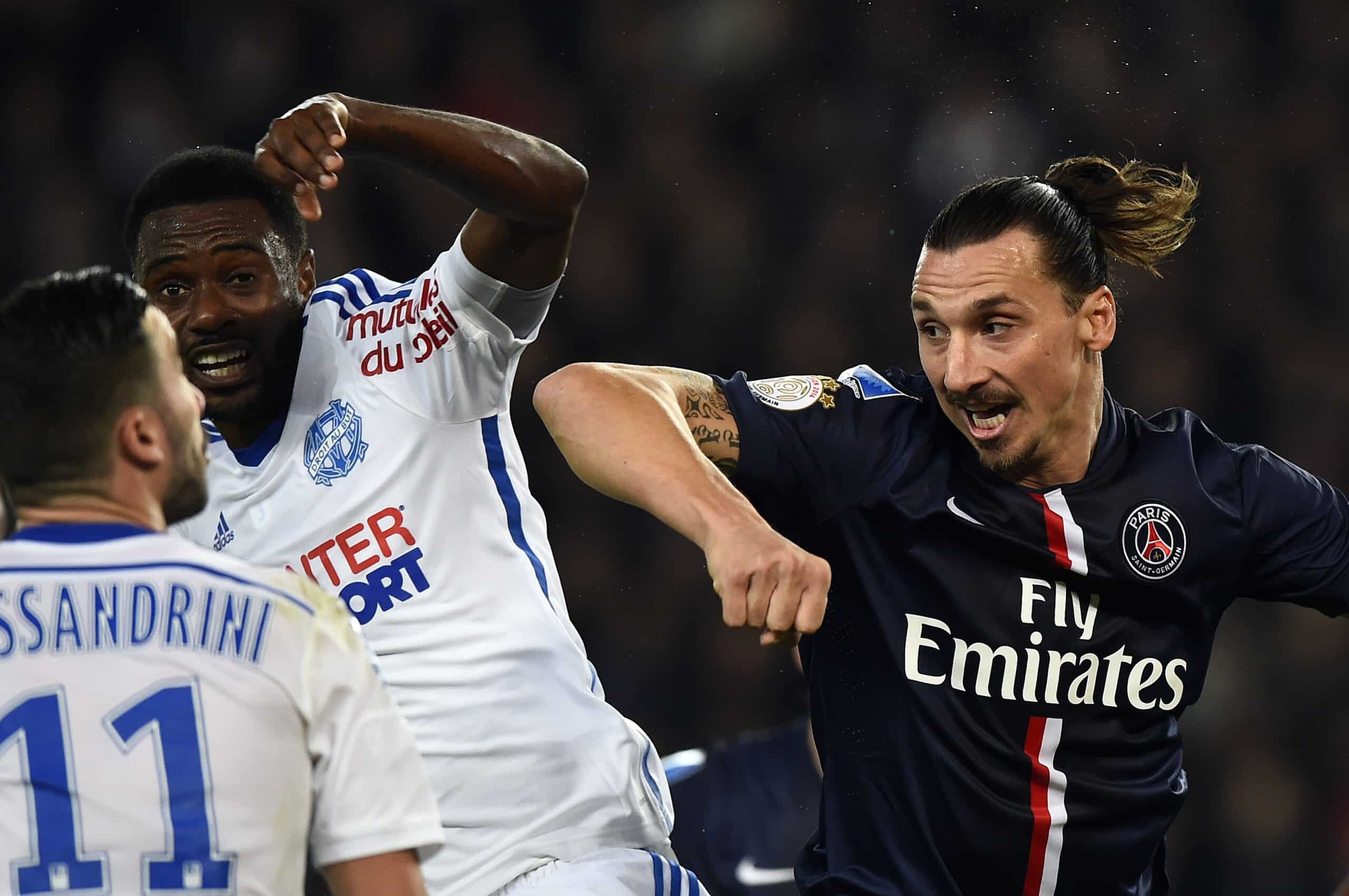

If you only watch one fixture in French football, make it Paris Saint-Germain vs Marseille. This is not only the biggest rivalry in Ligue 1; it is one of the most fascinating in the European game. PSG and Marseille are two of the most successful sides in France, but the shared animosity between the pair runs much deeper than the latest set of on-field results.
In this article we have taken a deeper dive into the derby known in France as Le Classique. We have considered the roots of the rivalry, examined some of the main narratives and characters involved, and looked at the major moments that defined this vibrant and passionate derby.
Roots of the Rivalry
Olympique de Marseille was founded in 1892 as a multisport organisation, although the football team’s official birth date is 31 August 1899. Marseille initially competed in local leagues and tournaments, before joining the French championship in 1904.
It took until the 1920s before Marseille made themselves a major force. The south coast side won three Coupes de France during that decade, as well as claiming their first league title. In 1937, Marseille won their first championship since French football’s professionalisation.
What about Paris Saint-Germain during this time? The answer is: nothing. Despite now being one of Europe’s biggest names, PSG did not exist until 1970. That makes the club several decades younger than most of the teams it currently competes against in Ligue 1 and the Champions League.
PSG was formed in 1970 as a merger of two existing clubs, Paris FC and Stade Saint-Germain. This action was taken to try and improve the state of football in the capital city. By the late 1960s, there were no teams from Paris in France’s top flight. The French Football Federation believed this was detrimental to the game within the country as a whole, so they helped to create the new PSG.
In their first ever season, PSG won promotion from Ligue 2 to Ligue 1. That same year, Marseille were crowned French champions. They retained the title the following year, just as PSG were relegated straight back to the second division. In the early days, then, there was no doubt about Marseille and PSG’s respective places in the pecking order of French football.
Narratives and Characters
PSG and Marseille have provided a home to numerous world-class footballers down the years, but arguably the two most significant figures in the rivalry never kicked a ball professionally: Bernard Tapie, the larger-than-life president of Marseille, and Andre Rousselet, a media titan whose Canal+ organisation owned PSG.
Indeed, the reasons for the rivalry between the two clubs are top-down as well as bottom-up. In the 1980s, key figures within French football felt the country lacked a heavyweight derby between two major clubs. There was no real equivalent to Manchester United vs Liverpool or Real Madrid vs Barcelona in France.
Tapie, a Paris-born businessman who became president of Marseille in 1986, was among those who felt that way. His eight-year tenure at OM was eventful to say the least. Tapie made Marseille into French football’s dominant force, spending huge sums on players all while playing up the club’s identity as anti-establishment upstarts.
Marseille were hugely successful under his stewardship, winning four league titles and a Champions League, but it all came crashing down when the club was found to have fixed a Ligue 1 game against Valenciennes, in order that Marseille’s players could take things easy ahead of a European match.
Canal+, a French television channel, bought PSG in 1991. That meant the club’s owners had a direct interest in making Ligue 1 (for which it had the broadcasting rights) more attractive to consumers. The aforementioned Rousselet helped to promote Le Classique for this reason, with Tapie more than happy to accept his role as the villain of the piece.
Fan Culture
Like many of the fiercest rivalries across the world, Le Classique is about more than just football. Paris is France’s biggest city and Marseille is the second biggest, but there are more differences than similarities between the two.
Power in France is concentrated in Paris, the political, cultural and economic hub of the country. To Marseille fans, PSG represents Parisian elitism compared to their own club’s regional, working-class identity. Paris is a wealthy capital and one of the most famous places in the world. Marseille is a gritty port city, and its inhabitants have long seen themselves as outsiders fighting against the establishment, in football and elsewhere.
The Stade Velodrome, Marseille’s home ground, has one of the best atmospheres anywhere in Europe. Marseille fans are renowned for their passionate support of their club, and pride in the football team reflects pride in the city as a whole.
When they are facing PSG, Marseille portrays itself as representing ordinary, working-class citizens and the Mediterranean south more broadly. There is also a connection with countries like Morocco, Tunisia and Algeria, with Marseille home to a large North African diaspora.
PSG have their fair share of passionate supporters too, many of whom come from the working-class neighbourhoods that ring the city. This mixes with a more internationalised celebrity culture: the list of VIPs at a big PSG game tends to be more star-studded than most. Their supporters view Marseille as chaotic, provincial and simply not as important as Paris and PSG.
Defining Derby Moments
The first game between PSG and Marseille took place in December 1971. Marseille won 4-1 in front of around 19,000 fans at the Stade Velodrome, and they also went on to triumph in the return fixture in Paris, running out 2-1 winners in May 1972. Those two victories helped Marseille win the title that season.
The first major flashpoint came three years later when the two teams faced off in the last eight of the Coupe de France. After PSG fought back from 2-0 down to draw 2-2 in the first leg in Marseille, some home supporters committed violent acts, including smashing the windows of the PSG team bus. The Parisians won the second leg to reach the semis, after which Marseille duo Caju and Jairzinho assaulted the referee.
That was PSG’s first ever victory over Marseille, but they had to wait a while longer for their first league win. That did not arrive until January 1978, but it was worth the wait as PSG thrashed their rivals 5-1. The following year, they registered their maiden victory at the Stade Velodrome.
One of the most contentious incidents in Le Classique history took place in May 1988, when PSG won 2-1 to deny Marseille a place in Europe. Jean-Pierre Papin was through on goal for Marseille, only to pull up short when he heard a whistle. However, the sound did not come from the referee but rather from PSG defender Michel Bibard, who mimicked the sound of a whistle to distract Papin.
In May 1989, both Marseille and PSG were in contention for the Ligue 1 title. A draw would have kept PSG on track to win the league, and the score was still 0-0 in the closing stages. But in the first minute of second-half stoppage time, Franck Sauzee scored the winning goal for Marseille, who went on to win the title.
The Rivalry Today
PSG vs Marseille remains a great occasion within French football. Le Classique represents a culture clash between residents of the country’s two biggest cities, and you can feel the mutual animosity in the air when the two teams butt heads at the Stade Velodrome or the Parc des Princes.
However, this is no longer a meeting of equals on the pitch. Ever since PSG were bought by Qatar Sports Investments in 2011, this has been a lopsided rivalry. The Parisians have won all but three Ligue 1 titles since their new owners came on board, and in 2025 they became the first French club to win the Champions League since Marseille in 1993.
No one else is able to compete with PSG financially - and that includes Marseille. In the latest edition of the Deloitte Money League, PSG ranked fourth in European football for revenue after taking in €837m in 2024/25. No other Ligue 1 team was in the top 30.
As a consequence of their financial might, PSG do not lose to Marseille very often. At the time of writing, OM have won only two of the last 28 league games between the pair. Between October 2022 and October 2024, Marseille did not even manage to score a goal against their rivals in five Ligue 1 matches.
In some ways that has only increased Marseille fans' antipathy towards PSG, but unfortunately Le Classique seldom determines the destination of the French title.