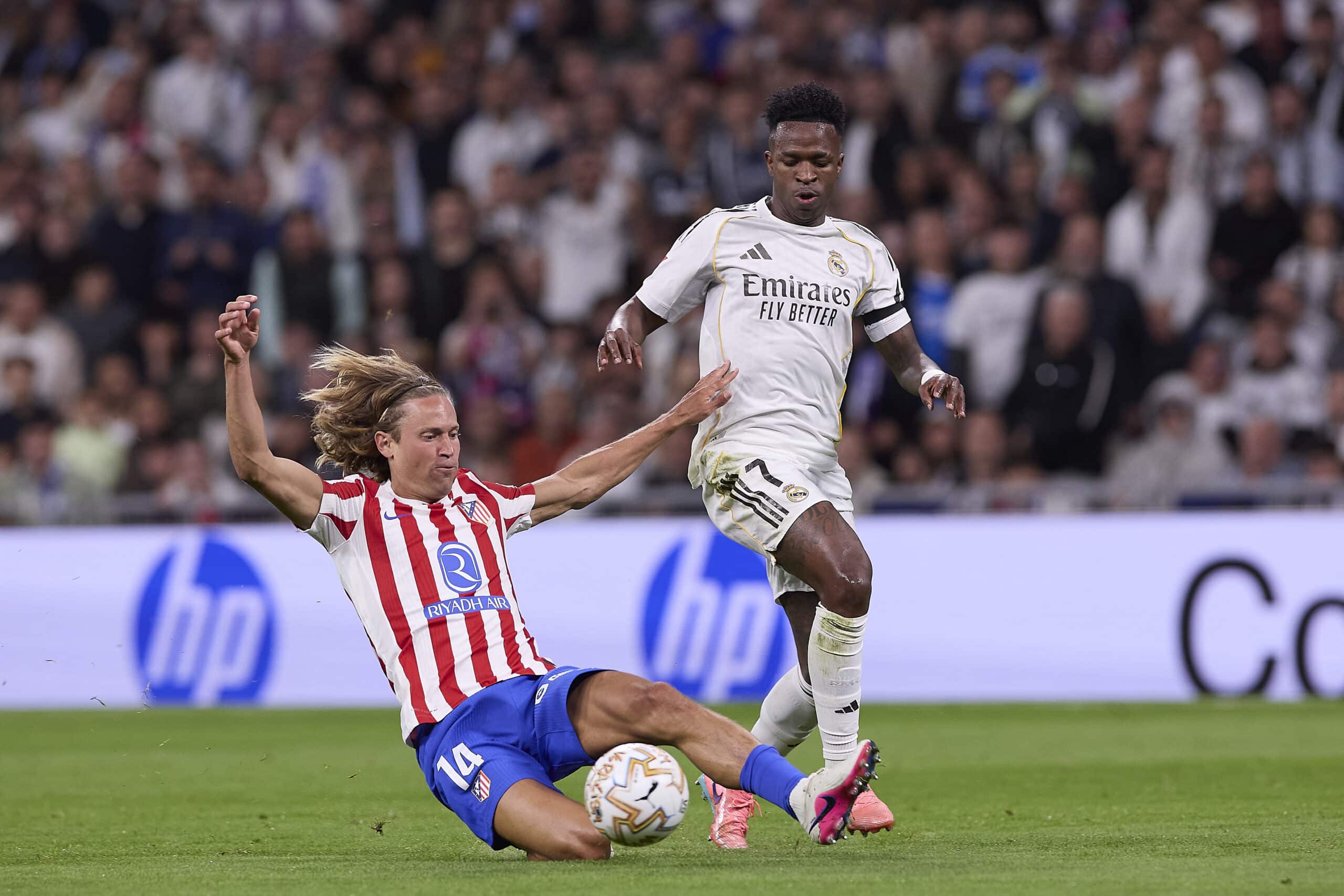

El Clasico, the rivalry between Real Madrid and Barcelona, is the biggest in world football. But Barcelona are not the only club with whom Real Madrid share mutual enmity. It sometimes gets overshadowed by the Clasico, but Real Madrid vs Atletico Madrid is also one of Europe’s most iconic grudge matches.
In this article, we have traced the rivalry right back to the very beginning, as well as looking at some of the key figures who made it what it is today. Here is everything you need to know about the Madrid derby.
Roots of the Rivalry
Real Madrid were founded in 1902 as Madrid Football Club. English expatriates brought the sport to Spain in the late 1800s, and it did not take long before it had caught on among locals. The founders of Madrid Football Club wanted their team to be open to everyone, no matter their class background or occupation. From the very start, Real Madrid wore an all-white kit.
Atletico Madrid traces its roots back to 1903. It was created as a branch of Athletic Club from Bilbao and was thus given the name Athletic Club Sucursal de Madrid. The club merged with Club Aviacion Nacional in 1939, and in 1949 it adopted the name Atletico Madrid. After initially playing in blue and white, Athletic Madrid changed their colours to red and white in 1910.
In 1905, Real Madrid won their first trophy in the form of the Spanish Cup, beating Athletic Bilbao in the final. In 1909 they joined the Royal Spanish Football Federation, while in 1920 they changed their name to Real Madrid. They took part in the inaugural edition of what would later become La Liga, finishing second in 1929 before winning the league in 1931/32 and 1932/33.
Athletic Madrid won a few regional tournaments in the 1920s, and they finished as runners-up in the cup in 1921. They too took part in the first ever edition of the Spanish league in 1929 and finished sixth out of 10. Athletic Madrid were relegated twice in the 1930s, although the Spanish Civil War interrupted football in 1936 and, when La Liga restarted, they were restored to the top flight.
Although Real Madrid were much more successful early on, Athletic Madrid were at least able to compete with them for the signing of talented local players due to the financial support they received from Athletic Club. This aid also helped Athletic Madrid to keep their stars despite overtures from Real Madrid.
Narratives and Characters
Throughout their history, Real Madrid have been defined by players more than managers. It is an identity which persists to the present day. Witness, for instance, how Xabi Alonso struggled to succeed as Real Madrid manager in 2025/26 because his hands-on approach to coaching did not fit the player-led environment at the club.
Any history of Real Madrid will therefore mention players before managers. Alfredo Di Stefano was the star of the team that dominated the early years of the European Cup. Cristiano Ronaldo was the main man during Madrid’s success in the 2010s. Ferenc Puskas, Raul Gonzalez and Zinedine Zidane also had huge roles to play at various points.
Two presidents have made a particularly significant mark on Real Madrid. The first was Santiago Bernabeu, after whom the club’s stadium is named. Bernabeu was Real Madrid’s president between 1943 and 1978, during which time they won 16 La Liga titles and six European Cups.
Florentino Perez had a mixed record as Real Madrid’s president between 2000 and 2006, but his second spell has contained much more glory. On his watch, the Blancos have won seven La Liga titles and seven Champions Leagues at the time of writing.
Atletico Madrid have had their share of legendary players. In the 21st century, Fernando Torres, Radamel Falcao, Koke and Antoine Griezmann all stand out for their contributions to the club. Going back further, the likes of Jose Eulogio Garate, Luis Pereira and Adelardo Rodriguez have a special place in the hearts of the supporters.
Two managers stand above the rest. Luis Aragones was an excellent player for Atletico Madrid, winning three La Liga titles and two Copas del Rey. He then led the club to one La Liga title and three Copas del Rey as a coach. In the modern era, Diego Simeone has won two La Liga crowns and two Europa Leagues as Atletico Madrid manager.
Fan Culture
As the two biggest clubs in Madrid, there was always going to be some sort of rivalry between Real Madrid and Atletico Madrid. But class identity, geography and even politics have also defined the derby down the years.
Starting with class. Real Madrid have long been seen as the club of the establishment, both within Madrid and Spain as a whole. In 1920, King Alfonso XIII bestowed the royal title on the club, which duly changed its name from Madrid FC to Real Madrid. With their galactico model of recruitment, the Blancos have an undeniable link to wealth.
Atletico Madrid, by contrast, have a reputation as the capital city’s underdogs and outsiders. They have traditionally drawn their support from working-class parts of Madrid. Whereas Real Madrid, as the biggest club in the world, have cultivated a global identity, Atletico Madrid have a stronger sense of place. For example, their crest features Madrid’s coat of arms, whereas Real Madrid’s contains nothing explicitly related to the city.
Real Madrid’s stadium is based in the Chamartin district of Madrid, which has historically been more affluent than other parts of the city. The centre of Atletico Madrid’s support base is in the south of Madrid in working-class neighbourhoods like Arganzuela and Carabanchel.
Atletico Madrid’s fans embrace their club’s underdog status. Although the Colchoneros have not won as much as their cross-city rivals, they see themselves as representatives of the real Madrid. Real Madrid supporters have much higher expectations of on-field success. A trophyless season at the Estadio Santiago Bernabeu is simply unacceptable for Real Madrid followers.
Defining Derby Moments
For most of Spanish football history, the Madrid derby has not been a meeting of equals. Just look at the two clubs’ respective honours lists.
Real Madrid have won 36 La Liga titles compared to 11 for Atletico Madrid. Real Madrid are 15-time European champions, whereas Atletico Madrid have never won that tournament. Real Madrid have 20 Copas del Rey to their name, with Atletico Madrid on 10 triumphs.
The head-to-head record is also in Real Madrid’s favour. As of April 2026, they have won 125 official derbies compared to 60 victories for Atletico Madrid. In La Liga, Real Madrid have beaten Atletico Madrid a whole 55 times more than vice versa. For the most part, this has been a one-sided rivalry.
However, that does not mean the rivalry has lacked meaningful moments. In 1992, Atletico Madrid beat Real Madrid 2-0 in the Copa del Rey final, humiliating their rivals in their own stadium. They did the exact same thing in the 2013 final, triumphing at the Bernabeu to end a painful 14-year winless streak against their rivals.
In Europe, Real Madrid have had the upper hand. Indeed, the two biggest games between Real Madrid and Atletico Madrid took place in continental competition, as the two teams locked horns in the 2014 and 2016 Champions League finals.
In 2014, Atletico Madrid led 1-0 until second-half stoppage time, when Sergio Ramos equalised for Real Madrid. The Blancos went on to win 4-1 after extra time. Two years later, Real Madrid defeated Atletico Madrid on penalties after a 1-1 draw.
The Rivalry Today
Real Madrid’s main rivalry is still with Barcelona and it is hard to see that ever changing. But over the last 15 years or so, the Madrid derby has grown more significant. That is primarily thanks to Diego Simeone, who has made Atletico a much more competitive adversary.
Of course, Real Madrid still enjoy a substantial financial advantage over Atletico Madrid, whose revenues will probably never reach the level of their neighbours’. But Simeone has guided Atletico to two La Liga titles during his tenure, as well as pushing Real Madrid close in two Champions League finals.
The head-to-head record has also been much more even since Simeone’s appointment. Since his first full season in 2011/12, Atletico Madrid have won seven and lost nine La Liga matches against Real Madrid, and there have been three victories each in the Copa del Rey. On and off the field, the Madrid derby is alive and well.