
Anyone with even a passing interest in football knows that Real Madrid vs Barcelona is a big deal. El Clasico is the rivalry to end all rivalries, a game which pits Spain’s two biggest clubs against each other at least twice a season. When Madrid and Barcelona butt heads, the whole footballing world is watching.
In this article we have traced the rivalry back to the very start, looking at the moments that made it into the global event it has become today. We have also picked out some of the most iconic matches between the pair, as well as looking at the players and coaches who had a major impact on El Clasico.
Roots of the Rivalry
Like all great rivalries, there is more than just football at play when it comes to Real Madrid vs Barcelona. Madrid have long been seen as the club of the Spanish establishment, a reputation which dates back to King Alfonso XIII’s decision to bestow the royal title on Madrid Football Club in 1920.
In a way, though, that status goes even further back. Madrid became the capital of Spain in 1561 when King Philip II moved his court from Toledo to Madrid. There was a brief period in the early 1600s when Valladolid became the seat of power, but since 1606 Madrid has continuously been Spain’s administrative centre. Once Real Madrid had become the city’s principal club, they were always likely to be viewed as the footballing representatives of the central elite.
Because of various geographical, historical and political factors, Spain is a highly regionalised country. Catalonia has an especially strong local identity, and by the 1920s Futbol Club Barcelona had started to embody a sense of Catalan patriotism which stood in opposition to the central power of Madrid and, by extension, Real Madrid.
This division was accelerated by the victory of General Francisco Franco in the Spanish Civil War. After Franco took charge in 1939, he restricted regional languages and forms of cultural expression in an attempt to create a singular Spanish identity which, in his eyes, would help to achieve his ultimate goal of centralising power in his own hands.
During the Franco dictatorship, Barcelona became one of the only outlets for displays of Catalan nationalism. There is no consensus on whether or not Franco actually supported Real Madrid, but his Spanish nationalist tendencies naturally drew him to an establishment club based in the capital, certainly more so than Barcelona.
Narratives and Characters
Two transfers loom large in the history of El Clasico. The first involved Alfredo Di Stefano, the best player in the world in his day. In the 1950s, Real Madrid and Barcelona both tried to sign him - and for a while, there was a major dispute over which club actually owned his rights.
Di Stefano had been playing for Millonarios in a breakaway Colombian league which was not affiliated to FIFA. In the eyes of the governing body, Di Stefano still belonged to River Plate, his previous club. In 1953, Barcelona made a deal with River to sign the attacker, but Madrid claimed their agreement with Millonarios was more relevant.
The Spanish Football Federation proposed a solution which would have seen Di Stefano play alternate seasons for Madrid and Barcelona over the next four years. But Barca rejected this suggestion, paving the way for Di Stefano to sign a full-time contract with Madrid. He went on to become one of their best ever players, winning eight La Liga titles and five European Cups in the Spanish capital. The saga was a foundational moment in the Real Madrid vs Barcelona rivalry.
The second contentious transfer occurred in 2000, when Madrid succeeded in an audacious attempt to sign Luis Figo directly from Barcelona. The Blancos met the €62m release clause in the winger’s contract, so Barca were obliged to let him go. When Figo returned to the Camp Nou for the first time as a Madrid player, a Barcelona fan memorably threw a pig’s head towards him.
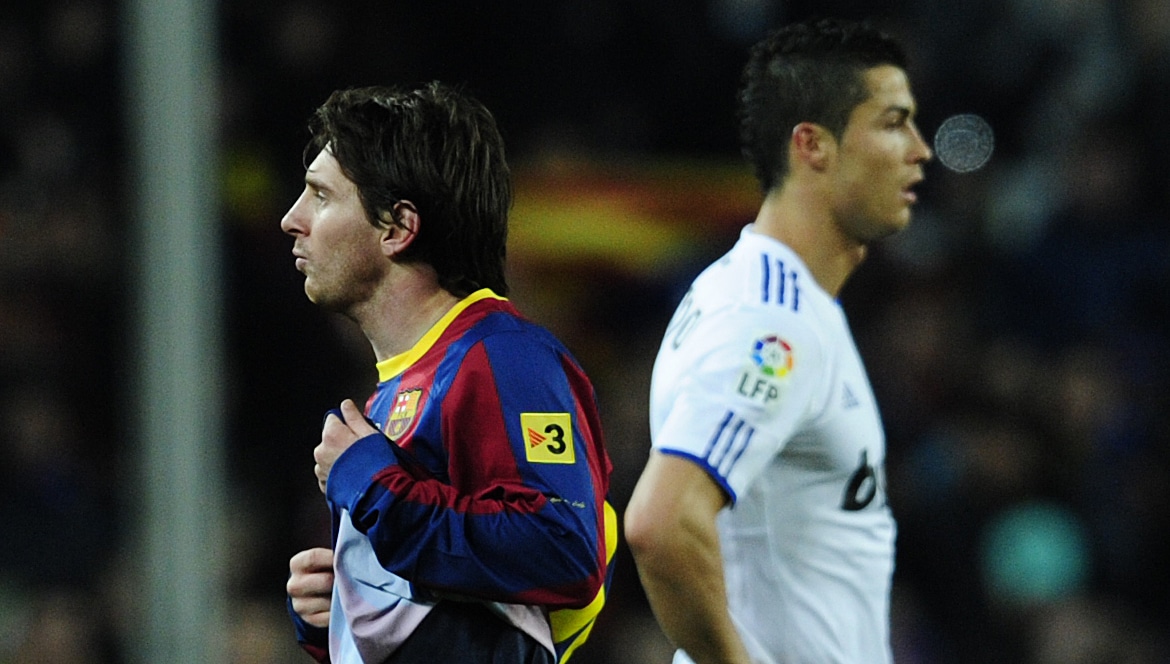
Beyond those two episodes, numerous individuals have made substantial contributions to the rivalry. Most notably, the personal contest between Lionel Messi and Cristiano Ronaldo in the late 2000s and 2010s added a new dimension to the broader competition between Real Madrid and Barcelona.
Messi and Ronaldo are two of the greatest footballers of all time. Between 2008 and 2017, no other player won the Ballon d’Or, which in effect became a two-way tussle between the Barcelona and Real Madrid icons. Their individual brilliance magnified the team rivalry and elevated El Clasico into a must-watch global event.
Fan Culture
In 1968, the then-Barcelona president Narcis de Carreras said in a speech: “El Barça és més que un club” (Barca is more than a club). It is a slogan that their fans continue to embrace today, with Barcelona still one of the foremost symbols of Catalan identity.
The meaning has expanded beyond politics over the years. As well as signalling Barcelona’s role as a proudly Catalan entity, it has also been used to defend the club’s longstanding policy of promoting youth players from the academy (whose graduates include Lionel Messi, Xavi Hernandez and Andres Iniesta), and playing a possession-based, attractive style of play which traces its roots back to Johan Cruyff’s time as manager.
Generally speaking, Real Madrid fans are less bothered about style of play. Winning is all that matters to many of those who follow the most successful club in European football. And while Madrid’s academy has produced some fantastic young players - think Raul Gonzalez, Iker Casillas and Dani Carvajal - their fans draw just as much pride from global superstars who became legends at the Bernabeu, such as Alfredo Di Stefano, Cristiano Ronaldo and Zinedine Zidane.
The pressure at both clubs is huge, and it would be an exaggeration to say Barcelona fans care about style more than results - they are just as unhappy as Real Madrid supporters when their team is not winning.
Defining Derby Moments
One of the most remarkable editions of the Clasico took place in 1943. In the first leg of a Copa del Generalisimo (the Copa del Rey, which had been renamed after Franco) tie, Barcelona beat Real Madrid 3-0. The Blancos were unhappy with some refereeing decisions that day, and the Madrid press criticised the whistling directed at the visiting players by Barcelona fans.
In controversial circumstances, Madrid won the second leg 11-1. More than any other, this match cemented the idea of Madrid as the team of Franco and Barcelona as victimised outsiders.
The two teams met in the final of the same competition in 1968, with Barcelona winning 1-0. Real Madrid fans were unhappy with the refereeing and threw bottles at the match officials and Barca players towards the end of the game. It was an unsavoury example of what can happen when emotions run too high.
In an extraordinary 18-day period in 2011, there were no fewer than four meetings between Real Madrid and Barcelona - one in La Liga, one in the Copa del Rey final and two legs of a Champions League semi-final. The league game was drawn, Madrid won the Copa del Rey, and Barcelona triumphed in Europe.
For all the antipathy, Madrid and Barcelona fans have at times been sporting enough to acknowledge talent on the other side. Madrid’s Laurie Cunningham was applauded by Barcelona fans for his exemplary performance in 1980. Madrid supporters have returned the favour for Diego Maradona, Ronaldinho and Andres Iniesta.
The Rivalry Today
El Clasico is a bigger event now than it has ever been. With La Liga broadcast all over the globe, Real Madrid vs Barcelona is no longer a strictly Spanish affair. Indeed, it was estimated that 600 million fans worldwide watched Real Madrid’s 2-1 victory over their arch-rivals in 2025.
Madrid and Barcelona’s dominance of the Spanish game is not new, but it has intensified over the last couple of decades as wealth has increasingly been concentrated in the hands of a handful of superclubs across Europe.
From 1969/70 to 1983/84, teams other than Madrid or Barcelona won the La Liga title in eight out of 15 seasons. In the 10 campaigns between 1994/95 and 2003/04, the league was won by non-big two sides on four occasions, with Atletico Madrid, Valencia (twice) and Deportivo La Coruna all successful.
Meanwhile, in the last 21 La Liga seasons, Real Madrid or Barcelona have won the title a combined 19 times. Only Atletico Madrid have been able to disrupt the duopoly in that time, and there is an argument that they were able to do so only because of the talents of their manager Diego Simeone.
With one of Madrid or Barcelona almost guaranteed to win the title these days, virtually every Clasico is extra meaningful.