
Football players are the ones that tend to get the most attention, plaudits and fame. But football managers are arguably just as important to the success of a team. A good one gets the best out of the players at his disposal. A great one does so while winning trophies or changing the game.
Who are the greatest managers in football history? That is the question we have set out to answer in this article.
The 14 head coaches we have picked were all world-class in a different way. We will explore their careers, touching on their tactics, leadership and legacy.
Alex Ferguson
When St Mirren sacked Alex Ferguson in 1978, an industrial tribunal ruled that he had “neither by experience nor talent, any managerial ability at all.” How wrong they were.
Ferguson first came to prominence at Aberdeen, where he disrupted Scotland’s Rangers-Celtic duopoly by winning three league titles and five domestic cups, plus a Cup Winners’ Cup (the Dons beat Bayern Munich and Real Madrid on their way to the trophy).
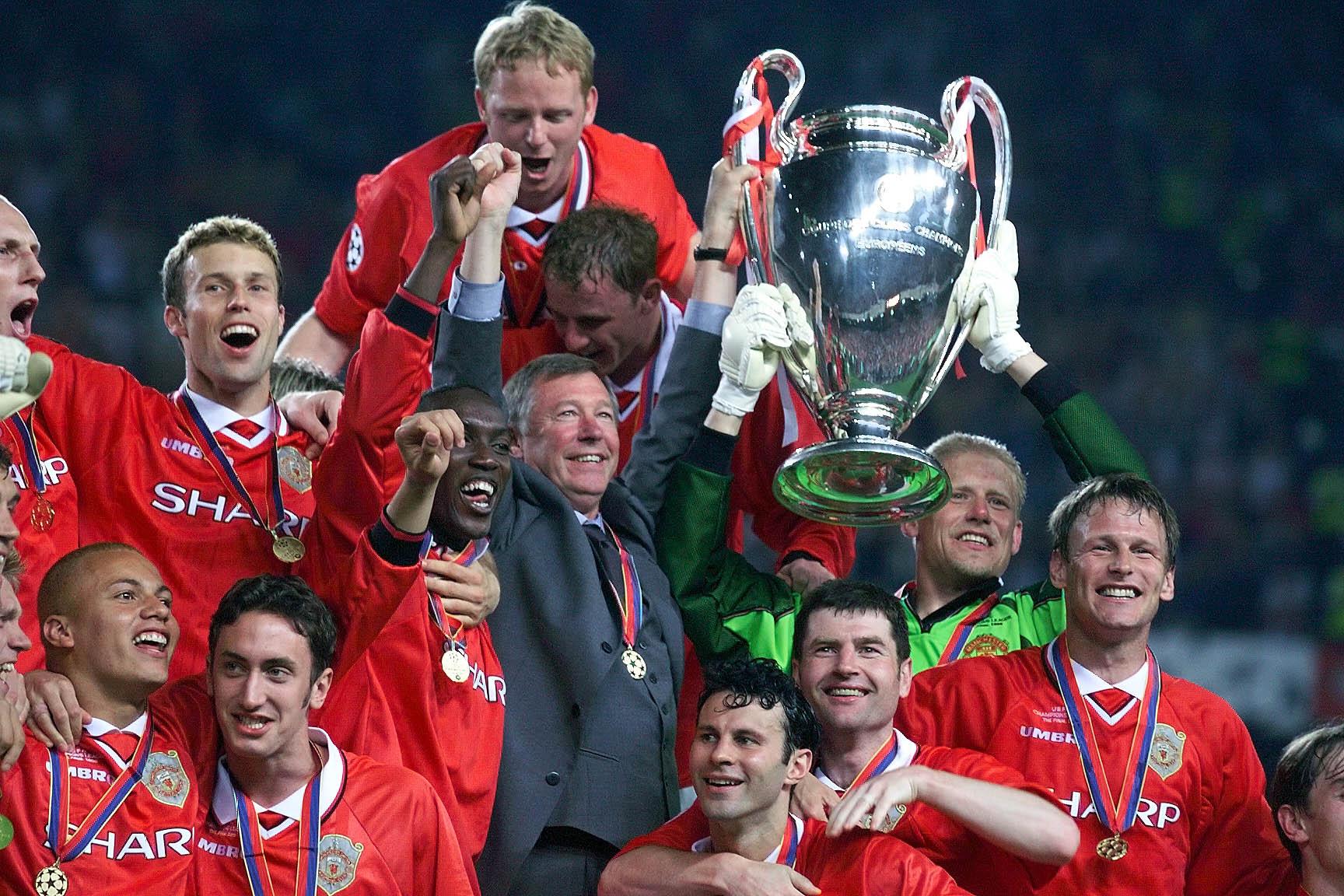
That brought Ferguson a move to Manchester United. During an extraordinary 27-year tenure at Old Trafford, the Scot masterminded 13 Premier League title triumphs, while he also made United the kings of Europe on two occasions.
Not renowned as a master tactician, Ferguson nevertheless encouraged his teams to play attacking football. He was a sublime man-manager and a fantastic squad-builder to boot.
Pep Guardiola
In hindsight, the decision looks obvious. But Barcelona took a major risk in 2008 when they decided to hire their B team manager Pep Guardiola ahead of more experienced contenders for the job of first-team head coach.
In his very first season, Guardiola showed that he was something special by winning a treble. By the time he left Barcelona in 2012, the club had won two Champions Leagues and three La Liga titles.
More than that, Guardiola’s Barcelona played some of the most spellbinding football the game has ever seen, with a strong emphasis on possession. He has been an innovator ever since.
Three Bundesliga crowns followed at Bayern Munich, before Guardiola established Manchester City as the best team in England. So far at the Etihad Stadium, he has won five Premier League titles and a Champions League.
Carlo Ancelotti
No manager in football history has won as many Champions Leagues as Carlo Ancelotti, who has lifted that famous trophy on four occasions.
The first two of those came with AC Milan in 2003 and 2007. His third European winner’s medal was secured at Real Madrid in 2014, while Ancelotti again won the tournament in his second spell in charge of the Spanish giants, going all the way in 2022.
Ancelotti has coached some of the biggest clubs on the continent: Juventus, Milan, Chelsea, Paris Saint-Germain, Bayern Munich and Madrid.
His teams generally play attacking football, but Ancelotti’s best quality is his ability to handle big personalities within the dressing room.
Arrigo Sacchi
Before he became a football manager, Arrigo Sacchi was a shoe salesman. Did the fact he had never played the game professionally hinder his ability as a coach, an Italian journalist once asked. “I never realised that to be a jockey you had to be a horse first,” Sacchi snapped back.
And he was some jockey. After a promising first job at Parma, Sacchi landed the AC Milan job in 1987. Over the next four years he created one of the best club teams of all time, winning a Serie A title and two European Cups.
After his time at San Siro, Sacchi’s Italy were a penalty shoot-out away from winning the 1994 World Cup. A second spell at Milan did not go to plan, while Sacchi could not bring success to Atletico Madrid either.
Sacchi gave the 4-4-2 formation new life the first time round at Milan, encouraging compactness, a high defensive line and zonal marking.
Giovanni Trapattoni
Giovanni Trapattoni won league titles in four different countries: Italy, Germany, Portugal and Austria. His first was in 1977 and his last was in 2007. That speaks to the Italian’s incredible longevity.
He remains best associated with Juventus, who won six Serie A championships, a European Cup, a Cup Winners’ Cup and two UEFA Cups with Trapattoni at the helm.
Another UEFA Cup and another Serie A were claimed during his time at Inter, before Trapattoni led Bayern Munich to Bundesliga glory in 1997.
Il Trap was known to be a top motivator who routinely got the best out of the players at his disposal. His teams did not always play free-flowing football, but they were usually solid at the back and difficult to play against.
Brian Clough
“I wouldn’t say I was the best manager in the business, but I was in the top one,” Brian Clough once said. His tongue might have been in his cheek, but the former Derby County and Nottingham Forest boss was not exactly shy and retiring when it came to self-promotion.
Clough had an ego, no doubt, but his assessment of his own ability was not far wrong. He took Derby from the second tier of English football into the first, then won the title within three years.
[Text Wrapping Break]Clough worked even greater miracles at Nottingham Forest, leading them to promotion in 1977 and the First Division title in 1978. Unbelievably, he then oversaw back-to-back triumphs in the European Cup, bringing that famous trophy to a provincial club that hardly won anything before or after his tenure.
Clough was known to be a superb man-manager, while his long-time assistant Peter Taylor thrived at recruitment. At Derby and Forest, they were the dream team.
Helenio Herrera
Helenio Herrera was arguably football’s first superstar manager. It helped that he was a big personality, but his uncompromising methods and strict disciplinarian attitude did not always endear him to his players.
By the time the Argentine joined Inter in 1960, he had already had 10 coaching jobs - including at Barcelona and with the Spain national team. But despite winning four La Liga titles with Barca and Atletico Madrid, it was in Italy that he really thrived.
Herrera’s team won three Serie A titles and two European Cups during his eight-year tenure at San Siro. Inter were the greatest ever proponents of Catenaccio, a defensive style of play that swept the club to glory in the first half of the 1960s. In fairness to the Nerazzurri, they were capable of some fine attacking play too.
Herrera’s contentious (at the time) off-field methods included managing his players’ diet and banning them from smoking and drinking.
Jose Mourinho
Jose Mourinho was not a professional player, but he learned his coaching trade under Bobby Robson and Louis van Gaal at Sporting CP, Porto and Barcelona. His first job as the main man came with Benfica, but it was with Porto that he made his name.
Mourinho achieved the unthinkable by guiding the Portuguese club to the Champions League in 2004. That earned him a move to Chelsea, where he won three Premier League titles across two spells.
Mourinho’s greatest season came with Inter in 2009/10, when he won a treble of Serie A, Champions League and Coppa Italia. He also claimed trophies with Real Madrid, Manchester United and Roma.
A big personality who oozes charisma, Mourinho at his peak was a master at getting his players on board and creating a siege mentality within the dressing room.
Rinus Michels
The architect of Total Football, a style of play which dictated that every player on the pitch should be able to play in every role on the pitch, Rinus Michels was one of the most influential coaches of all time.
His ideas proved to be hugely successful too. Using the approach, which usually involved a base 4-3-3 formation and encouraged the dominance of possession, Michels led Ajax to the European Cup in 1971.
He later won a La Liga with Barcelona, before taking charge of the Netherlands for their European Championship campaign of 1988, which was ultimately victorious.
Michels’ legacy to the game goes far beyond his achievements, though. Many of the principles he introduced at Ajax are commonplace around the world today.
Bob Paisley
The biggest compliment you can pay Bob Paisley is that he made replacing Bill Shankly, a titan at Liverpool, look easy. Previously a long-serving assistant at Anfield, Paisley reluctantly took the top job after Shankly stepped down in 1974.
He was a very different character to his charismatic predecessor. Much quieter and less comfortable in front of the media, Paisley was nevertheless a masterful football manager who excelled out on the training pitch.
During a nine-year spell in the Anfield dugout, Paisley led Liverpool to six First Division titles, a UEFA Cup and three European Cups, all while playing attack-minded, attractive football.
Despite his considerable achievements with the Reds, Paisley never managed another club. “Other people have earned more money than me in football,” he once said. But no one has enjoyed it as much as me.”
Miguel Munoz
Real Madrid are perhaps the biggest football club in the world, but while there were always certain factors in their favour, their foremost status was not predestined. The likes of Santiago Bernabeu and Alfredo Di Stefano were integral to Madrid attaining it, but so was Miguel Munoz.
Born in the city, Munoz spent 10 years as a Real Madrid player before being appointed as the club’s head coach in 1960. Over the course of 13 full seasons with the Blancos, Munoz won nine La Liga titles and two European Cups. During that time, he became the first person to win the latter competition as both a player and a manager.
Anyone familiar with the intense pressure that comes with managing Madrid will understand how much of an accomplishment it was for Munoz to simply remain in charge for the best part of a decade and a half.
Munoz might not be as famous as some of the names listed here, but he deserves to go down as one of soccer’s greatest managers.
Valeriy Lobanovskyi
Valeriy Lobanovski is best known for his work with Dynamo Kyiv across two spells and as the manager of the Soviet Union team that reached the final of Euro 1988.
The proud Ukrainian won a total of eight Soviet Top Leagues plus two Cup Winners’ Cup at the helm of Dynamo, who he also led to the semi-finals of the European Cup on three separate occasions.
His impact on the game was deeper than those accomplishments, though. Lobanovskyi pioneered the use of statistics within football. Together with the help of Anatoliy Zelentsov, a professor turned analyst, Lobanovskyi made use of data to give his teams an edge.
His use of mathematics led Lobanovskyi to pressing, another area in which he was ahead of his time. His teams used to press high up the pitch and routinely won the ball back in advanced areas.
Johan Cruyff
Johan Cruyff might just be the most influential person in the history of football. Widely regarded as one of the best players in history, the Dutchman was also a success when he crossed over into the dugout.
Cruyff managed the two clubs closest to his heart, Ajax and Barcelona. With the former he won the Cup Winners’ Cup in 1987, while at Barca he was a four-time La Liga champion and the coach who won the club’s first ever European Cup in 1992.
With both teams he promoted a possession-based, attacking style of play, using either a 3-4-3 or 4-3-3 formation. This was to prove the template for much of what came later, as Pep Guardiola once acknowledged.
“Johan Cruyff painted the chapel, and Barcelona coaches since merely restore or improve it. I knew nothing about football before Johan Cruyff.”
Ernst Happel
Ernst Happel made his name with Den Haag in the Netherlands, but his big break came when he landed the Feyenoord job. He won a European Cup and a Dutch title during his time at De Kuip, achievements which made him one of the hottest managerial talents around.
Three more league titles, this time in Belgium, came with Club Brugge, with whom he reached another European Cup final. Happel went one better with Hamburg, getting his hands on another European Cup in 1983.
The Austrian won trophies with six clubs in four countries. His adaptability was one of his strongest attributes, allowing Happel to thrive in various different environments. He was one of the managers to popularise the 4-3-3 formation, but he was never rigid in his thinking.
At international level, Happel took the Netherlands to the final of the 1978 World Cup, which they easily could have won on another day.