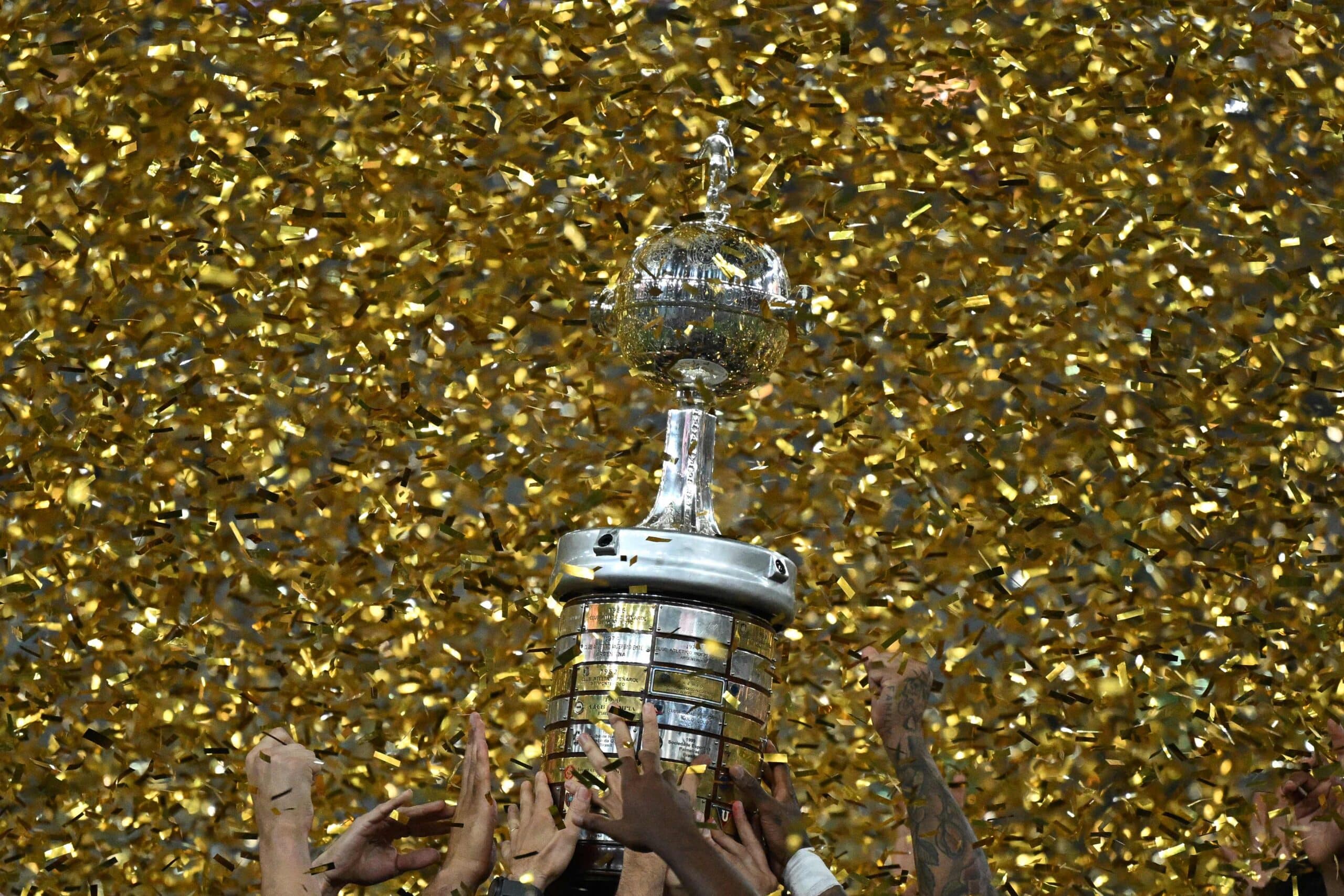

The Copa Libertadores is undoubtedly the holy grail of South American football. While the likes of Real Madrid and Barcelona chase the infamy that comes with holding the Champions League trophy aloft, the likes of Boca Juniors, Palmeiras, River Plate, and Flamengo dream of making Copa Libertadores history. However, the path to South American glory is far from simple, with some clubs looking at a 19-match run to turn qualification into silverware. Let’s take a look at what it actually takes to win the prestigious Copa Libertadores.
What is the path to winning the Copa Libertadores?
The Hard Work Starts Early
In the grand scheme of things, the path to Copa Libertadores glory starts a whole year before a ball is even kicked. The competition includes four teams from Venezuela, Uruguay, Peru, Paraguay, Ecuador, Bolivia, Colombia, and Chile, six from Argentina, and seven from Brazil. The holders of the Copa Libertadores and the Copa Sudamericana win automatic group stage qualification. The vast majority of South American teams qualify for the tournament based on their success from the previous season.
For example, Platense qualified for the 2026 Copa Libertadores by winning the 2025 Apertura season. Corinthians qualified by winning the 2025 Copa do Brasil. Some teams win tournaments; others qualify for the Copa Libertadores based on league position. Whatever the case, you need to earn your right to be there before you can even think about lifting the trophy.
The Long Road to Silverware
For clubs entering the Copa Libertadores at the First Stage, it takes 18 long games to even get to the final, not to mention the fact that you have to win number 19 to take home the trophy. Considering the vast majority of those 19 games have to be wins, it requires a whole lot of consistency to win a Copa.
- First Stage – Two-legged knockout qualifier
- Second Stage – Two-legged knockout qualifier
- Third Stage - Two-legged knockout qualifier
- Group Stage – Six matches (Three home and three away)
- Round of 16 - Two-legged knockout
- Quarter-finals - Two-legged knockout
- Semi-finals - Two-legged knockout
- Final – Winner takes all
Peak at the right moment, and you can beat anyone. Dip at the wrong moment, and it’s curtains on your continental campaign. Remember, the First Stage begins in February, and the final isn’t until November. No one team is able to play at their best for nine consecutive months.
Most Copa Libertadores champions qualify automatically for the group stage based on their previous season’s accomplishments. However, First Stage and Second Stage entrants should never be discounted. We’ll touch a little more on that later…
Peaking at the Right Moments
Although you have to win most of your matches on the path to Copa Libertadores glory, you do not have to win them all. Knockout competition is all about peaking at the right moments and taking your foot off the gas when you can afford to. For example, if you win a first leg 5-0, you can make rotations and risk a narrow defeat in the second leg. If you win your first four Group Stage matches, you can rest key players in the final two games. Tournament football isn’t about playing your best stuff in the opening stages of the competition. It’s about scraping your way through the early rounds before peaking in the latter knockouts.
When Flamengo won the Copa Libertadores in 2025, they didn’t even top their group. In the quarter-finals, they scraped through via a penalty shootout against Estudiantes. They only managed a single goal across two legs of their semi-final against Racing, yet still progressed as 1-0 aggregate winners. Again, in the final, one single goal was all it took to take down Palmeiras and claim the trophy. Palmeiras had come into the final with goals galore under their belt. A 4-0 win in the R16, 5-2 in the quarters, and 4-3 in the semis. Yet it was Flamengo who peaked at the right moment and used defensive solidity to take down the in-form side.
Botafogo Should Give Underdogs Confidence
Many would assume that the Copa Libertadores is always won by one of the Brazilian or Argentine champions from the year before, but that would be wrong. While the gulf between your Real Madrids and your Eintracht Frankfurts may be vast in Europe, there is a far more level playing field in South America. This breeds excitement, unpredictability, and shocks galore! Just look at Botafogo in 2024.
Qualifying as Brazil’s sixth entry, Botafogo weren’t tipped to even be the best in their country, let alone the whole continent. They arrived at the 2024 Copa Libertadores not as reigning champions, but as the 2023 Campeonato Brasileiro Serie A 5th-place finishers. For that, they missed out on automatic qualification for the Group Stage and instead had to fight through the qualifying knockouts. Thankfully, a 7-1 aggregate win over Bolivia’s Aurora booked them a place in the Third Stage, and a 3-2 win over Red Bull Bragantino granted them safe passage into the tournament proper.
Even during the Group Stage, Botafogo looked far from unbeatable. The Brazilian side won just three of their six matches, losing to both Junior and LDU Quito, to finish second in Group D. Yet second place was enough to progress to the knockouts as the 14th seed. Botafogo were handed about as tough a R16 draw as possible, facing off against the 2020 and 2021 champions, Palmeiras. Despite this, they managed a home win and an away draw to set up a quarter-final against São Paulo. A 0-0 home draw put them up against it against their Brazilian rivals, but they held on in the away leg and scraped through on penalties. In the semi-finals, it was done and dusted after a single leg, with Botafogo thrashing Uruguay’s Penarol 5-0 at home. In the final itself, it was another dominant display, beating Atletico Mineiro 3-1 in Buenos Aires to lift the Copa Libertadores title.
It Helps to be From Brazil at the Moment
Since the first tournament in 1960, part of the allure of the Copa Libertadores has been the variety of winners from countries all across South America. While Brazil and Argentina have always dominated, clubs from Uruguay, Colombia, Paraguay, Chile, and Ecuador have all lifted the trophy. However, even the gap between the big two appears to be growing. Brazilian clubs have now won the last seven Copa Libertadores, with five of those finals being all-Brazil affairs. With Brazilian football benefiting from an influx of money, you wonder just how long the run of dominance could continue.
Every Copa Libertadores Winner From 1960 to 2025: Who Will be 2026 Champion?
Since the very first competition back in 1960, there have been 27 different winners of the Copa Libertadores. In the same time, only 23 different clubs have won the Champions League. Let’s take a look at the rundown of all the Copa Libertadores winners from 2025 all the way back to 1960.
- 2025: Flamengo beat Palmeiras
- 2024: Botafogo beat Atlético Mineiro
- 2023: Fluminense beat Boca Juniors
- 2022: Flamengo beat Athletico Paranaense
- 2021: Palmeiras beat Flamengo
- 2020: Palmeiras beat Santos
- 2019: Flamengo beat River Plate
- 2018: River Plate beat Boca Juniors
- 2017: Grêmio beat Lanús
- 2016: Atlético Nacional beat Independiente del Valle
- 2015: River Plate beat UANL
- 2014: San Lorenzo beat Nacional
- 2013: Atlético Mineiro beat Olimpia
- 2012: Corinthians beat Boca Juniors
- 2011: Santos beat Peñarol
- 2010: Internacional beat Guadalajara
- 2009: Estudiantes beat Cruzeiro
- 2008: LDU Quito beat Fluminense
- 2007: Boca Juniors beat Grêmio
- 2006: Internacional beat São Paulo
- 2005: São Paulo beat Atlético Paranaense
- 2004: Once Caldas beat Boca Juniors
- 2003: Boca Juniors beat Santos
- 2002: Olimpia beat São Caetano
- 2001: Boca Juniors beat Cruz Azul
- 2000: Boca Juniors beat Palmeiras
- 1999: Palmeiras beat Deportivo Cali
- 1998: Vasco da Gama beat Barcelona SC
- 1997: Cruzeiro beat Sporting Cristal
- 1996: River Plate beat América de Cali
- 1995: Grêmio beat Atlético Nacional
- 1994: Vélez Sársfield beat São Paulo
- 1993: São Paulo beat Universidad Católica
- 1992: São Paulo beat Newell's Old Boys
- 1991: Colo-Colo beat Olimpia
- 1990: Olimpia beat Barcelona SC
- 1989: Atlético Nacional beat Olimpia
- 1998: Nacional beat Newell's Old Boys
- 1987: Peñarol beat América de Cali
- 1986: River Plate beat América de Cali
- 1985: Argentinos Juniors beat América de Cali
- 1984: Independiente beat Grêmio
- 1983: Grêmio beat Peñarol
- 1982: Peñarol beat Cobreloa
- 1981: Flamengo beat Cobreloa
- 1980: Nacional beat Internacional
- 1979: Olimpia beat Boca Juniors
- 1978: Boca Juniors beat Deportivo Cali
- 1977: Boca Juniors beat Cruzeiro
- 1976: Cruzeiro beat River Plate
- 1975: Independiente beat Unión Española
- 1974: Independiente beat São Paulo
- 1973: Independiente beat Colo-Colo
- 1972: Independiente beat Universitario
- 1971: Nacional beat Estudiantes
- 1970: Estudiantes beat Peñarol
- 1969: Estudiantes beat Nacional
- 1968: Estudiantes beat Palmeiras
- 1967: Racing beat Nacional
- 1966: Peñarol beat River Plate
- 1965: Independiente beat Peñarol
- 1964: Independiente beat Nacional
- 1963: Santos beat Boca Juniors
- 1962: Santos beat Peñarol
- 1961: Peñarol beat Palmeiras
- 1960: Peñarol beat Olimpia