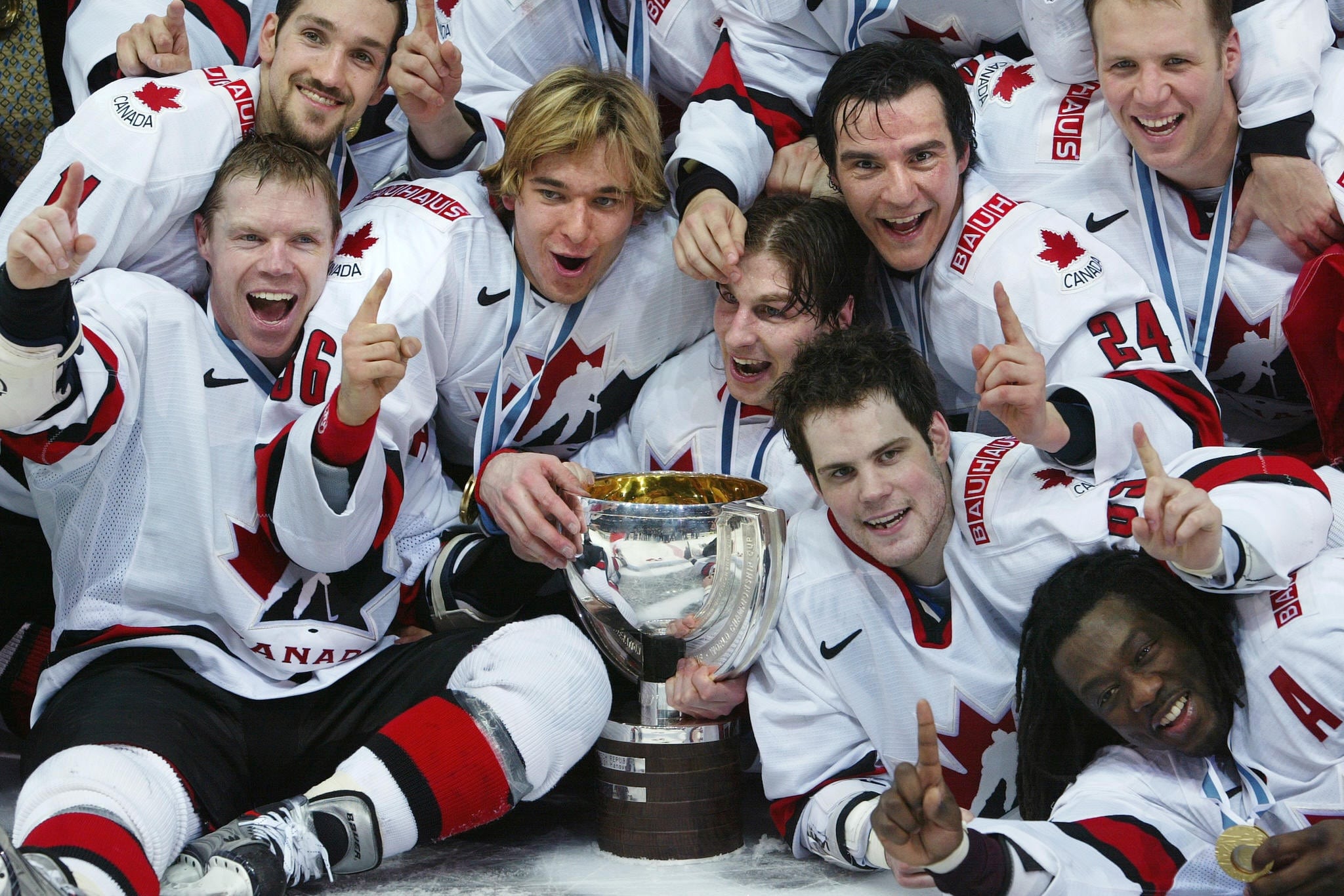

The IIHF World Championship is the pinnacle of international ice hockey annually, with only the quadrennial Winter Olympics offering, perhaps, more prestige and global acclaim.
But the IIHF has done a tremendous job of making their World Championships feel like a pivotal tournament each year – aided by the fact that the event has now been held for more than a century. That’s a lot of history and heritage.
Within the 106 years of IIHF World Championships, there’s been some stunning finals: captivating narratives, herculean efforts and jaw-dropping feats of individual and collective brilliance.
And, in this very article, we’re going to countdown the top ten most memorable IIHF World Championship finals in history.
What Makes a Great World Championship Final?
So what makes for the greatest hockey finals in the annals of the IIHF?
We want drama, that’s the most fundamental thing. Whether it’s an intriguing storyline, an enduring rivalry or a game of historical importance, these are the scenarios that can only serve to enhance one of the most important matches in ice hockey.
And, of course, intense action on the ice never hurts. Whether it’s a remarkable comeback, an individual player delivering an all-timer of a performance or a nerve-jangling overtime conclusion, anything that ramps up the excitement is most welcome.
Some finals can have a huge cultural impact too, especially when the champion is a first-time winner or a significant underdog going into the game. That can enhance the visibility and popularity of ice hockey with a whole new audience.
Finals That Defined Eras of International Hockey
For many decades, the IIHF World Championships had a league format, in which the medallists were decided by who performed best against one another in round robin competition.
But in the year 2000, the format was updated to have a bracket stage, creating the drama that only quarter finals, semi-finals and a final can bring.
This new system has helped to define eras of dominance in the modern game, with Sweden one of the first nations to truly stamp their authority on hockey in this revamped era.
They had won the Winter Olympic gold medal in 2006, defeating Finland in the championship game. The Swedes headed to Latvia three months later for the Worlds; rightly full of confidence.
Sweden demolished the United States 6-0 in their quarter-final, edged out the Canadians 5-4 in the semis before producing a defensive display for the ages against Czechia in the final.
They completely shut out the Czechs in a 4-0 romp, with Johan Holmqvist and Niklas Kronwall ultimately named Best Goaltender and Best Defender at the tournament awards.
This was the first time that a team had won the Olympic and World Championship gold medal in the same year. Incredibly, it would be another seven years before Sweden got their hands on IIHF gold again.
The 2024 final also deserves a quick mention. That was the scene of Czechia’s 13th IIHF gold medal, but one made all the more special by the fact that they were on home soil – and it’s surprising how infrequently the host nation goes on to hoist the trophy.
Finland did so in 2022 – becoming the second nation to win Olympic and World Championship gold in the same year, while Sweden did so as co-hosts nine years prior to that. But then you have to go all the way back to 1986 and the Soviet Union’s victory for the prior example.
So Czechia winning in front of their own supporters was a huge deal… and especially so when you learn that the 2024 edition was the best attended in tournament history, with more than 797,000 people turning out to watch the action (source: https://en.wikipedia.org/wiki/List_of_IIHF_World_Championships_by_attendance).
The Longest, Tightest and Most Dramatic Finals
Having won the gold medal at the World Championship for three consecutive years (1999-2001), Czechia were highly fancied to make it four on the spin in 2002.
But they were upset by Russia in the quarter finals… who then went on to play their part in one of the most dramatic finals that the IIHF showpiece has seen.
Waiting in the gold medal match were Slovakia, who were yet to win a World Championship. But they had beaten both Canada and Sweden on route to the final, so the Slovaks were the epitome of a dangerous underdog.
And what a gold medal match it was. Slovakia led 2-0 after the first period and 3-1 after the second, but Russia pulled back level in the final stanza to set up a titanic finish.
With barely a minute left on the clock… cometh the hour, cometh the man. Peter Bondra ended the 2002 World Championship as the top goalscorer, and it was his seventh goal of the tournament that would prove most decisive – securing a 4-3 win for Slovakia in the most dramatic of finals.
To this day, that remains Slovakia’s only IIHF gold medal. And what a moment it was for a hockey-mad country.
Perhaps the longest IIHF World Championship final came in 1999, back when the gold medal was awarded following a two-game series.
Czechia had won the first fixture in Lillehammer 3-1, but Finland bounced back the very next day to send the final into overtime.
And it was there, after 16 minutes of play, that Jan Hlavac found the winning golden goal for the Czechs. So, it took 136 minutes to separate the two teams… making the 1999 final the longest in IIHF history.
Comebacks, Overtime and Golden Goals
The 2003 World Championships offered up both a crazy comeback story and an edge-of-the seat overtime victory in the final.
Sweden, one of the favourites for the gold having won bronze in both 2001 and 2002, were well and truly on the ropes against Finland in their quarter-final – they were down 1-5 after just 26 minutes of play.
Three goals in nine minutes reduced the Swedes’ arrears, before Peter Forsberg – with his second goal of the game – pulled them level in the third period. There was an inevitability, given the flow of the contest, when Sweden’s Per-Johann Axelsson slotted home the winner to complete a miraculous comeback against the hosts.
Sweden would progress to the final… where they would lose out to that rarest of beasts: an overtime goal in an IIFH World Championship gold medal match.
Having led 2-0 thanks to a pair of early goals, the Swedes were pegged back by Canadian goals in the first and third period. The contest finished 2-2, sending it into overtime – where, 13 minutes later, Anson Carter popped up with what looked to be the winning strike.
But it wasn’t without controversy. The match officials were not completely sure that the puck had crossed the goal line, and so followed a video replay review that took more than ten minutes to come to a verifiable conclusion.
And that conclusion? A goal for Canada… crowning them champions in one of the most dramatic finales to a World Championship final.
The most recent example of the ‘golden goal’ rule being enacted in the final of the IIHF World Championship came as recently as 2025.
It was a tournament of shocks, with co-hosts Denmark sensationally defeating Canada in the quarter finals. The USA, meanwhile, dumped both Sweden and Finland out of the competition.
That set up an unlikely final between the United States and Switzerland, who had demolished the Danes 7-0 in the semis. That would turn out to be a war of attrition, with neither side willing to take any risks given the importance of the contest, and so it finished 0-0 at the end of regulation time.
After two more minutes of play, the puck came to be at the stick of Tage Thompson, who blasted home a shot to secure the USA’s first World Championship gold medal since 1933 – and succumb the winless Swiss to a fourth loss in the final since 2013.
Players Who Rose on the Biggest Stage
As we’ve learned, Canada dominated the early years of IIHF ice hockey championship history.
Many of the star players of those formative years were to be found in a Canadian jersey, and one of them – Harry Watson – delivered the most extraordinary performance at the 1924 World Championship.
The second edition of the event, held at the Winter Olympics in Chamonix, saw Watson stand head and shoulders above the rest.
In just five games, he scored a staggering 37 goals. Add into the mix nine assists, and you’re left with 46 points in all – perhaps the greatest individual performance the IIHF World Championship finals have ever seen.
Wayne Gretzky is considered by many to be the greatest ice hockey player of all time. His NHL exploits, often taking his team to the Stanley Cup, meant that his involvement in the World Championships was sadly limited.
But Gretzky did feature in the 1982 edition, hoping to recapture former glories for a Canadian team that hadn’t won the gold medal at the Worlds in more than 20 years.
With 14 points (six goals and eight assists), Gretzky finished the tournament as the leading scorer… however, he couldn’t guide the Canadians to a medal as they 3-4 to the Soviet Union in a crunch clash.
Goaltenders don’t always get the praise they deserve in ice hockey. But they can be just as important as any other position on the ice in determining that tantalising gap between success and failure.
So let’s credit Vladislav Tretiak, who is still one of the most decorated players in World Championship history to this day. Born in Russia and representing the Soviet Union, Tretiak won ten gold medals and 13 medals in all – the joint-best record on both counts.
His first and last World Championship golds were separated by 13 years (1970-1983), and Tretiak even found time to play his part in the gold medal triumph at the Winter Olympics in Sarajevo in 1984.
The Russian was named Best Goaltender at three editions of the IIHF World Championships, so the success of the Soviet Union in the 1970s and 80s owes much to Tretiak’s ability to keep the puck out of his net.
Scoring a hat-trick in the final of the World Championship… there aren’t many better moments available to an offensive hockey player than that.
And talk about coming up clutch for your country. Ville Peltonen scored six goals at the 1995 edition, but three of those came in the final – that hat-trick helping Finland to a memorable 4-1 victory over Sweden, who had the perk of being on home ice against Stockholm.
Teams in all sports often look to their captain for inspirational leadership and bold performances amidst the most pressure.
Canada had a gem in Rick Nash, who made the 2007 World Championship his own – scoring the winning goal in the final and being crowned tournament MVP.
Facing a particularly strong Finland outfit in the gold medal match, the crowd in Moscow – and the millions watching around the world – were treated to a game that would instantly be added to the annals of classic hockey matches.
Nash scored the opening goal for the Canadians as they opened up a commanding 3-0 lead, but the Finns fought back – with two minutes left on the clock, the game was finely balanced at 3-2.
And so up stepped Nash, in captain fashion, to stamp his authority on the game once more. He scored a beauty to ensure Canada would take home gold, with Nash himself crowned the tournament’s best player.
Why These Finals Still Matter
It’s no coincidence that many of the IIHF World Championship finals we have witnessed over the years have been classic hockey matches.
These are contested by the best teams and players outside of the NHL, in host nations that simply love their hockey.
It’s a fantastic spectacle for fans of the sports, as well as an opportunity for the finest players outside of the major franchises to showcase their class on the big stage.
Does the IIHF World Championship still matter? Ask the players involved and you’ll get a unanimous answer.