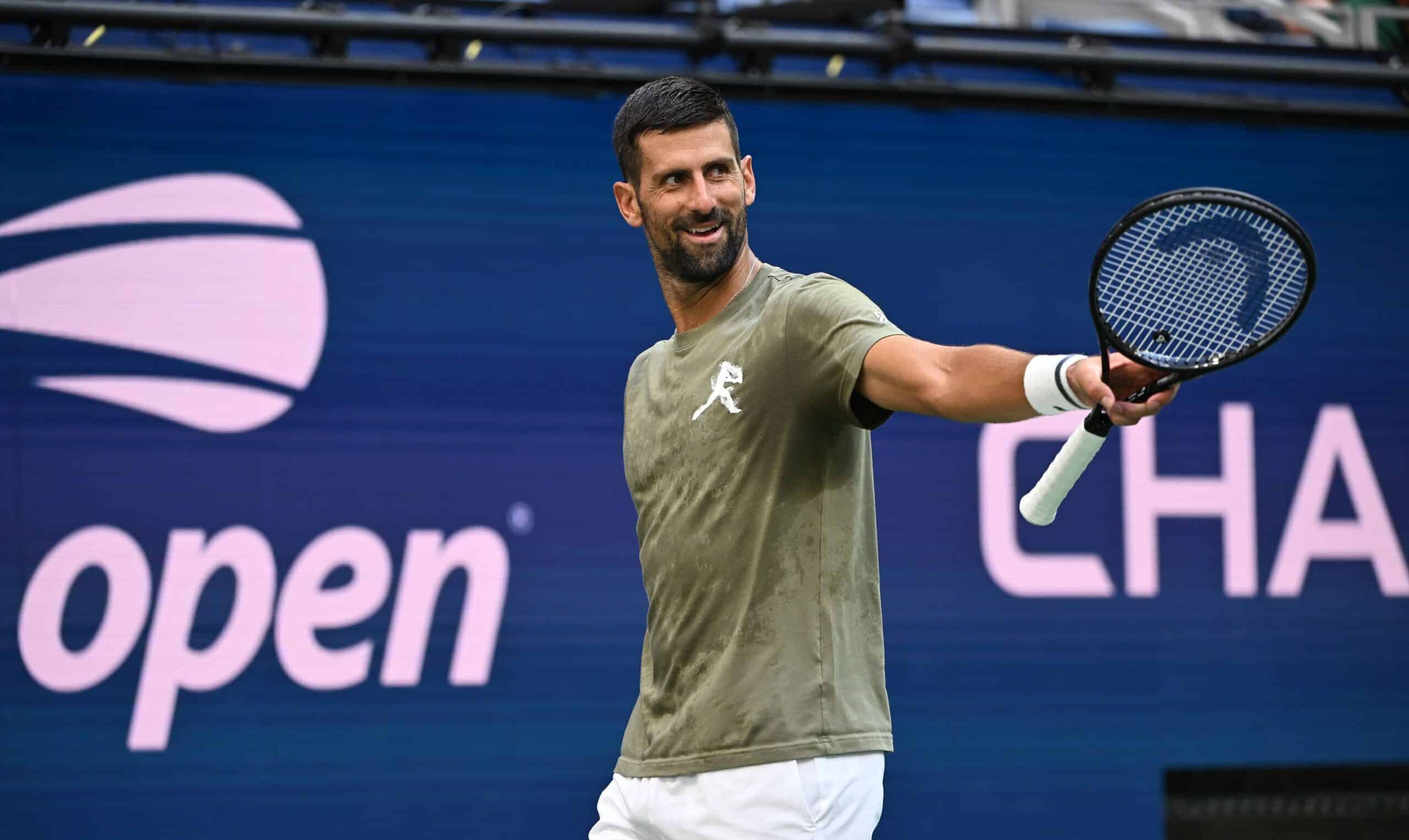

The best tennis players ever to pick up a racquet have been able to adapt their game to each individual surface – hence why the likes of Carlos Alcaraz, Novak Djokovic, Rafa Nadal and Roger Federer have been able to complete the career Grand Slam, i.e. winning all four majors.
But some other players thrive on a specific surface, saving their best work for the clay of Roland Garros or the grass of Wimbledon.
The hard courts of Melbourne Park and the Billie Jean King National Tennis Center have also become a happy hunting ground for some individuals… especially those with the playing style to suit the rigours of short points and fast rallies.
So, heading into the next edition of the US Open, what are the key attributes to look for in potential champions and underdogs who can defy their lowly world ranking?
Fast and Furious
The iconic blue-and-green US Open hard courts are famous for playing incredibly fast during the tournament.
That is exacerbated by the typical conditions in New York during August and September each year, with baking sun and tropical humidity only serving to quicken the ball through the air.
What is really interesting, though, is that the acrylic courts at the Billie Jean King National Tennis Center haven’t always been quick. They were once classified as medium-fast, with the hard surfaces used at the Australian Open said to play faster.
However, in 2019, the courts used at the US Open were redesigned, replacing the old DecoTurf material with the Laykold acrylic used today1. The upshot? Things got a whole lot quicker for the players.
When talking about the conditions in 2025, Djokovic said2: “The court speed, I can't recall actually what was the year when it changed, when it started being slightly quicker than what it used to be.”
Others have described the new(ish) surfaces as ‘quick and skiddy’, although some players have reported that the atmospheric conditions are ultimately the key factor – when it’s cold and damp, as New York can be in the mornings and evenings in particular, the ball tends to move more sluggishly irrespective of the court.
The reports of the players have been backed up by the data, which confirms that the US Open is now the second fastest Grand Slam behind Wimbledon.
Over the past three editions, the average rally length in Queens is just 3.86, which is lower than the action at Melbourne Park and considerably less than the clay courts of Roland Garros, as you’d expect3.
Interestingly, the number of aces served at the US Open is fractionally lower than both the Australian Open and Wimbledon, while CourtSpeed continues to designate the ‘medium fast’ classification to the surface – rather than the pure ‘fast’ descriptor given to grass courts.
So these acrylic courts are fast, but not too fast, which perhaps explains why all-rounders – albeit those able to thrive in baseline shootouts – have tended to fare best at the tournament since the surface switch in 2020.
Something for Everyone
It’s notable how each Grand Slam surface is reflected in the winners’ circle.
At Wimbledon, the likes of Richard Krajicek and Goran Ivanisevic won their sole major titles on the grass – the latter appeared in four Grand Slam finals, with all of them coming at SW19.
Milos Raonic, Nick Kyrgios and Tomas Berdych, meanwhile, played their only major final at Wimbledon, so clearly that’s a surface that favoured individual styles – notably booming serves, serve-and-volley and risk-and-reward, point-ending groundstrokes.
A similar pattern has been witnessed at tennis’ other ‘extreme’ Grand Slam, the French Open. Gustavo Kuerten, Carlos Moya, Albert Costa, Juan Carlos Ferrero and Gaston Gaudio all landed their sole major successes at Roland Garros… indeed Kuerten, Costa and Gaudio didn’t even progress beyond the quarter finals of any other Slam event.
These are players that all thrived by being outstanding movers around the court, hitting unique angles with spin and having the craft and guile that a tennis apprenticeship in South America or Mediterranean Europe provides.
But the US Open is more open to different tennis playing styles… with the cream tending to rise to the top. Of the last seven men’s singles champions, five have won other Grand Slam events as well, with the two anomalies – Dominic Thiem and Daniil Medvedev – appearing in major finals elsewhere but failing to hoist the trophy.
These courts in Queens allow the elite to thrive, and there’s seemingly one good reason for that – consistency.
On the grass, players are wary of low bounces and slippery footwork – especially early in tournaments when the turf is lush and fresh. At Roland Garros, the need to slide around and move vertically, in addition to laterally, can upset the rhythm of those not well versed in clay court tennis… taller players, for example, tend to struggle when compared to those with a lower centre of gravity.
But at the US Open, everyone gets a fair chance. Players can move freely without worrying about slipping and sliding, while they’re unlikely to face dodgy bounces of the ball – so consistency and trust are assured.
Short or tall. Flat hitters or topspin lovers. There seems to be opportunities for all types of tennis tactics to succeed.
Because the ball bounces somewhat higher than on grass and other hard courts, defensive players are able to stay in rallies for longer – before launching their own counter attacks.
The master of that art form – Djokovic – has appeared in ten finals at the Billie Jean King National Tennis Center. Nobody in the Open Era has featured in more.
So there is no single best playing style for US Open tennis. That perhaps explains why the tournament is so much fun to watch.
Horses for Courses
Since the change to the new surface in 2020, four of the six champions have won multiple Grand Slams – with Thiem and Medvedev having chances to join them, as mentioned.
That confirms that an all-court style is the most indicative when it comes to predicting success at the US Open, with the finest ball-strikers getting the best value for their buck.
Since the switch to the Laykold surface, the US Open analysis has also changed – we’ve seen a ‘Wimbledon-ification’ of the tournament.
The last three champions in Queens – Alcaraz, Sinner and Djokovic – are all former Wimbledon winners, while Medvedev reached two semi-finals at SW19. Alex Zverev, the 2026 Wimbledon finalist, also reached the final of the US Open in that first Laykold year of 2020.
Of the eight quarter finalists in the men’s singles at the 2025 US Open, three were former Wimbledon champions, two (Lorenzo Musetti and Taylor Fritz) have lost in semi-finals at the All England Club and another pair (Alex de Minaur and Felix Auger-Aliassime) have reached the quarters on the grass.
Even the anomaly, Jiri Lehecka, furthers the link. Despite a personal best of reaching the fourth round at Wimbledon, the Czech player reached the final of the 2025 Queen’s Club Championships on grass, winning a set from Alcaraz before going down in three.
There was a similar sort of theme when studying the last eight at the 2024 US Open. Here’s those quarter-finalists, with their best effort at Wimbledon in brackets:
- Grigor Dimitrov (SF)
- Jack Draper (second round)
- Taylor Fritz (SF)
- Daniil Medvedev (SF)
- Alex de Minaur (QF)
- Jannik Sinner (winner)
- Frances Tiafoe (fourth round)
- Alexander Zverev (finalist)
So, although not an exact science, when trying to predict the winner of the US Open you can look to those that have reached the quarter-finals, at least, at Wimbledon previously – that has been an excellent indicator in recent years.
Those hard court tennis advantages have certainly been maximised since the switch to the Laykold surface, with big servers – not necessarily in terms of just raw pace, but speed and direction – thriving alongside those able to hit clean winners from the baseline.
We may even start to see a trend towards serve-and-volley at the Billie Jean King National Tennis Center, particularly on hotter and more humid days, as the players look to take advantage of their big serve by backing up to the net and winning points early.
Since the court change in 2020, Aryna Sabalenka has appeared in three US Open finals – winning two of them, so clearly the shift towards more powerful groundstrokes has migrated into the women’s draw, too.
Naomi Osaka, the 2020 champion, and Amanda Animisova – the beaten 2025 finalist – certainly contribute further evidence to the power theme.
Meanwhile, the 2026 WTA Tour stats see Sabalenka, Coco Gauff – the 2023 US Open champion – and Jessica Pegula, the beaten finalist in 2024, ranked inside the top four in the women’s game for service points won4.
Top level sport is unpredictable… that’s why we love it. But when it comes to the US Open, there are clearly some key stats and pointers that can be used to predict the possible outcome of the tournament to a reasonable degree of confidence.
Sources