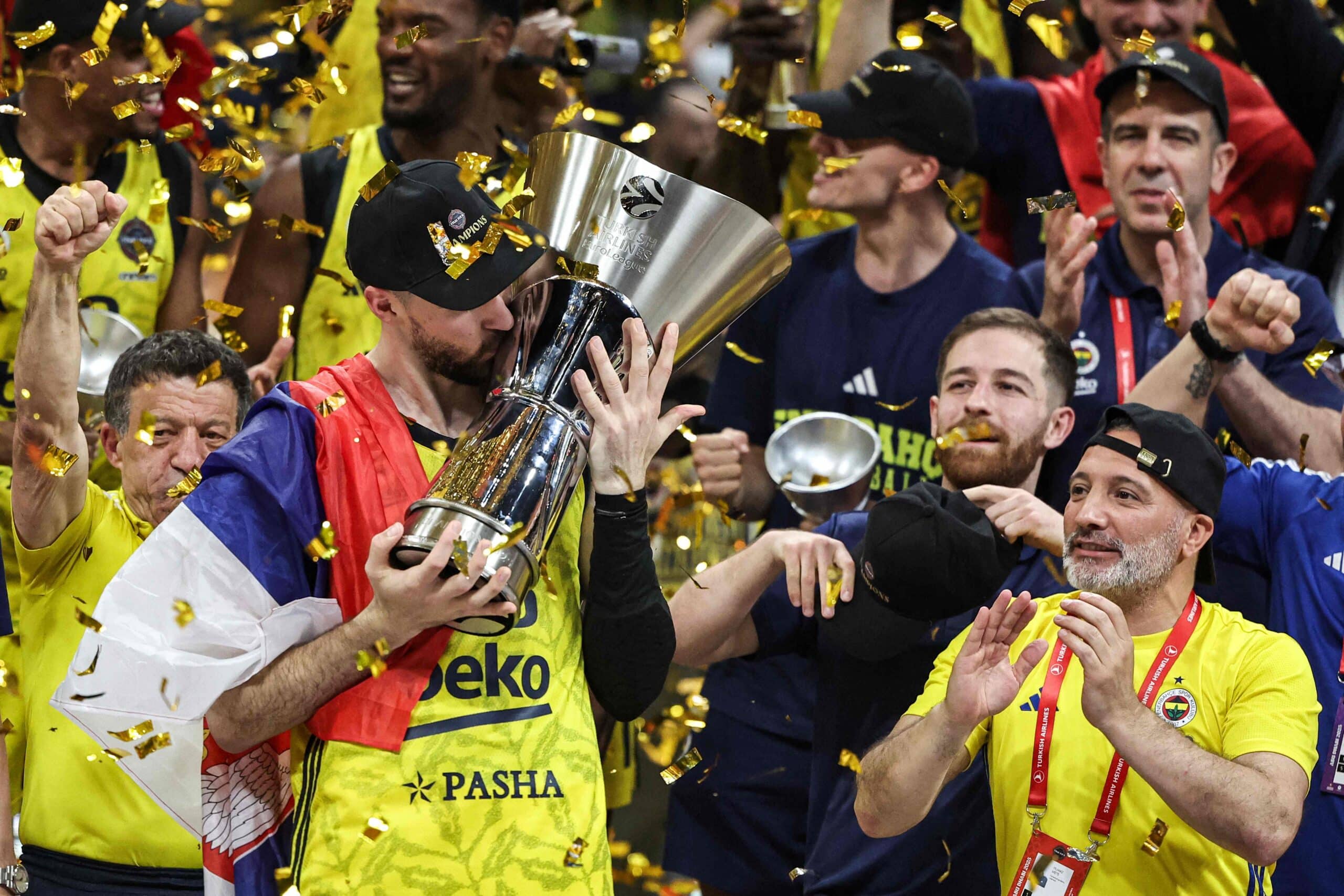

EuroLeague basketball has changed and evolved over the years; not least in 2015, when the previous tournament style format – which was introduced way back in 1958 – was altered to the league phase that we all know and love today.
But for all those fluctuations, the great EuroLeague dynasties – those teams that won multiple titles and changed the face of European basketball forever – remain front and centre in the history books.
From traditional powerhouses to modern day giants, and from European stalwarts to young stars that have gone on to star in the NBA, this is your look at some of the finest EuroLeague dynasties of the past seven decades.
The Early Years
FIBA created EuroLeague because they wanted the best basketball teams across the continent to enjoy a higher standard of competition than was, for the most part, available in their individual countries.
The move was also something of a reaction to football’s fledgling European Cup, which showed the benefits of pitting the best against the best.
The competition was launched in 1958 and, straight out of the gate, ASK Riga established themselves as the top team in Europe.
They won the first three editions of the EuroLeague, thanks to a blend of outstanding on court talent and the respected coaching of Alexander Gomelsky.
The Real Madrid teams of the 1960s then went on to cement their place in EuroLeague history with four title wins during the decade, although the turnover of staff and players means that this wasn’t a single dynasty, as such.
That changed, however, when we move into the 1970s with Ignis Varese, today known as Pallacanestro Varese, who represent Italy’s only true spell of dominance in European basketball.
They reached a staggering ten consecutive finals, winning in 1970, 1973 and 1973, as well as in 1975 and 1976. This was, undoubtedly, the first of the major basketball dynasties in Europe.
The success of Ignis Varese extended beyond the EuroLeague as they won the 1973 ‘triple crown’, made up of the domestic league title, domestic cup and EuroLeague. The Italians also won the European Cup Winners’ Cup twice, cementing their status as the best in the business.
The End of the Union
Some of the most dominant forces in the early years of the EuroLeague were the likes of CSKA Moscow and Dinamo Tbilisi.
Today, they would represent Russia and Georgia respectively, but back in the 1960s and 70s they were part of the old Soviet Union.
And then there was Yugoslavia, the unified country that produced the likes of Bosna, the 1979 champions, and Cibona Zagreb (1985 and 1986).
But it was Jugoplastika Split, known formerly as POP 84 and today as KK Split, that created Eastern Europe’s first dynasty of the era. They won three EuroLeague titles in a row between 1989 and 1991, proving too strong for other elite operators like Barcelona and Maccabi Tel Aviv.
ThisJugoplastika Split team was notable not only for its collective success but also for the players that it helped to develop. Stars like Toni Kukoc and Dino Radja transcended European basketball, going on to play in the NBA for the Chicago Bulls, Milwaukee Bucks and Boston Celtics, among other sides.
By the early 1990s, the Soviet Union had crumbled and Yugoslavia had been dissolved. Although the region has produced countless elite players since, they haven’t quite had a dynastic team to call their own – CSKA Moscow’s pair of EuroLeague titles in 2006 and 2008 being just about as close as they have come.
Greece Lightning
Some of thegreatest EuroLeague teams have found their feet since the dawn of the new millennium.
The Greek sides in particular began to thrive in this contemporary era, with Panathinaikos the next to truly stamp their authority on the competition.
They marked cards by winning the championship in 2002 and reaching the final three years later, before they truly hit their stride between 2007 and 2012. During that time they bagged three titles and lost in a fourth as their golden generation truly hit their peak.
That team was headed by Dimitris Diamantidis, who is widely regarded as one of, if not the best defender in European basketball history. He was part of all of three of Panathinaikos’ EuroLeague titles of that vintage, being named the overall MVP in 2011 and Final Four MVP in 2007 and 2011.
Such is Diamantidis’ legacy he was named in the EuroLeague Team of the Decade twice – the 2000s and 2010s editions.
As if having Diamantidis repelling wave after wave of offensive moves wasn’t enough, Panathinaikos were also able to sign one of the finest point guards that European basketball has ever seen.
Sarunas Jasikevicius had something of a nomadic playing career that took him across the continent, but Panathinaikos were able to nail the Lithuanian down in 2009 – and what a move that turned out to be.
He formed part of that all-conquering 2009 team that swept to the EuroLeague title – his fourth championship in all, while becoming the first player to win the final with three different teams.
Sadly, Jasikevicius suffered a serious knee injury in 2010 that derailed his career, but his position in EuroLeague folklore and as one of Europe’s most prolific basketball champions was assured.
By 2012, Panathinaikos had been usurped by their Greek rivals, Olympiacos. Although theirs was a star that shone brightly only briefly during that period – titles in 2012 and 2013, plus a final appearance in 2015 – this was a team that has to go down as one of the finest EuroLeague champions in history.
Vassilis Spanoulis is considered by many to be among the best EuroLeague players of all time. The guard was named Final Four MVP in both of Olympiacos’ championship victories, remaining at the club until his retirement in 2021, meaning the Greek surely goes down as one of the true giants of European basketball.
Modern Day Powerhouses
So competitive now is EuroLeague that it has become increasingly difficult for one team to totally dominate.
One of the last teams to have a good crack at it, though, was Real Madrid, with the Spanish side winning the championship in 2015 and 2018 and reaching the Final Four in 2017.
Their ability to attract the finest young talent has been one of the reasons for their long-standing success – nobody has won more EuroLeague titles than the Spaniards. And in 2015, a youngster by the name of Luka Doncic passed through their academy.
By the age of 18, he was starring in Slovenia’s EuroBasket triumph, and by 19 he was a key component in Madrid’s quest for the continental championship. Doncic dominated, pulling his teammates along in an outstanding run to the 2018 EuroLeague trophy.
The Slovenian superstar was named regular season and Final Four MVP, before waving goodbye to European basketball and heading for the NBA Draft… where his remarkable talent has continued to shine through.
It goes without saying that players like Doncic are impossible to replace. But he wasn’t the only mainstay of that dynastic team – plenty of praise should also be reserved for Sergio Llull as well.
The guard has played the entirety of his career in Madrid, winning three EuroLeague titles – including those 2015 and 2018 successes, while being named MVP in 2017.
Few players in European basketball are as decorated as Llull, who has won medals at the Olympic Games, EuroBasket and the FIBA World Cup. He’s also Real Madrid’s top points scorer in history, but it was his work alongside Doncic in 2018 that will be best remembered – and maybe that was the last true dynasty in the competition.
Anadolu Efes, something of a late bloomer among European basketball clubs, might be inclined to argue with that, however.
The beaten finalist in 2019, the Turkish team returned after the Covid pandemic to win the championship in fine style in consecutive seasons, defeating Barcelona and Real Madrid in the 2021 and 2022 finals respectively.
The Serbian point guard, Vasilije Micic, established himself as a EuroLeague superstar with Anadolu Efes, winning the Final Four MVP award in both of those title runs.
It would be unfair to say that Anadolu Efes were solely reliant on Micic, but this was a player who delivered his very best when it mattered most. In the 2022 championship run, the Serbian threw the winning three-pointer in the Final Four semi-final, before going on to score 23 points in the final against Real Madrid.
We remember Anadolu Efes as the last great dynasty team of the EuroLeague, while appreciating the irreplaceable role that Micic played in their successes.
A new season brings fresh opportunities for new dynasties to be born. Can this outstanding Olympiacos side continue to deliver the goods? Or will the likes of Panathinaikos or Fenerbahce make a return to the EuroLeague winners’ circle?